Translational Neuroscience Laboratory, Mclean Hospital, 115 Mill Street, Belmont, MA, 02478 USA; Dept. of Psychiatry, Harvard Medical School, 25 Shattuck St, Boston, MA, 02115 USA.
Translational Neuroscience Laboratory, Mclean Hospital, 115 Mill Street, Belmont, MA, 02478 USA.
Eur Psychiatry. 2018 Apr;50:60-69. doi: 10.1016/j.eurpsy.2018.02.003. Epub 2018 Mar 2.
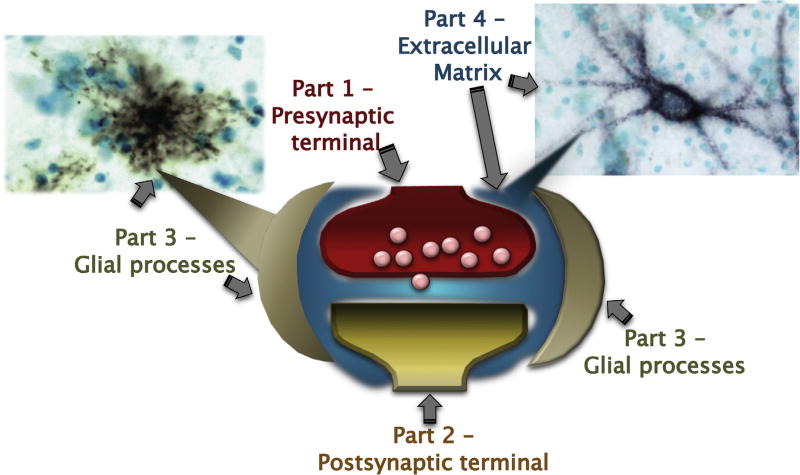
Growing evidence points to synaptic pathology as a core component of the pathophysiology of schizophrenia (SZ). Significant reductions of dendritic spine density and altered expression of their structural and molecular components have been reported in several brain regions, suggesting a deficit of synaptic plasticity. Regulation of synaptic plasticity is a complex process, one that requires not only interactions between pre- and post-synaptic terminals, but also glial cells and the extracellular matrix (ECM). Together, these elements are referred to as the 'tetrapartite synapse', an emerging concept supported by accumulating evidence for a role of glial cells and the extracellular matrix in regulating structural and functional aspects of synaptic plasticity. In particular, chondroitin sulfate proteoglycans (CSPGs), one of the main components of the ECM, have been shown to be synthesized predominantly by glial cells, to form organized perisynaptic aggregates known as perineuronal nets (PNNs), and to modulate synaptic signaling and plasticity during postnatal development and adulthood. Notably, recent findings from our group and others have shown marked CSPG abnormalities in several brain regions of people with SZ. These abnormalities were found to affect specialized ECM structures, including PNNs, as well as glial cells expressing the corresponding CSPGs. The purpose of this review is to bring forth the hypothesis that synaptic pathology in SZ arises from a disruption of the interactions between elements of the tetrapartite synapse.
越来越多的证据表明,突触病理学是精神分裂症(SZ)病理生理学的核心组成部分。在几个脑区已经报道了树突棘密度的显著减少和其结构和分子成分的改变表达,这表明存在突触可塑性缺陷。突触可塑性的调节是一个复杂的过程,不仅需要前突触和后突触末端之间的相互作用,还需要神经胶质细胞和细胞外基质(ECM)的参与。这些元素共同被称为“四联体突触”,这是一个新兴的概念,越来越多的证据表明神经胶质细胞和细胞外基质在调节突触可塑性的结构和功能方面发挥着作用。特别是,细胞外基质(ECM)的主要成分之一,软骨素硫酸盐蛋白聚糖(CSPGs),主要由神经胶质细胞合成,形成称为周围神经网(PNNs)的有组织的突触周聚集物,并在出生后发育和成年期调节突触信号和可塑性。值得注意的是,我们小组和其他小组的最近研究结果表明,精神分裂症患者的几个脑区存在明显的 CSPG 异常。这些异常被发现影响了专门的 ECM 结构,包括 PNNs 以及表达相应 CSPGs 的神经胶质细胞。本文的目的是提出这样一个假设,即 SZ 中的突触病理学是由于四联体突触的组成部分之间的相互作用中断而引起的。