Mardones M, Trampe-Jaschik T, Oster S, Elliott M, Urbina H, Schmitt I, Piepenbring M
Institute of Ecology, Evolution and Diversity, Faculty of Biosciences, Goethe University Frankfurt am Main, Biologicum, Max-von-Laue-Str. 13, 60439 Frankfurt am Main, Germany.
Escuela de Biología, Universidad de Costa Rica, San Pedro, 11501 San José, Costa Rica.
Persoonia. 2017 Dec;39:74-90. doi: 10.3767/persoonia.2017.39.04. Epub 2017 Jun 20.
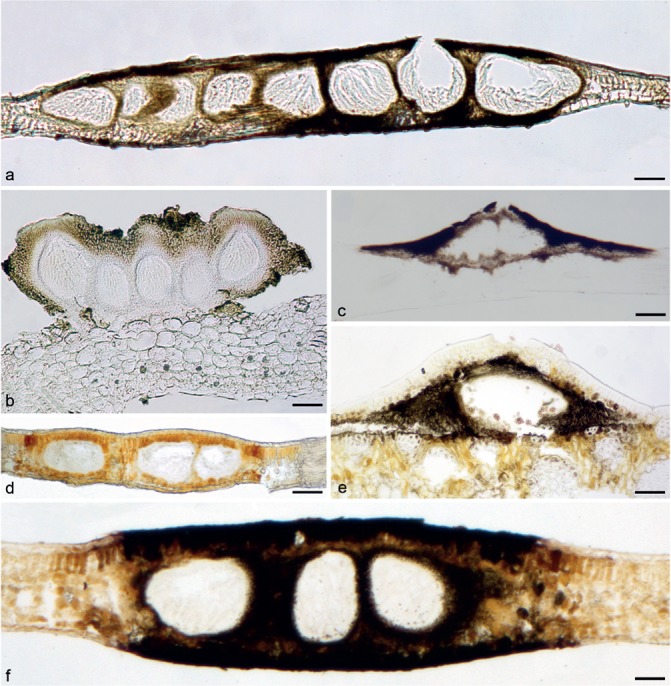
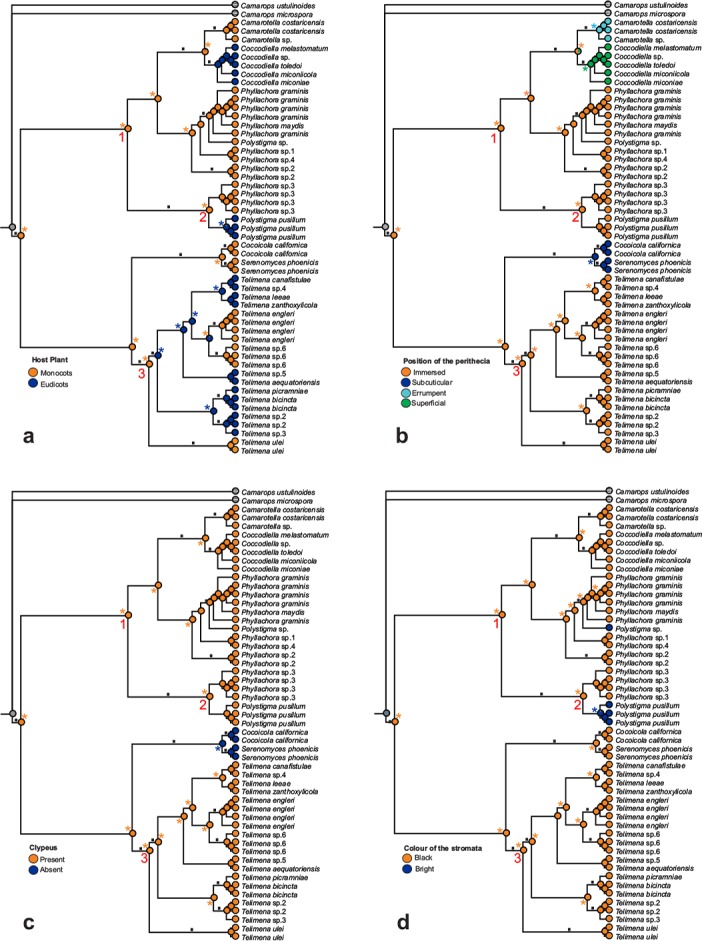
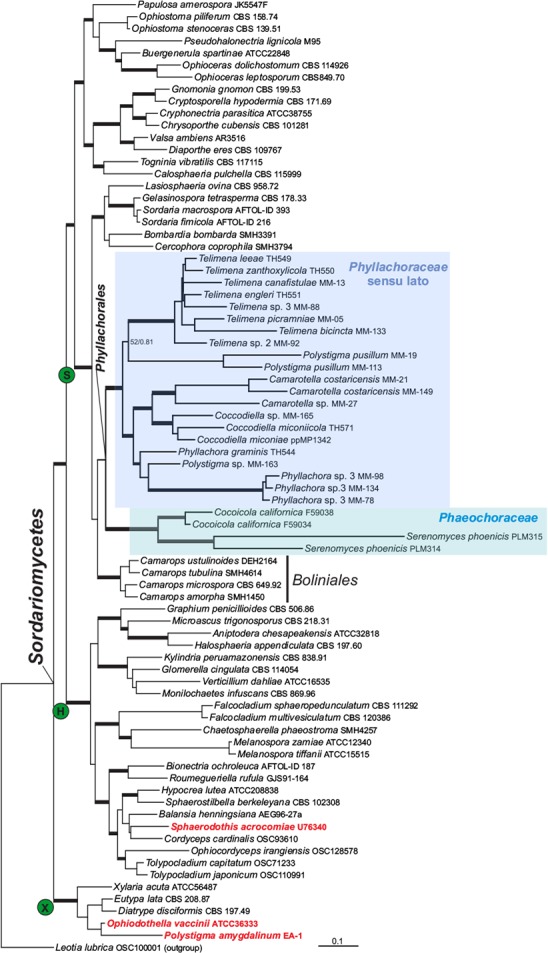
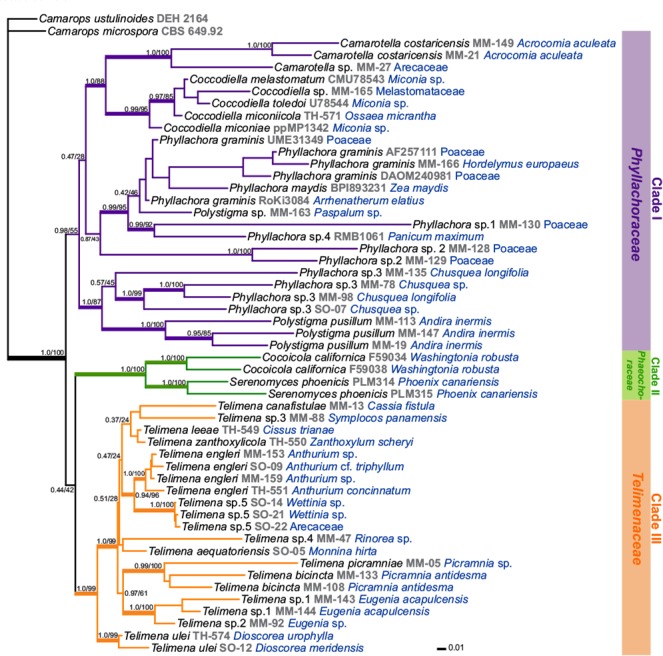
The order (, ) is a group of biotrophic, obligate plant parasitic fungi with a tropical distribution and high host specificity. Traditionally two families are recognised within this order: and , based mostly on morphological and host characteristics. Currently, the position of the order within the class is inconclusive, as well as the monophyly of the order, and its internal phylogenetic structure. Here we present a phylogeny of the order based on sequence data of 29 species with a broad host range resulting from a wide geographical sampling. We inferred Maximum Likelihood and Bayesian phylogenies from data of five DNA regions: nrLSU rDNA, nrSSU rDNA, ITS rDNA, and the protein coding genes , and . We found that the order is monophyletic and related to members of the subclass within . Within the order, members of the family form a monophyletic group, and the family is split into two lineages. Maximum Likelihood ancestral state reconstructions indicate that the ancestor of had a monocotyledonous host plant, immersed perithecia, and a black stroma. Alternative states of these characters evolved multiple times independently within the order. Based on our results we redefine the family and propose the new family with as type species, resulting in three families in the order. Species of spp. occur in several monocotyledonous and eudicotyledonous host plants except , and generally have enlarged black pseudostroma around the perithecia, a character not present in species of .
白粉菌目(Erysiphales)是一类专性活体营养的植物寄生真菌,分布于热带地区,寄主专一性强。传统上,该目下分为两个科:白粉菌科(Erysiphaceae)和小煤炱科(Meliolaceae),主要依据形态学和寄主特征划分。目前,该目在座囊菌纲(Dothideomycetes)中的位置尚无定论,其单系性以及内部系统发育结构也不明确。在此,我们基于广泛地理采样的29个寄主范围广泛的物种的序列数据,构建了白粉菌目的系统发育树。我们从五个DNA区域的数据推断出最大似然法和贝叶斯系统发育树,这五个区域分别是:nrLSU rDNA、nrSSU rDNA、ITS rDNA以及蛋白质编码基因rpb1和rpb2。我们发现白粉菌目是单系的,并且与座囊菌纲下的座囊菌亚纲(Dothideomycetidae)的成员相关。在该目内,白粉菌科的成员形成一个单系类群,而小煤炱科则分为两个谱系。最大似然法祖先状态重建表明,白粉菌目的祖先具有单子叶寄主植物、埋生的子囊壳以及黑色的子座。这些特征的替代状态在该目内多次独立演化。基于我们的结果,我们重新定义了白粉菌科,并提出了以Erysiphella为模式种的新科Erysiphellaceae,使得该目下有三个科。白粉菌属(Erysiphe spp.)的物种存在于除禾本科外的多种单子叶和双子叶寄主植物上,并且通常在子囊壳周围有膨大的黑色假子座,这是白粉菌科物种所没有的特征。