Ball Jane, Ballinger Claire, De Iongh Anya, Dall'Ora Chiara, Crowe Sally, Griffiths Peter
1National Institute for Health Research Collaboration for Leadership in Applied Health Research and Care (CLAHRC), Wessex, UK.
2University of Southampton, Building 67, Highfield Campus, Southampton, SO17 1BJ UK.
Res Involv Engagem. 2016 Oct 12;2:31. doi: 10.1186/s40900-016-0045-8. eCollection 2016.
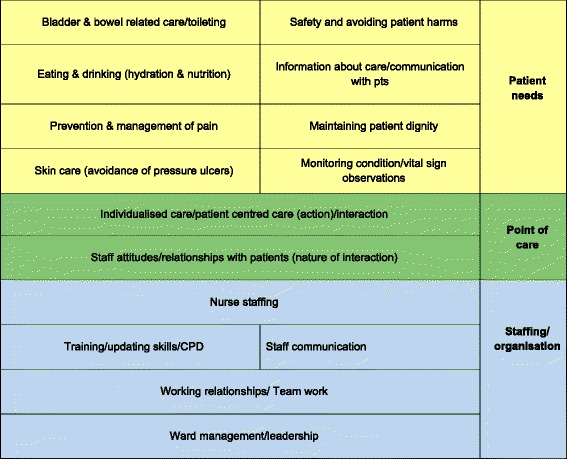
The aim of this project was to find out the priorities for research that could improve fundamental care. 'Fundamental care' covers all aspects of basic care in hospital wards, such as helping with core physical needs, building positive relationships and keeping patients safe.By setting the priorities with patients, carers, the public and health care professionals, research can look at the issues that really matter to people who are receiving or delivering care in hospital wards.Previously, prioritisation exercises have started with a menu of options and asked people to choose from that list. They have also been focused on specific health conditions. Traditionally, there has been little opportunity for patients, carers and the public to contribute to identifying the issues to be prioritised.To develop the priorities for research, we started by exploring what is meant by 'fundamental care', looking at patient and carer accounts and academic and policy reports. Patients, carers, staff, and members of the public were consulted via surveys, interviews and group discussions to share experiences and issues.A list of 15 topics was identified based on what was most commonly mentioned by patients, carers and healthcare professionals as well as what was practical for the CLAHRC Wessex team to research. A workshop with patients, carers and healthcare professionals was held, to decide the top 5 areas.The five priority areas identified were:Nurse staffingIndividualised patient careStaff communicationStaff attitudes and relationships with patientsInformation about care/communication.
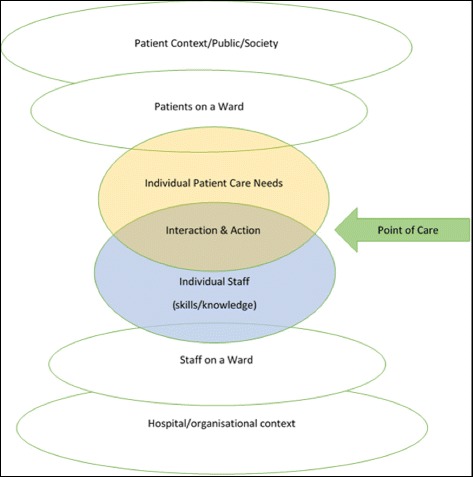
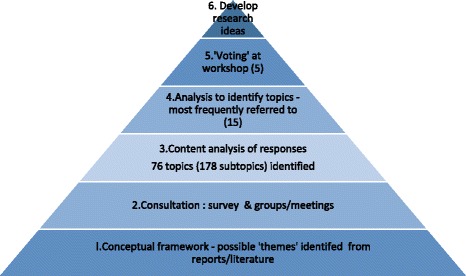
The provision of high quality fundamental care in hospitals is a top priority for the NHS. Recent reports and investigations highlight that at times care has fallen below standard. It is unclear what research should be prioritised to improve care. The aim of this work is to involve patients/carers/public, clinicians and other stakeholders to identify issues that are priorities for research which could improve fundamental care in hospital. Patient and public involvement was integral to this project, with a patient leader/service user being a member of the core team who designed and executed this research. After consideration of existing priority setting approaches, we developed an inclusive approach which consisted of six main phases: 1) Development of a conceptual framework of fundamental care, based on reports and literature 2) Consultation with a wide range of stakeholders through a survey, focus groups and interviews 3) Identifying themes from the responses to the consultation phase (76 themes identified) 4) Analysis to identify the 15 topics most frequently cited 5) Prioritisation of the top 15 themes through a half day workshop, which led to a shortlist of five themes 6) Development of the top 5 themes into research areas. Three hundred forty stakeholders (29 % of whom were patients/carers/public) completed the consultation survey. Analysis of the survey responses and of focus groups and interviews led us to identify 15 high scoring themes. We presented these at the prioritisation workshop, attended by 39 participants (23 of whom patients/carers/public). After a voting exercise, the 5 top research priorities which emerged were: nurse staffing; individualised patient care; staff communication; staff attitudes and relationships with patients; and information about care. We involved a range of stakeholders in identifying topics for research to improve fundamental care and asked them to prioritise these. The process provided a means of reaching consensus as to the important issues for future research to focus on to improve fundamental care on hospital wards.
本项目旨在确定能够改善基础护理的研究重点。“基础护理”涵盖医院病房基础护理的各个方面,比如满足核心身体需求、建立积极关系以及保障患者安全。通过与患者、护理人员、公众和医疗保健专业人员共同确定优先事项,研究可以关注对在医院病房接受护理或提供护理的人真正重要的问题。此前,确定优先事项的活动一开始会提供一系列选项,让人们从中选择。这些活动还聚焦于特定的健康状况。传统上,患者、护理人员和公众几乎没有机会参与确定需要优先处理的问题。为了确定研究重点,我们首先探讨“基础护理”的含义,研究患者和护理人员的描述以及学术和政策报告。通过调查、访谈和小组讨论,咨询了患者、护理人员、工作人员和公众,以分享经验和问题。根据患者、护理人员和医疗保健专业人员最常提及的内容以及韦塞克斯临床学术研究合作中心团队实际可研究的内容,确定了15个主题。与患者、护理人员和医疗保健专业人员举办了一次研讨会,以确定前5个领域。确定的五个优先领域为:护士人员配备、个性化患者护理、工作人员沟通、工作人员态度以及与患者的关系、护理/沟通信息。
在医院提供高质量的基础护理是英国国家医疗服务体系(NHS)的首要任务。近期的报告和调查凸显出护理有时未达标准。目前尚不清楚应优先开展哪些研究来改善护理。这项工作的目的是让患者/护理人员/公众、临床医生和其他利益相关者参与进来,确定哪些问题是改善医院基础护理的研究重点。患者和公众参与是本项目不可或缺的部分,一名患者领袖/服务使用者是设计和开展这项研究的核心团队成员。在考虑了现有的确定优先事项的方法后,我们制定了一种包容性方法,该方法包括六个主要阶段:1)基于报告和文献,制定基础护理的概念框架;2)通过调查;焦点小组和访谈,与广泛的利益相关者进行磋商;3)从磋商阶段的回复中确定主题(共确定76个主题);4)进行分析,确定最常被提及的15个主题;5)通过为期半天的研讨会,对前15个主题进行优先排序,从而确定了五个主题的入围名单;6)将前五个主题发展为研究领域。340名利益相关者(其中29%为患者/护理人员/公众)完成了磋商调查。对调查回复以及焦点小组和访谈的分析使我们确定了15个高分主题。我们在优先排序研讨会上展示了这些主题,39名参与者(其中23名是患者/护理人员/公众)参加了该研讨会。经过投票,得出的前5个研究优先事项为:护士人员配备、个性化患者护理、工作人员沟通、工作人员态度以及与患者的关系、护理信息。我们让一系列利益相关者参与确定改善基础护理的研究主题,并要求他们对这些主题进行优先排序。该过程为就未来研究应关注的重要问题达成共识提供了一种方式,以便改善医院病房的基础护理。