Duke University Medical Center, Campus mail 439 Seeley-mudd Bldg, 10 Bryan Searle Drive, Duke University M, Durham, NC, 27710, USA.
Clinical Digestive Oncology, University Hospitals Leuven and KU Leuven, UZ Herestraat 49, 3000, Leuven, Belgium.
Invest New Drugs. 2018 Aug;36(4):683-695. doi: 10.1007/s10637-018-0580-2. Epub 2018 Mar 6.
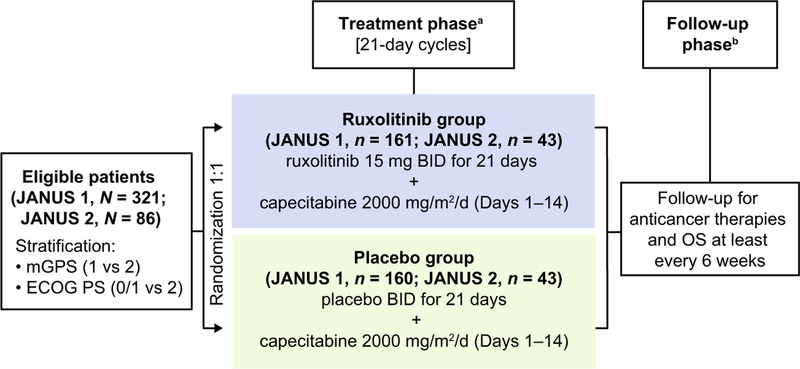
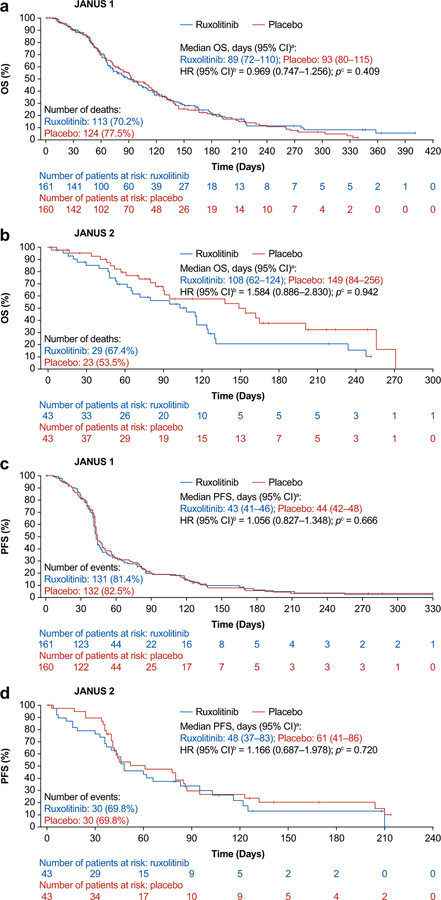
Background Ruxolitinib, a Janus kinase 1 (JAK1)/JAK2 inhibitor, plus capecitabine improved overall survival (OS) vs capecitabine in a subgroup analysis of patients with metastatic pancreatic cancer and systemic inflammation (C-reactive protein [CRP] >13 mg/dL) in the randomized phase II RECAP study. We report results from two randomized phase III studies, JANUS 1 (NCT02117479) and JANUS 2 (NCT02119663). Patients and Methods Adults with advanced/metastatic pancreatic cancer, one prior chemotherapy regimen and CRP >10 mg/L were randomized 1:1 (stratified by modified Glasgow Prognostic Score [1 vs 2] and Eastern Cooperative Oncology Group performance status [0/1 vs 2]) to 21-day cycles of ruxolitinib 15 mg twice daily plus capecitabine 2000 mg/m/day (Days 1-14) or placebo plus capecitabine. The primary endpoint was OS. Results Both studies were terminated following a planned interim futility/efficacy analysis of JANUS 1. Overall, 321 and 86 patients were randomized in JANUS 1 (ruxolitinib: n = 161; placebo: n = 160) and JANUS 2 (ruxolitinib: n = 43; placebo: n = 43). There was no significant difference in OS or progression-free survival (PFS) between treatments in JANUS 1 (OS: hazard ratio [HR], 0.969, 95% confidence interval [CI], 0.747-1.256; PFS: HR, 1.056; 95% CI, 0.827-1.348) or JANUS 2 (OS: HR, 1.584; 95% CI, 0.886-2.830; PFS: HR, 1.166; 95% CI, 0.687-1.978). The most common hematologic adverse event was anemia. No new safety signals with ruxolitinib or capecitabine were identified. Conclusions Ruxolitinib plus capecitabine was well tolerated in refractory pancreatic cancer patients; this combination did not improve survival.
鲁索利替尼是一种 Janus 激酶 1(JAK1)/JAK2 抑制剂,在 RECAP 研究的亚组分析中,转移性胰腺癌和全身炎症患者(C 反应蛋白[CRP]>13mg/dL)中,鲁索利替尼联合卡培他滨治疗组的总生存期(OS)优于卡培他滨单药组。我们报告了两项随机 III 期研究 JANUS 1(NCT02117479)和 JANUS 2(NCT02119663)的结果。入组患者为晚期/转移性胰腺癌患者,既往接受过一种化疗方案,且 CRP>10mg/L,按照改良格拉斯哥预后评分(1 或 2 分)和东部肿瘤协作组体力状况(0/1 或 2 分)1:1 分层,随机接受 21 天周期的鲁索利替尼 15mg 每日两次联合卡培他滨 2000mg/m/天(第 1-14 天)或安慰剂联合卡培他滨治疗。主要终点为 OS。
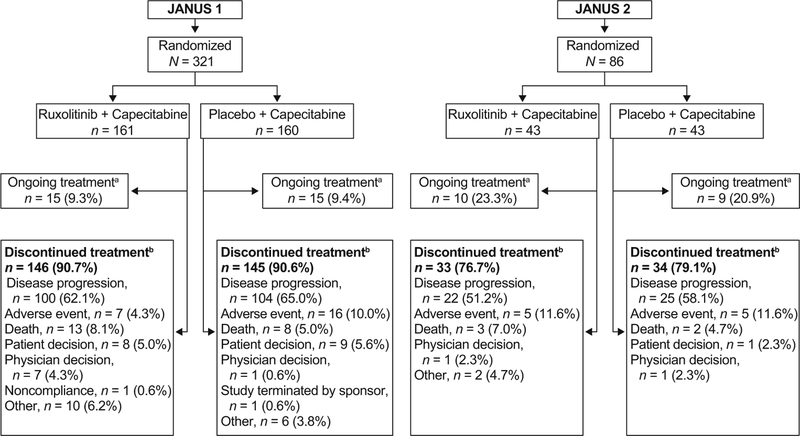
在 JANUS 1 的计划性中期无效/疗效分析后,两项研究均提前终止。总体而言,JANUS 1 中共有 321 例和 86 例患者被随机分配至鲁索利替尼组(n=161)和安慰剂组(n=160),JANUS 2 中共有 43 例和 43 例患者被随机分配至鲁索利替尼组(n=43)和安慰剂组(n=43)。在 JANUS 1(OS:风险比[HR],0.969,95%置信区间[CI],0.747-1.256;PFS:HR,1.056;95%CI,0.827-1.348)和 JANUS 2(OS:HR,1.584;95%CI,0.886-2.830;PFS:HR,1.166;95%CI,0.687-1.978)中,治疗组之间 OS 或无进展生存期(PFS)均无显著差异。最常见的血液学不良事件是贫血。未发现鲁索利替尼或卡培他滨有新的安全性信号。
鲁索利替尼联合卡培他滨在难治性胰腺癌患者中耐受性良好;该联合方案未能改善生存。