Ju Yixin, Xu Dongzhi, Liao Miao-Miao, Sun Yutong, Bao Wen-Dai, Yao Fan, Ma Li
Hubei Hongshan Laboratory, College of Biomedicine and Health, College of Life Science and Technology, Huazhong Agricultural University, Wuhan, Hubei, 430070, China.
Shenzhen Institute of Nutrition and Health, Huazhong Agricultural University, Shenzhen, Guangdong, 518000, China.
NPJ Precis Oncol. 2024 Sep 12;8(1):199. doi: 10.1038/s41698-024-00681-z.
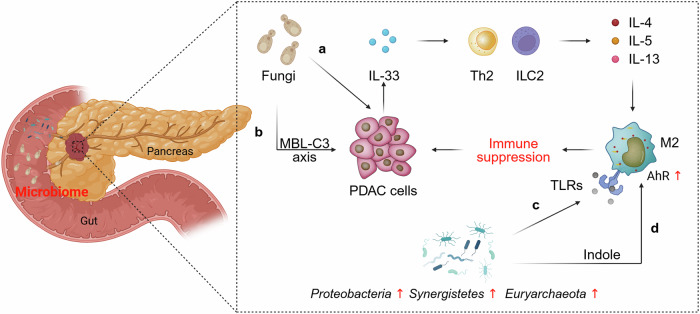
Pancreatic ductal adenocarcinoma (PDAC) presents a fatal clinical challenge characterized by a dismal 5-year overall survival rate, primarily due to the lack of early diagnosis and limited therapeutic efficacy. Immunotherapy, a proven success in multiple cancers, has yet to demonstrate significant benefits in PDAC. Recent studies have revealed the immunosuppressive characteristics of the PDAC tumor microenvironment (TME), including immune cells with suppressive properties, desmoplastic stroma, microbiome influences, and PDAC-specific signaling pathways. In this article, we review recent advances in understanding the immunosuppressive TME of PDAC, TME differences among various mouse models of pancreatic cancer, and the mechanisms underlying resistance to immunotherapeutic interventions. Furthermore, we discuss the potential of targeting cancer cell-intrinsic pathways and TME components to sensitize PDAC to immune therapies, providing insights into strategies and future perspectives to break through the barriers in improving pancreatic cancer treatment.
胰腺导管腺癌(PDAC)是一项严峻的临床挑战,其5年总生存率极低,主要原因是缺乏早期诊断且治疗效果有限。免疫疗法在多种癌症中已被证明有效,但在PDAC中尚未显示出显著益处。最近的研究揭示了PDAC肿瘤微环境(TME)的免疫抑制特性,包括具有抑制特性的免疫细胞、促纤维增生性基质、微生物群影响以及PDAC特异性信号通路。在本文中,我们综述了在理解PDAC免疫抑制性TME、胰腺癌各种小鼠模型之间的TME差异以及免疫治疗干预耐药机制方面的最新进展。此外,我们讨论了靶向癌细胞内在途径和TME成分以使PDAC对免疫疗法敏感的潜力,为突破改善胰腺癌治疗的障碍提供策略和未来展望。