Stud Fam Plann. 2018 Mar;49(1):57-70. doi: 10.1111/sifp.12049.
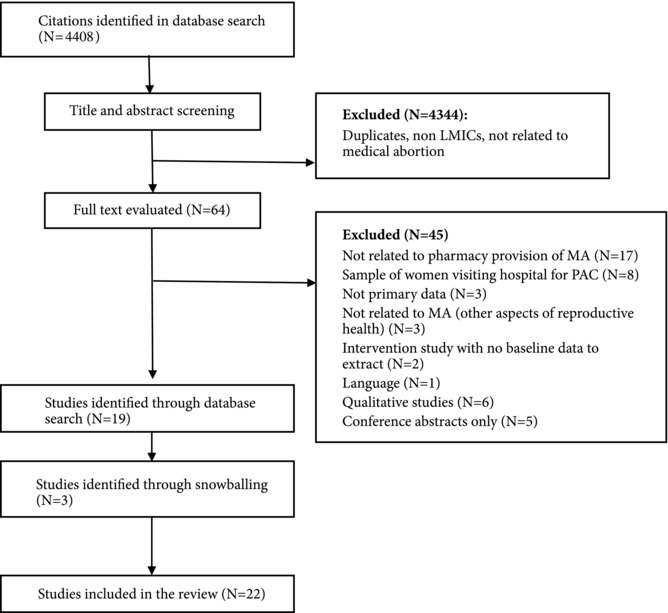
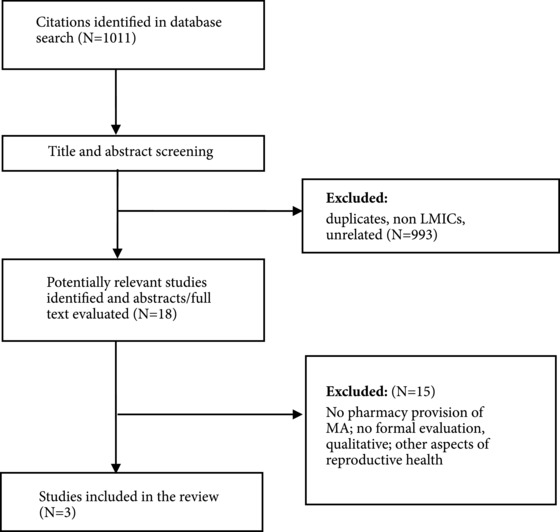
We undertook a systematic review to assess 1) the level and quality of pharmacy and drug shop provision of medical abortion (MA) in low- and middle-income countries (LMICs) and 2) interventions to improve quality of provision. We used standardized terms to search six databases for peer-reviewed and grey literature. We double-extracted data using a standardized template, and double-graded studies for methodological quality. We identified 22 studies from 16 countries reporting on level and quality of MA provision through pharmacies and drug sellers, and three intervention studies. Despite widespread awareness and provision of MA drugs, even in legally restricted contexts, most studies found that pharmacy workers and drug sellers had poor knowledge of effective regimens. Evidence on interventions to improve pharmacy and drug shop provision of MA was limited and generally low quality, but indicated that training could be effective in improving knowledge. Programmatic attention should focus on the development and rigorous evaluation of innovative interventions to improve women's access to information about MA self-management in low-and middle-income countries.
我们进行了一项系统评价,以评估 1)在中低收入国家(LMICs)中,药房和药店提供药物流产(MA)的水平和质量,以及 2)改善提供质量的干预措施。我们使用标准化术语在六个数据库中搜索同行评审和灰色文献。我们使用标准化模板对数据进行双重提取,并对研究方法的质量进行双重评分。我们从 16 个国家确定了 22 项研究,这些研究通过药房和药店报告了 MA 提供的水平和质量,以及三项干预研究。尽管在法律限制的情况下,普遍意识到并提供了 MA 药物,但大多数研究发现,药剂师和药店工作人员对有效的治疗方案知之甚少。关于改善药房和药店提供 MA 服务的干预措施的证据有限且质量普遍较低,但表明培训可以有效提高知识水平。计划方案应重点关注开发和严格评估创新干预措施,以改善妇女在中低收入国家获得 MA 自我管理信息的机会。