San Francisco VA Medical Center, San Francisco, CA, United States of America.
University of California San Francisco, Department of Medicine, San Francisco, CA, United States of America.
PLoS One. 2018 Mar 6;13(3):e0193706. doi: 10.1371/journal.pone.0193706. eCollection 2018.
The harmful effects of marijuana on health and in particular cardiovascular health are understudied. To develop such knowledge, an efficient method of developing an informative cohort of marijuana users and non-users is needed.
We identified patients with a diagnosis of coronary artery disease using ICD-9 codes who were seen in the San Francisco VA in 2015. We imported these patients' medical record notes into an informatics platform that facilitated text searches. We categorized patients into those with evidence of marijuana use in the past 12 months and patients with no such evidence, using the following text strings: "marijuana", "mjx", and "cannabis". We randomly selected 51 users and 51 non-users based on this preliminary classification, and sent a recruitment letter to 97 of these patients who had contact information available. Patients were interviewed on marijuana use and domains related to cardiovascular health. Data on marijuana use collected from the medical record was compared to data collected as part of the interview.
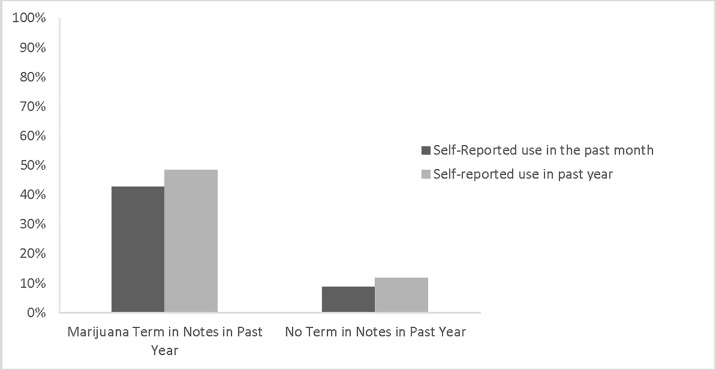
The interview completion rate was 71%. Among the 35 patients identified by text strings as having used marijuana in the previous year, 15 had used marijuana in the past 30 days (positive predictive value = 42.9%). The probability of use in the past month increased from 8.8% to 42.9% in people who have these keywords in their medical record compared to those who did not have these terms in their medical record.
Methods that combine text search strategies for participant recruitment with health interviews provide an efficient approach to developing prospective cohorts that can be used to study the health effects of marijuana.
大麻对健康的危害,尤其是对心血管健康的危害,研究不足。为了获得相关知识,我们需要一种有效的方法来建立一个有信息的大麻使用者和非使用者队列。
我们使用 ICD-9 代码识别了 2015 年在旧金山退伍军人事务部就诊的患有冠心病的患者。我们将这些患者的病历记录导入一个信息学平台,该平台便于进行文本搜索。我们使用以下文本字符串将患者分为过去 12 个月内有大麻使用证据的患者和无此类证据的患者:“marijuana”、“mjx”和“cannabis”。我们根据这一初步分类随机选择了 51 名使用者和 51 名非使用者,并向其中 97 名有联系方式的患者发送了招募信。对这些患者进行了关于大麻使用情况以及与心血管健康相关的领域的访谈。从病历中收集的大麻使用数据与作为访谈一部分收集的数据进行了比较。
访谈完成率为 71%。在通过文本字符串确定的过去一年中使用过大麻的 35 名患者中,有 15 名在过去 30 天内使用过大麻(阳性预测值=42.9%)。与病历中没有这些术语的患者相比,病历中有这些关键词的患者过去一个月使用大麻的概率从 8.8%增加到 42.9%。
将参与者招募的文本搜索策略与健康访谈相结合的方法为开发可用于研究大麻健康影响的前瞻性队列提供了一种有效的方法。