Laboratory of Experimental Surgery, Department of Gastro- Intestinal Surgery, Ghent University Hospital, De Pintelaan 185, B-9000, Ghent, Belgium.
Laboratory of Experimental Cancer Research, Department of Radiation Oncology and Experimental Cancer Research, Ghent University, Ghent, Belgium.
Radiat Oncol. 2018 Mar 7;13(1):39. doi: 10.1186/s13014-018-0984-3.
Esophageal cancer is an aggressive disease with poor survival rates. A more patient-tailored approach based on predictive biomarkers could improve outcome. We aimed to predict radiotherapy (RT) response by imaging tumor hypoxia with F-FAZA PET/CT in an esophageal adenocarcinoma (EAC) mouse model. Additionally, we investigated the radiosensitizing effect of the hypoxia modifier nimorazole in vitro and in vivo.
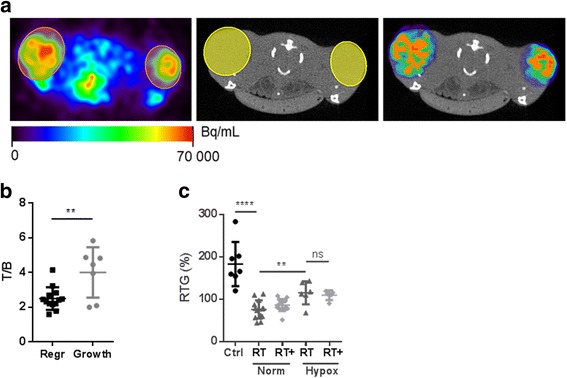
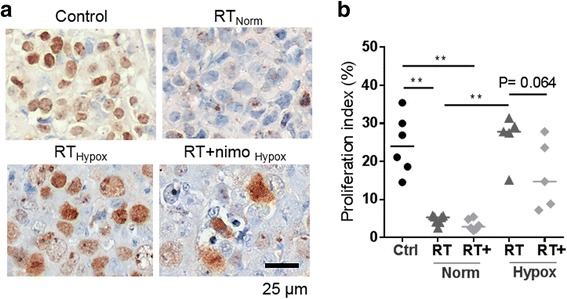
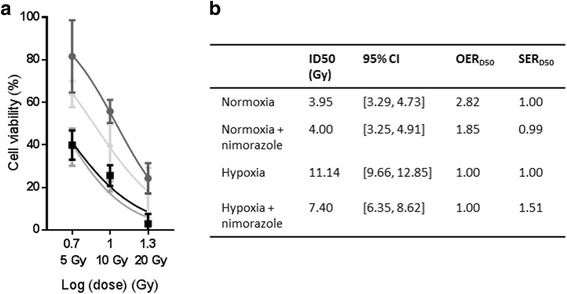
In vitro MTS cell proliferation assays (OACM5 1.C SC1, human EAC cell line) were performed under normoxic and hypoxic (< 1%) conditions: control (100 μL PBS), nimorazole, irradiation (5, 10 or 20 Gy) with or without nimorazole. In vivo, subcutaneous xenografts were induced in nude mice (OACM5 1.C SC1). Treatment was given daily for 5 consecutive days: (A) control (600 μl NaCl 0.9% intraperitoneally (IP)) (N = 5, n = 7), (B) RT (5 Gy/d) (N = 11, n = 20), (C) combination (nimorazole (200 mg/kg/d IP) 30 min before RT) (N = 13, n = 21). N = number of mice, n = number of tumors. F-FAZA PET/CT was performed before treatment and tumor to background (T/B) ratios were calculated. Relative tumor growth was calculated and tumor sections were examined histologically (hypoxia, proliferation).
A T/B ≥ 3.59 on pre-treatment F-FAZA PET/CT was predictive for worse RT response (sensitivity 92.3%, specificity 71.4%). Radiation was less effective in hypoxic tumors (T/B ≥ 3.59) compared to normoxic tumors (T/B < 3.59) (P = 0.0025). In vitro, pre-treatment with nimorazole significantly decreased hypoxic radioresistance (P < 0.01) while in vivo, nimorazole enhanced the efficacy of RT to suppress cancer cell proliferation in hypoxic tumor areas (Ki67, P = 0.064), but did not affect macroscopic tumor growth.
Tumor tissue hypoxia as measured with F-FAZA PET/CT is predictive for RT response in an EAC xenograft model. The radiosensitizing effect of nimorazole was questionable and requires further investigation.
食管癌是一种侵袭性疾病,患者生存率低。基于预测生物标志物的更个体化的治疗方法可能会改善预后。本研究旨在通过氟代去铁胺(F-FAZA)PET/CT 成像来预测食管腺癌(EAC)小鼠模型中的放射治疗(RT)反应,并研究缺氧修饰剂尼莫唑在体外和体内的放射增敏作用。
在体外,进行 OACM5 1.C SC1(人 EAC 细胞系)细胞 MTS 增殖测定,在常氧和缺氧(<1%)条件下进行:对照(100μL PBS)、尼莫唑、照射(5、10 或 20Gy)加或不加尼莫唑。在体内,在裸鼠中诱导皮下异种移植(OACM5 1.C SC1)。连续 5 天每天给予治疗:(A)对照(600μl 0.9%NaCl 腹腔内(IP))(N=5,n=7),(B)RT(5Gy/d)(N=11,n=20),(C)联合治疗(尼莫唑(200mg/kg/d IP)30min 前 RT)(N=13,n=21)。N=小鼠数量,n=肿瘤数量。F-FAZA PET/CT 在治疗前进行,计算肿瘤与背景(T/B)比值。计算相对肿瘤生长,并检查肿瘤切片的组织学(缺氧、增殖)。
治疗前 F-FAZA PET/CT 的 T/B≥3.59 预测 RT 反应较差(灵敏度 92.3%,特异性 71.4%)。与常氧肿瘤相比,缺氧肿瘤(T/B≥3.59)的放射效果较差(P=0.0025)。体外,尼莫唑预处理可显著降低缺氧的放射抗性(P<0.01),而体内,尼莫唑增强 RT 抑制缺氧肿瘤区域癌细胞增殖的疗效(Ki67,P=0.064),但不影响宏观肿瘤生长。
用 F-FAZA PET/CT 测量的肿瘤组织缺氧可预测 EAC 异种移植模型中的 RT 反应。尼莫唑的放射增敏作用尚不确定,需要进一步研究。