King's Centre for Military Health Research, King's College London, Weston Education Centre,Cutcombe Road,London SE5 9RJ,UK.
Dstl (Defence Science & Technology Laboratory) Portsdown West,Fareham,Hampshire,PO17 6AD,UK.
Psychol Med. 2018 Jul;48(9):1400-1409. doi: 10.1017/S0033291717001386. Epub 2018 Mar 8.
Dementia is currently incurable, irreversible and a major cause of disability for the world's older population. The association between mental health difficulties, such as post-traumatic stress disorder (PTSD) and major depressive disorder (MDD), and dementia has a long history within the civilian population. Despite the increased importance of this link within the military veteran population, who suffer a greater propensity of mental health difficulties and consist largely of over 65s, attention is only recently being paid to the salience of such an association for this group. This paper aims to explore the relationship between PTSD and MDD with dementia within the military veteran population.
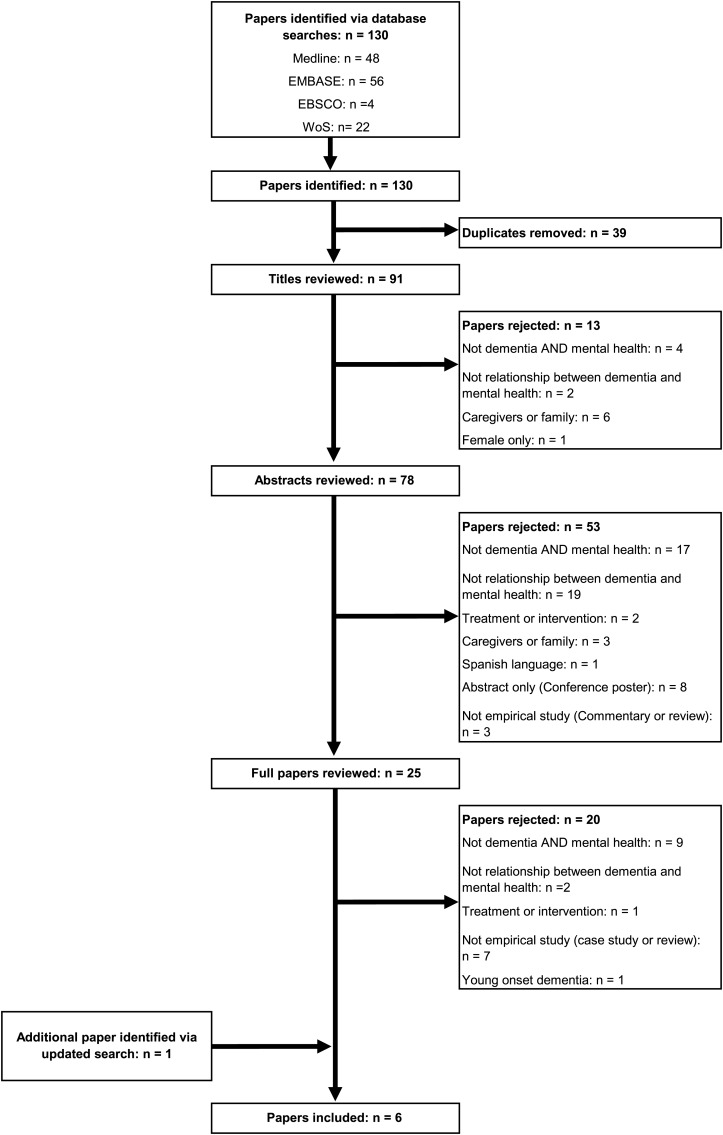
A systematic review was conducted on articles from 1990 to July 2016 on MEDLINE, EMBASE, EBSCO and Web of Science electronic databases with an update conducted in February 2017.
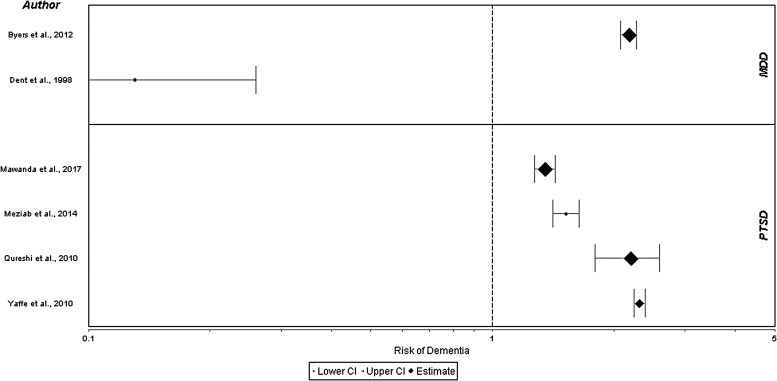
Six empirical studies were identified from the review, the majority of which originated from the USA. Five of the studies asserted that veterans with a diagnosis of either PTSD or MDD are at a significantly greater risk of developing dementia than 'healthy' controls. The final study, conducted in Australia, found only a small, but non-significant, correlation between earlier MDD and future dementia, but no concurrent correlation.
While causality cannot be determined, it is likely that PTSD and depressive disorders are related to an increased risk of dementia in military veterans. Potential pathological explanations and risk factors are reviewed and the clinical and neuroscience implications of these findings are explored.
痴呆症目前无法治愈、无法逆转,是全球老年人群体残疾的主要原因。在平民人群中,心理健康问题(如创伤后应激障碍(PTSD)和重度抑郁症(MDD))与痴呆症之间的关联由来已久。尽管在更易出现心理健康问题的退伍军人人群中,这种关联的重要性日益增加,而他们主要是 65 岁以上的人群,但直到最近才开始关注这种关联对这一群体的重要性。本文旨在探讨退伍军人人群中 PTSD 和 MDD 与痴呆症之间的关系。
对 MEDLINE、EMBASE、EBSCO 和 Web of Science 电子数据库中的 1990 年至 2016 年 7 月的文章进行了系统回顾,并于 2017 年 2 月进行了更新。
从本次综述中确定了 6 项实证研究,其中大多数来自美国。其中 5 项研究断言,患有 PTSD 或 MDD 诊断的退伍军人患痴呆症的风险明显高于“健康”对照组。最后一项在澳大利亚进行的研究发现,早期 MDD 与未来痴呆症之间只有很小但无统计学意义的相关性,但没有同时发生的相关性。
虽然不能确定因果关系,但 PTSD 和抑郁障碍很可能与退伍军人痴呆症风险增加有关。回顾了潜在的病理解释和危险因素,并探讨了这些发现的临床和神经科学意义。