Yamazaki Nobuyoshi, Koga Yoshikatsu, Taniguchi Hirokazu, Kojima Motohiro, Kanemitsu Yukihide, Saito Norio, Matsumura Yasuhiro
Division of Developmental Therapeutics, Exploratory Oncology Research & Clinical Trial Center, National Cancer Center, Kashiwa, Japan.
Department of Colorectal Surgery, National Cancer Center Hospital East, Kashiwa, Japan.
Oncotarget. 2017 Jan 24;8(4):6970-6983. doi: 10.18632/oncotarget.14344.
A standard treatment for stage II colorectal cancer (CRC) is surgical resection without adjuvant chemotherapy. However, the recurrence rate of these patients is approximately 20%. To date, there are no robust biomarkers suitable for predicting recurrence in stage II CRC patients. In this study, microRNAs (miRNAs) extracted from CRC tissues were examined for a possible biomarker to predict recurrence in stage II CRC patients.
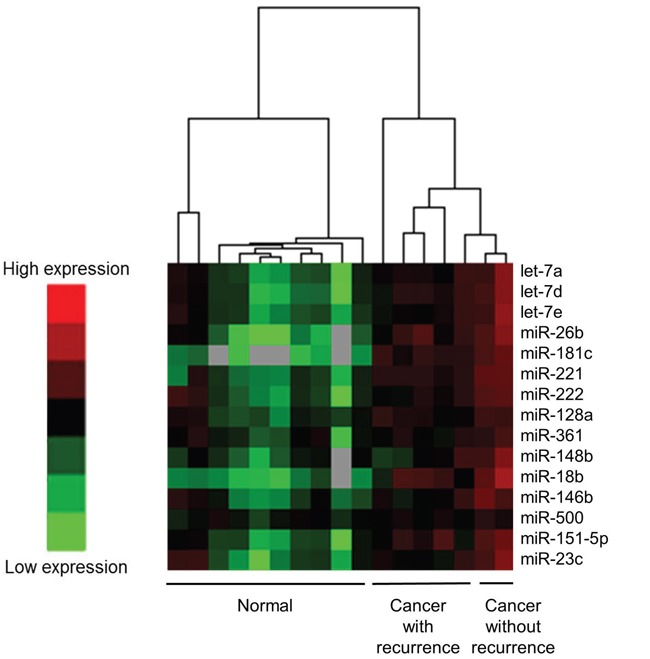
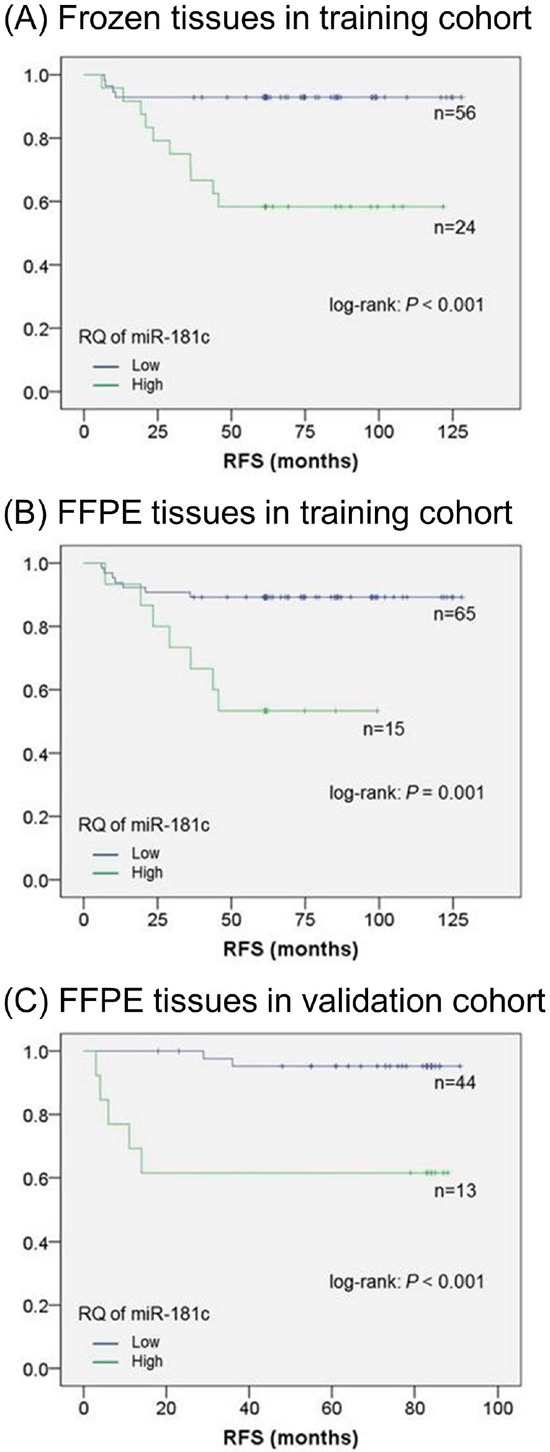
From the comprehensive analysis, 15 miRNAs were selected as candidates for further study. Regarding let-7a, -7d, -7e, miR-23c, -26b, -128a, -151-5p, and -181c, recurrence rates in training cohort patients with higher expression of these miRNAs isolated from their frozen tissues samples were significantly higher than those with lower expression (P < 0.05). According to multivariate analysis, the higher expression of miR-181c was detected as an independent predictive factor of recurrence (P = 0.001, OR: 9.43, 95% CI: 2.57-34.48). Results were similar in miR-181c extracted from FFPE tissues obtained from the training cohort (P = 0.003, OR: 7.46, 95% CI: 1.97-28.57). In the validation cohort using FFPE tissues, the recurrence rate in patients with higher miR-181c expression was significantly higher than those with lower miR-181c expression (P < 0.001).
Comprehensive analysis using a highly sensitive miRNA chip was initially performed to select candidate miRNAs associated with recurrence. Candidate miRNAs were analyzed by real-time RT-PCR using RNA from frozen and formalin-fixed, paraffin-embedded (FFPE) tissues.
Higher expression of miR-181c may be a useful recurrence predictor of stage II CRC patients.
II期结直肠癌(CRC)的标准治疗方法是手术切除,无需辅助化疗。然而,这些患者的复发率约为20%。迄今为止,尚无适用于预测II期CRC患者复发的可靠生物标志物。在本研究中,对从CRC组织中提取的微小RNA(miRNA)进行检测,以寻找可能用于预测II期CRC患者复发的生物标志物。
通过综合分析,选择了15种miRNA作为进一步研究的候选物。对于let-7a、-7d、-7e、miR-23c、-26b、-128a、-151-5p和-181c,在训练队列中,从其冷冻组织样本中分离出的这些miRNA表达较高的患者的复发率显著高于表达较低的患者(P < 0.05)。根据多变量分析,miR-181c的高表达被检测为复发的独立预测因素(P = 0.001,OR:9.43,95% CI:2.57 - 34.48)。从训练队列获得的福尔马林固定石蜡包埋(FFPE)组织中提取的miR-181c的结果相似(P = 0.003,OR:7.46,95% CI:1.97 - 28.57)。在使用FFPE组织的验证队列中,miR-181c表达较高的患者的复发率显著高于miR-181c表达较低的患者(P < 0.001)。
最初使用高灵敏度miRNA芯片进行综合分析,以选择与复发相关的候选miRNA。使用来自冷冻和福尔马林固定石蜡包埋(FFPE)组织的RNA,通过实时RT-PCR对候选miRNA进行分析。
miR-181c的高表达可能是II期CRC患者有用的复发预测指标。