Somia I Ketut Agus, Teeratakulpisarn Nipat, Jeo Wifanto S, Yee Ilias A, Pankam Tippawan, Nonenoy Siriporn, Trachuntong Deondara, Mingkwanrungrueng Pravit, Sukmawati Made Dewi D, Ramautarsing Reshmie, Nilasari Hanny, Hairunisa Nany, Azwa Iskandar, Yunihastuti Evy, Merati Tuti P, Phanuphak Praphan, Palefsky Joel, Phanuphak Nittaya
Division of Tropical and Infectious Disease, Department of Internal Medicine, Faculty of Medicine, Udayana University and Sanglah Hospital, Denpasar, Bali, Indonesia Prevention Department, Thai Red Cross AIDS Research Centre, Bangkok, Thailand Department of Surgery, School of Medicine Universitas Indonesia/HIV Integrated Clinic Cipto Mangunkusomo Hospital, Jakarta, Indonesia Clinical Investigation Centre, University Malaya Medical Centre, Kuala Lumpur, Malaysia Department of Dermatovenerology Department of Internal Medicine, School of Medicine Universitas Indonesia/HIV Integrated Clinic Cipto Mangunkusomo Hospital, Jakarta, Indonesia University of California San Francisco School of Medicine.
Medicine (Baltimore). 2018 Mar;97(10):e9898. doi: 10.1097/MD.0000000000009898.
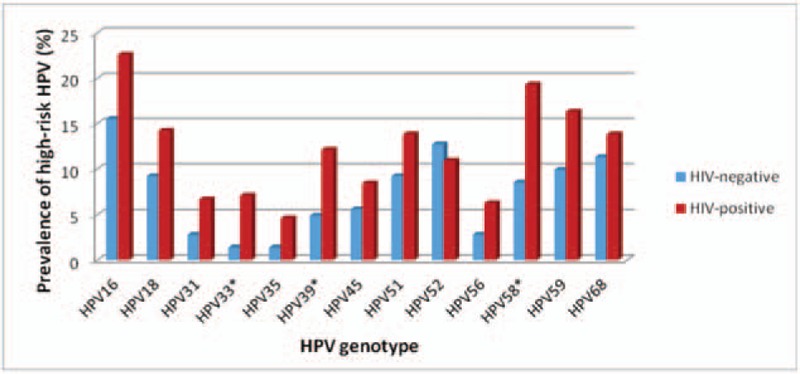
This study aimed to assess the prevalence of and associated risk factors for anal high-risk human papillomavirus (hr-HPV) infection among men who have sex with men (MSM) and transgender women (TGW) in Indonesia, Thailand, and Malaysia.This was baseline data from a prospective cohort study with clinic sites in Jakarta and Bali (Indonesia), Bangkok (Thailand), and Kuala Lumpur (Malaysia).MSM and TGW aged 18 years and older from Indonesia, Thailand, and Malaysia were enrolled. Demographic and behavioral characteristics were assessed, and anal samples were collected for HPV genotyping. Multivariate logistic regression models were used to assess risk factors for anal hr-HPV overall and among HIV-positive participants.A total of 392 participants were enrolled, and 48 were TGW. As many as 245 were HIV-positive, and 78.0% of the participants were on combination antiretroviral therapy (cART). Median CD4 count was 439 cells/mm and 68.2% had undetectable HIV-RNA. HIV-positive participants had significantly more hr-HPV compared to HIV-negative participants (76.6% vs 53.5%, P < .001). HPV-16 was the most common high-risk type (20%), whereas HPV-33, -39, and -58 were significantly more common among HIV-positive participants. HIV-positive participant significantly associated with anal hr-HPV infection compared with HIV-negative (OR: 2.87, 95% CI: 1.76-4.70, P ≤ .001), whereas among HIV-positive participants transgender identity had lower prevalence of hr-HPV infection (OR: 0.42, 95% CI: 0.19-0.91, P = .03).High-risk HPV infection was very common among MSM and TGW in South-East Asia. Overall, HIV-infection, regardless of cART use and immune status, significantly increased the risk, while among HIV-positive participants transgender identity seemed to decrease the risk of anal hr-HPV.
本研究旨在评估印度尼西亚、泰国和马来西亚男男性行为者(MSM)及跨性别女性(TGW)中肛门高危型人乳头瘤病毒(hr-HPV)感染的患病率及其相关危险因素。这是一项前瞻性队列研究的基线数据,研究地点位于雅加达和巴厘岛(印度尼西亚)、曼谷(泰国)以及吉隆坡(马来西亚)的诊所。纳入了来自印度尼西亚、泰国和马来西亚年龄在18岁及以上的MSM和TGW。评估了人口统计学和行为特征,并采集肛门样本进行HPV基因分型。采用多变量逻辑回归模型评估总体及HIV阳性参与者中肛门hr-HPV的危险因素。共纳入392名参与者,其中48名是TGW。多达245名参与者为HIV阳性,78.0%的参与者正在接受联合抗逆转录病毒治疗(cART)。CD4细胞计数中位数为439个/立方毫米,68.2%的参与者HIV-RNA检测不到。与HIV阴性参与者相比,HIV阳性参与者的hr-HPV感染率显著更高(76.6%对53.5%,P<0.001)。HPV-16是最常见的高危型(20%),而HPV-33、-39和-58在HIV阳性参与者中显著更为常见。与HIV阴性参与者相比,HIV阳性参与者与肛门hr-HPV感染显著相关(比值比:2.87,95%置信区间:1.76-4.70,P≤0.001),而在HIV阳性参与者中,跨性别身份的hr-HPV感染率较低(比值比:0.42,95%置信区间:0.19-0.91,P=0.03)。高危型HPV感染在东南亚的MSM和TGW中非常普遍。总体而言,无论是否使用cART及免疫状态如何,HIV感染均显著增加风险,而在HIV阳性参与者中,跨性别身份似乎可降低肛门hr-HPV感染风险。