Department of Global Public Health, Karolinska Institutet, Stockholm, Sweden
Community Health Sciences, Aga Khan University Medical College, Karachi, Sindh, Pakistan.
BMJ Open. 2021 Nov 1;11(11):e052176. doi: 10.1136/bmjopen-2021-052176.
The aim of this study was to determine the prevalence of infection, genotypes and risk factors for human papillomavirus (HPV) among men who have sex with men (MSM) and transgender women living with and without HIV in Pakistan. Anal infection with HPV is very common worldwide among MSM, particularly among MSM living with HIV. The high prevalence of HIV among MSM and male-to-female transgendered individuals in Pakistan is a significant health concern since access to screening and health-seeking is often delayed in this stigmatised key population.
This cross-sectional study was conducted between March 2016 and November 2017.
PARTICIPANTS, SETTING AND DATA COLLECTION: This study recruited MSM and transgender-women who self-reported to have had anal sex in the last 6 months, and were at least 18 years of age, from the sexual health and antiretroviral therapy centres. Structured questionnaires were administered, and blood samples were obtained to confirm HIV status. Anal swabs were collected for HPV-DNA detection and typing.
The primary outcome was the prevalence of 'HPV-DNA infection'. The prevalence ratios (PR) were calculated using Cox proportional hazard model algorithms to analyse the association between exposure variables and HPV-infection.
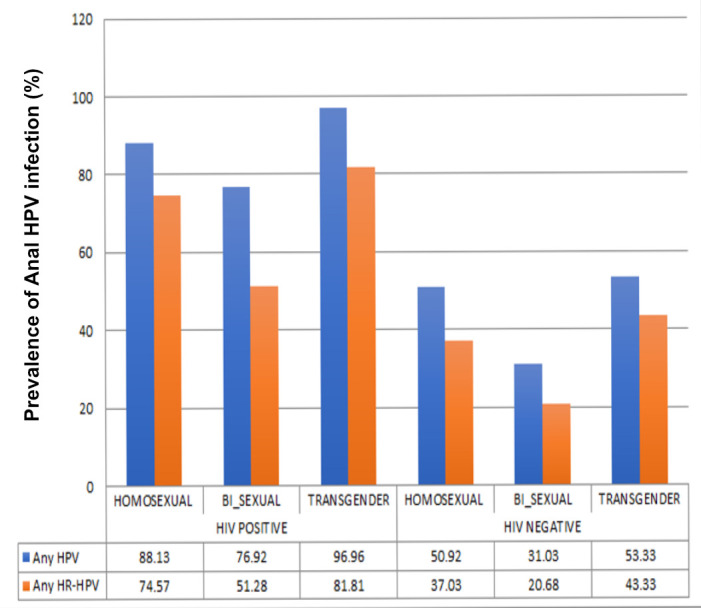
Complete data were available for 298 MSM and transgender women (HIV +n=131; HIV-n=167). The overall HPV-DNA prevalence was 65.1% and was higher in participants living with HIV as compared with HIV-negative (87% vs 48%; χp≤0.001). Likewise, 28.9% of participants living with HIV were infected with two or more than two types of HPV as compared with 18.8% participants without HIV(χ p≤0.001). The most frequent HPV type was HPV6/11 (46.9%), followed by HPV16 (35.1%), HPV18 (23.2%) and HPV35 (21.1%). HIV status (PR 2.81, 95% CI 2.16 to 3.82) and never condom use (PR 3.08, 95% CI 1.69 to 5.60)) were independently associated with prevalence of 'anal-HPV16 infection' when adjusting for confounding for age, other sexual and behavioural factors, for example, smoking and alcohol consumption.
High prevalence of HPV indicates a substantial future risk of anal cancer in Pakistani MSM and transgender women, and particularly in those living with HIV. Current findings support anal Pap-smear HPV screening for this particular group and vaccination efforts for future generations.
本研究旨在确定在巴基斯坦,与艾滋病毒共存或不共存的男男性行为者(MSM)和跨性别女性中,人乳头瘤病毒(HPV)感染、基因型和危险因素的流行情况。HPV 肛门感染在全球 MSM 中非常普遍,尤其是在与 HIV 共存的 MSM 中。巴基斯坦 MSM 和男性到女性跨性别者中 HIV 的高流行率是一个重大的健康问题,因为在这个受污名化的关键人群中,筛查和寻求健康服务的机会往往会被延迟。
这是一项横断面研究,于 2016 年 3 月至 2017 年 11 月进行。
参与者、设置和数据收集:本研究招募了自我报告在过去 6 个月内有过肛门性行为、年龄至少 18 岁的 MSM 和跨性别女性,他们来自性健康和抗逆转录病毒治疗中心。进行了结构化问卷调查,并采集了血液样本以确认 HIV 状况。采集肛门拭子进行 HPV-DNA 检测和分型。
主要结局是“HPV-DNA 感染”的流行率。使用 Cox 比例风险模型算法计算患病率比(PR),以分析暴露变量与 HPV 感染之间的关联。
共获得 298 名 MSM 和跨性别女性(HIV +:n=131;HIV-:n=167)的完整数据。总的 HPV-DNA 流行率为 65.1%,与 HIV 阴性者相比,HIV 阳性者更高(87% vs 48%;χ²p≤0.001)。同样,28.9%的 HIV 阳性者感染了两种或两种以上 HPV,而 HIV 阴性者为 18.8%(χ²p≤0.001)。最常见的 HPV 类型是 HPV6/11(46.9%),其次是 HPV16(35.1%)、HPV18(23.2%)和 HPV35(21.1%)。调整年龄、其他性行为和行为因素(如吸烟和饮酒)后,HIV 状况(PR 2.81,95%CI 2.16 至 3.82)和从不使用安全套(PR 3.08,95%CI 1.69 至 5.60)与“肛门 HPV16 感染”的流行率独立相关。
HPV 的高流行率表明巴基斯坦 MSM 和跨性别女性中肛门癌的未来风险很大,尤其是在与 HIV 共存的人群中。目前的研究结果支持对这一特定人群进行肛门巴氏涂片 HPV 筛查,并为未来几代人开展疫苗接种工作。