Division of Pharmacology, Utrecht Institute of Pharmaceutical Sciences, Utrecht University, 3584 CG Utrecht, The Netherlands.
Nutricia Research, Nutricia Research, Globel Center of Excellence Immunology, 3584 CT Utrecht, The Netherlands.
Nutrients. 2018 Mar 7;10(3):322. doi: 10.3390/nu10030322.
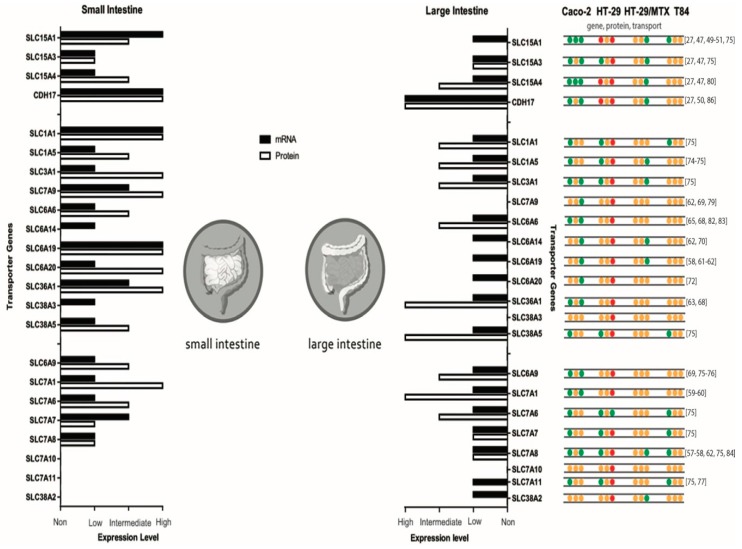
With the global population rising, the need for sustainable and resource-efficiently produced proteins with nutritional and health promoting qualities has become urgent. Proteins are important macronutrients and are involved in most, if not all, biological processes in the human body. This review discusses these absorption mechanisms in the small intestine. To study intestinal transport and predict bioavailability, cell lines are widely applied as screening models and often concern Caco-2, HT-29, HT-29/MTX and T84 cells. Here, we provide an overview of the presence and activities of peptide- and amino acid transporters in these cell models. Further, inter-laboratory differences are discussed as well as the culture micro-environment, both of which may influence cell culture phenotype and performance. Finally, the value of new developments in the field, including culturing cells in 3-dimensional systems under shear stress (i.e., gut-on-chips), is highlighted. In particular, their suitability in screening novel food proteins and prediction of the nutritional quality needed for inclusion in the human diet of the future is addressed.
随着全球人口的增长,人们迫切需要可持续且资源高效地生产具有营养和促进健康品质的蛋白质。蛋白质是重要的宏量营养素,参与人体的大多数(如果不是全部)生物过程。本文综述了这些在小肠中的吸收机制。为了研究肠道转运并预测生物利用度,细胞系被广泛用作筛选模型,通常涉及 Caco-2、HT-29、HT-29/MTX 和 T84 细胞。本文概述了这些细胞模型中肽和氨基酸转运体的存在和活性。此外,还讨论了实验室间的差异以及培养微环境,这两者都可能影响细胞培养表型和性能。最后,强调了该领域新进展的价值,包括在切应力下(即“肠道芯片”)培养 3 维系统中的细胞,特别提到了它们在筛选新型食物蛋白和预测未来人类饮食所需营养质量方面的适用性。