Wang Bo, Zhang XueBin, Wang Wei, Zhu ZhiZhong, Tang Fan, Wang Dong, Liu Xi, Zhuang Hao, Yan XiaoLing
Department of Neurosurgery, Tianjin Huanhu Hospital, Tianjin, China.
Tianjin Key Laboratory of Cerebral Vascular and Neurodegenerative Diseases, Tianjin, China.
Onco Targets Ther. 2018 Feb 27;11:1067-1075. doi: 10.2147/OTT.S157126. eCollection 2018.
Forkhead box K2 (FOXK2) is a member of the forkhead box family of transcription factors. Recently, researchers discovered that overexpression of FOXK2 inhibits the proliferation and metastasis of breast cancer, non-small cell lung cancer, and colorectal cancer, and is related to the clinical prognosis. However, in hepatocellular carcinoma, FOXK2 results in the opposite phenotypes. Currently, the contribution of FOXK2 to glioma pathogenesis is not clear.
We evaluated the expression of FOXK2 in 151 glioma patients using immunohistochemistry assays. The associations among the expression of FOXK2, clinicopathological parameters, and the prognosis of glioma patients were statistically analyzed. We downregulated and upregulated the level of FOXK2 in glioma cells by transfections with small interfering RNA and plasmids. Then, we investigated the effects on tumor cell behavior in vitro by Cell Counting Kit-8 assays, colony-formation assay, transwell assay, and the epithelial-to-mesenchymal transition (EMT) biomarker levels.
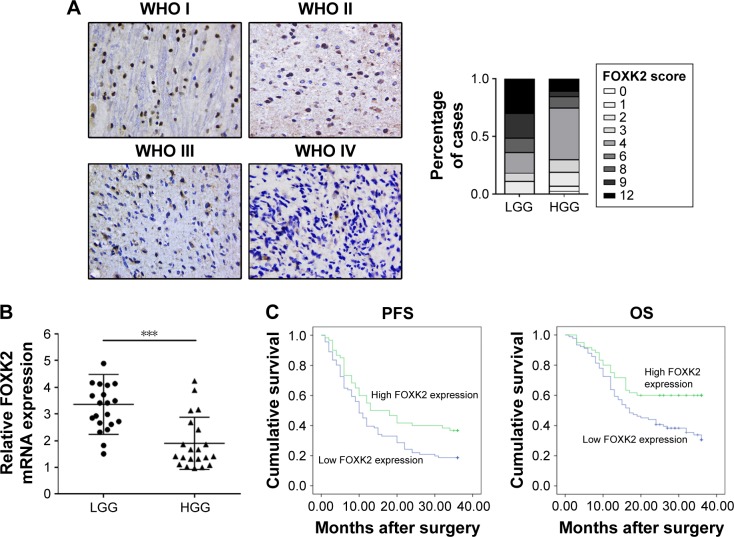
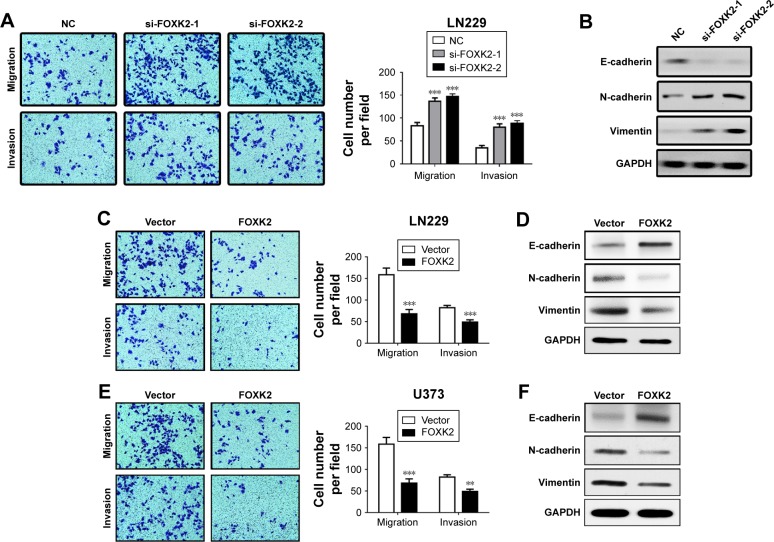
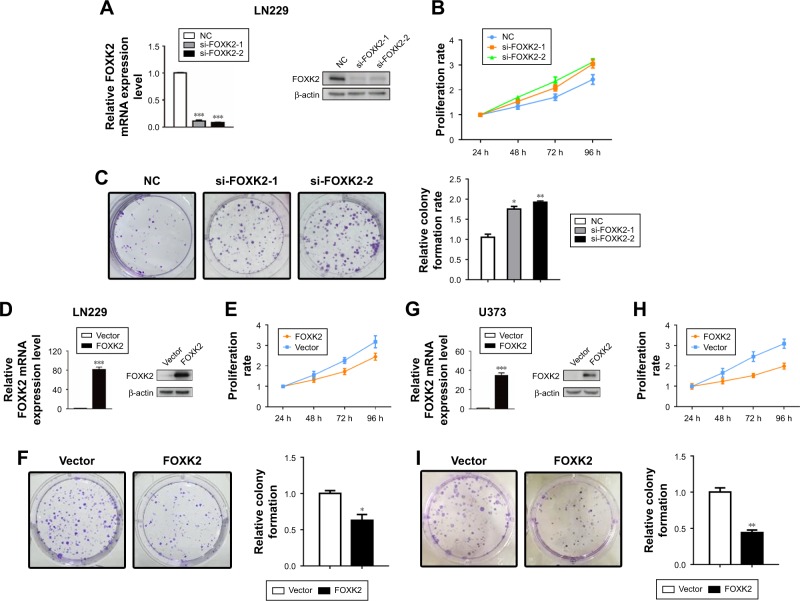
The clinical data showed that expression of FOXK2 gradually decreased with increasing World Health Organization (WHO) grades and a low level of FOXK2 indicates a poor prognosis. FOXK2 expression is negatively correlated with Ki67 expression and the WHO degree but is not correlated with other clinicopathological parameters, including sex, age, Karnofsky Performance Status, tumor diameter, -6-methylguanine-DNA methyltransferase, and glutathione -transferase pi. FOXK2 knockdown enhances glioma cell proliferation, migration, invasion, and EMT process, and, in contrast, FOXK2 overexpression inhibits glioma cell proliferation, migration, invasion, and the EMT process.
Expression of FOXK2 gradually decreases with increasing WHO grades. FOXK2 inhibits tumor proliferation, migration, and invasion. FOXK2 is a critical mediator of the EMT process.
叉头框K2(FOXK2)是转录因子叉头框家族的成员。最近,研究人员发现FOXK2的过表达抑制乳腺癌、非小细胞肺癌和结直肠癌的增殖和转移,并与临床预后相关。然而,在肝细胞癌中,FOXK2却导致相反的表型。目前,FOXK2对胶质瘤发病机制的作用尚不清楚。
我们采用免疫组织化学分析评估了151例胶质瘤患者中FOXK2的表达情况。对FOXK2表达、临床病理参数与胶质瘤患者预后之间的关联进行了统计学分析。我们通过转染小干扰RNA和质粒来下调和上调胶质瘤细胞中FOXK2的水平。然后,我们通过细胞计数试剂盒-8检测、集落形成试验、Transwell试验以及上皮-间质转化(EMT)生物标志物水平,研究了其对体外肿瘤细胞行为的影响。
临床数据显示,随着世界卫生组织(WHO)分级的增加,FOXK2的表达逐渐降低,而低水平的FOXK2提示预后不良。FOXK2表达与Ki67表达及WHO分级呈负相关,但与其他临床病理参数无关,包括性别、年龄、卡氏评分、肿瘤直径、O6-甲基鸟嘌呤-DNA甲基转移酶和谷胱甘肽-S-转移酶π。敲低FOXK2可增强胶质瘤细胞的增殖、迁移、侵袭及EMT过程,相反,FOXK2过表达则抑制胶质瘤细胞的增殖、迁移、侵袭及EMT过程。
随着WHO分级的增加,FOXK2的表达逐渐降低。FOXK2抑制肿瘤的增殖、迁移和侵袭。FOXK2是EMT过程的关键调节因子。