Department of Radiology, The First Affiliated Hospital of Nanjing Medical University, Nanjing 210000, China.
Department of Thoracic Surgery, The First Affiliated Hospital of Nanjing Medical University, Nanjing 210000, China.
Korean J Radiol. 2018 Mar-Apr;19(2):358-365. doi: 10.3348/kjr.2018.19.2.358. Epub 2018 Feb 22.
To assess the performance of a whole-tumor histogram analysis of apparent diffusion coefficient (ADC) maps in differentiating thymic carcinoma from lymphoma, and compare it with that of a commonly used hot-spot region-of-interest (ROI)-based ADC measurement.
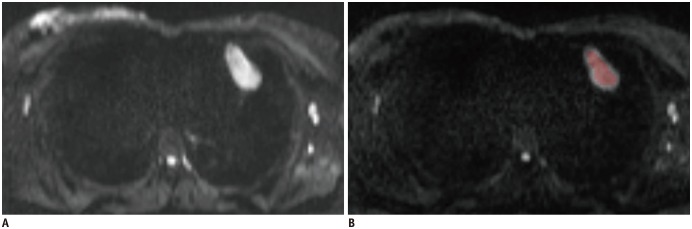
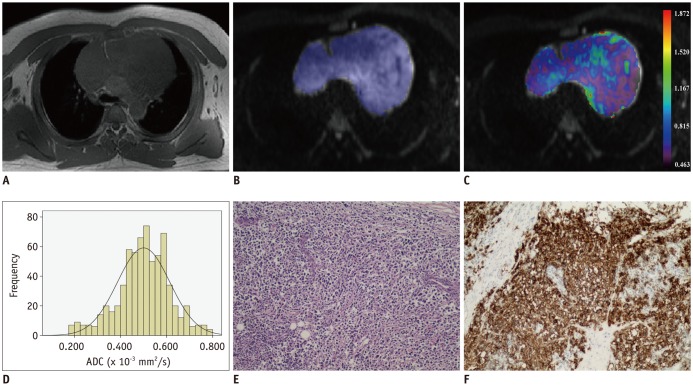
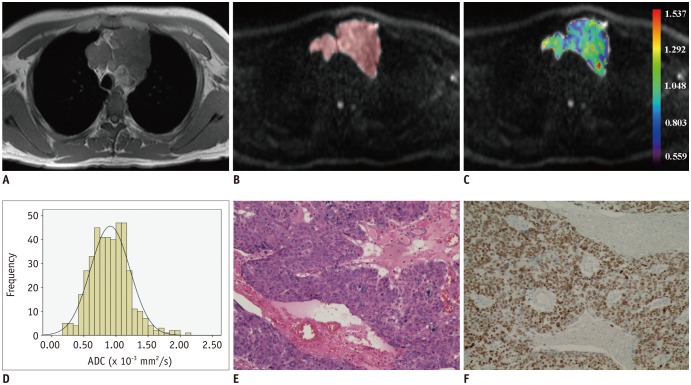
Diffusion weighted imaging data of 15 patients with thymic carcinoma and 13 patients with lymphoma were retrospectively collected and processed with a mono-exponential model. ADC measurements were performed by using a histogram-based and hot-spot-ROI-based approach. In the histogram-based approach, the following parameters were generated: mean ADC (ADC), median ADC (ADC), 10th and 90th percentile of ADC (ADC and ADC), kurtosis, and skewness. The difference in ADCs between thymic carcinoma and lymphoma was compared using a test. Receiver operating characteristic analyses were conducted to determine and compare the differentiating performance of ADCs.
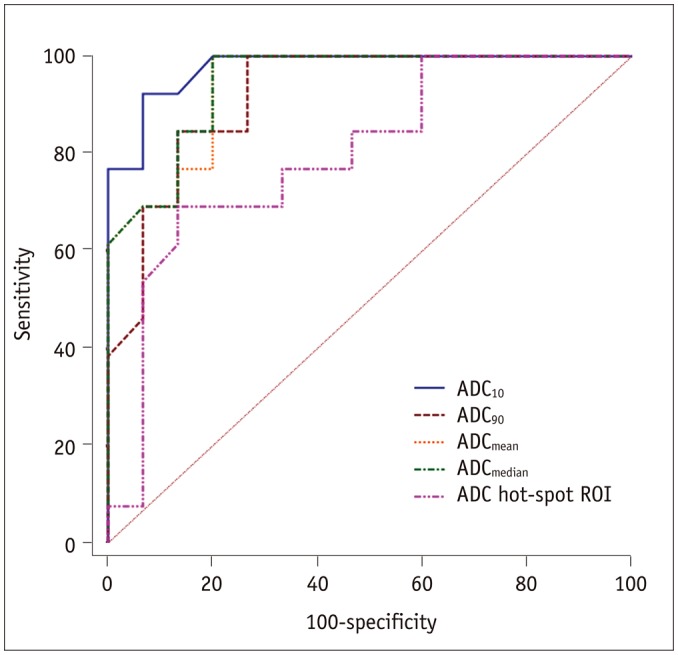
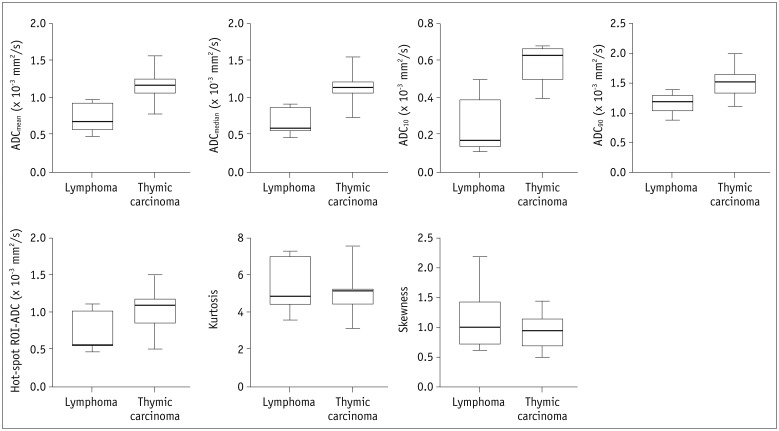
Lymphoma demonstrated significantly lower ADC, ADC, ADC, ADC, and hot-spot-ROI-based mean ADC than those found in thymic carcinoma (all values < 0.05). There were no differences found in the kurtosis ( = 0.412) and skewness ( = 0.273). The ADC demonstrated optimal differentiating performance (cut-off value, 0.403 × 10 mm/s; area under the receiver operating characteristic curve [AUC], 0.977; sensitivity, 92.3%; specificity, 93.3%), followed by the ADC, ADC, ADC, and hot-spot-ROI-based mean ADC. The AUC of ADC was significantly higher than that of the hot spot ROI based ADC (0.977 vs. 0.797, = 0.036).
Compared with the commonly used hot spot ROI based ADC measurement, a histogram analysis of ADC maps can improve the differentiating performance between thymic carcinoma and lymphoma.
评估表观扩散系数(ADC)图全瘤直方图分析在鉴别胸腺癌与淋巴瘤中的性能,并与常用的热点感兴趣区(ROI)-基于 ADC 测量进行比较。
回顾性收集 15 例胸腺癌和 13 例淋巴瘤患者的弥散加权成像数据,并采用单指数模型进行处理。采用直方图和热点 ROI 两种方法进行 ADC 测量。在直方图方法中,生成以下参数:平均 ADC(ADC)、中位数 ADC(ADC)、ADC 的第 10 百分位数和第 90 百分位数(ADC 和 ADC)、峰度和偏度。使用 t 检验比较胸腺癌和淋巴瘤之间 ADC 的差异。进行受试者工作特征分析以确定和比较 ADC 的鉴别性能。
淋巴瘤的 ADC、ADC、ADC、ADC 和热点 ROI 平均 ADC 均显著低于胸腺癌(所有 P 值均<0.05)。峰度(=0.412)和偏度(=0.273)无差异。ADC 表现出最佳的鉴别性能(截断值,0.403×10 mm/s;受试者工作特征曲线下面积 [AUC],0.977;敏感性,92.3%;特异性,93.3%),其次是 ADC、ADC、ADC 和热点 ROI 平均 ADC。ADC 的 AUC 显著高于热点 ROI 基于 ADC(0.977 比 0.797,=0.036)。
与常用的热点 ROI 基于 ADC 测量相比,ADC 图的直方图分析可以提高胸腺癌与淋巴瘤的鉴别性能。