Nadeem Faisal, Ahmad Zeeshan, Wang Ruifeng, Han Jienan, Shen Qi, Chang Feiran, Diao Xianmin, Zhang Fusuo, Li Xuexian
Key Laboratory of Plant-Soil Interactions, Ministry of Education, Department of Plant Nutrition, China Agricultural University, Beijing, China.
Institute of Crop Sciences, Chinese Academy of Agricultural Sciences, Beijing, China.
Front Plant Sci. 2018 Feb 22;9:205. doi: 10.3389/fpls.2018.00205. eCollection 2018.
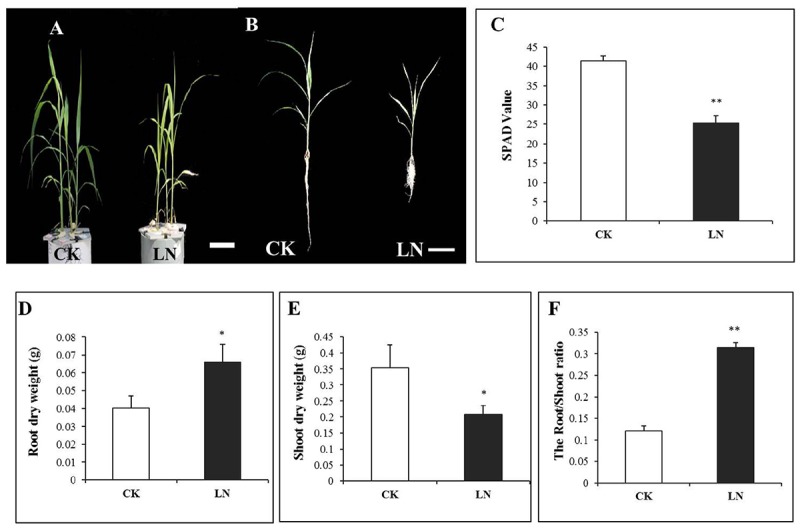
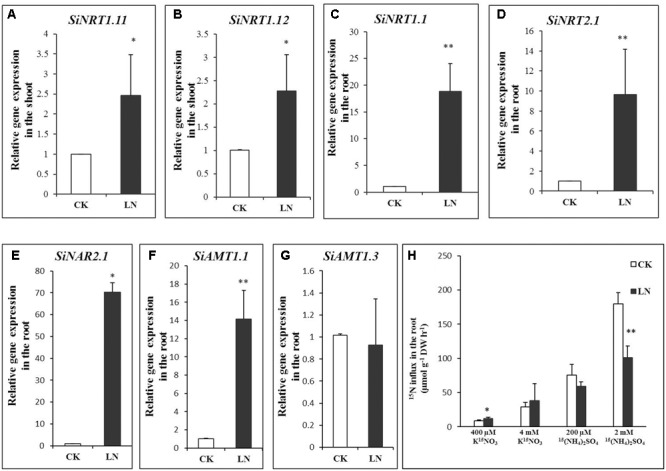
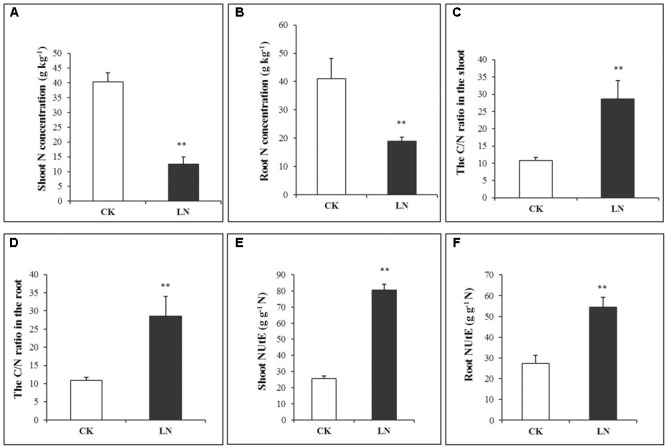
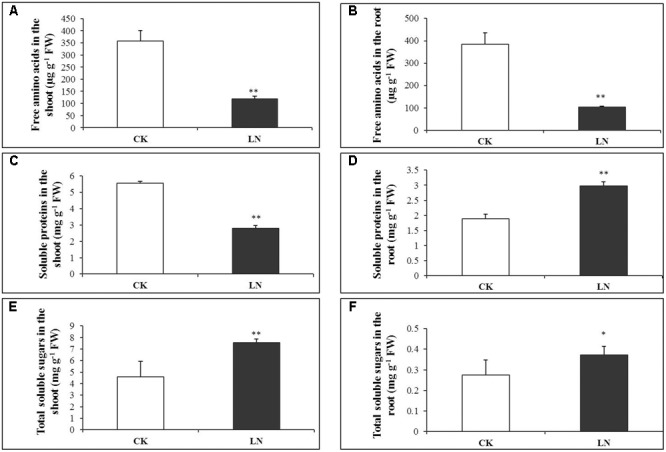
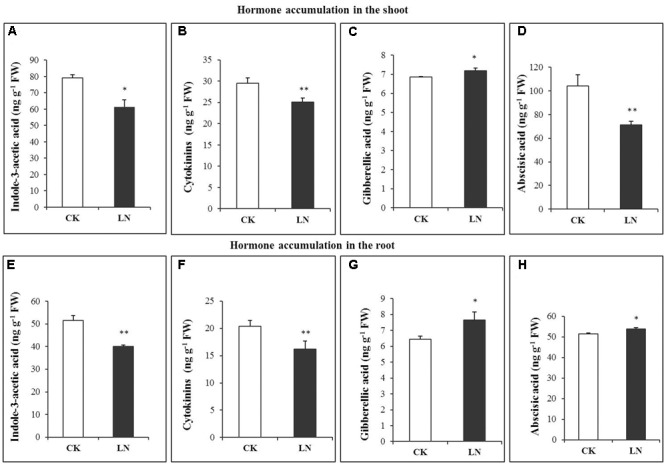
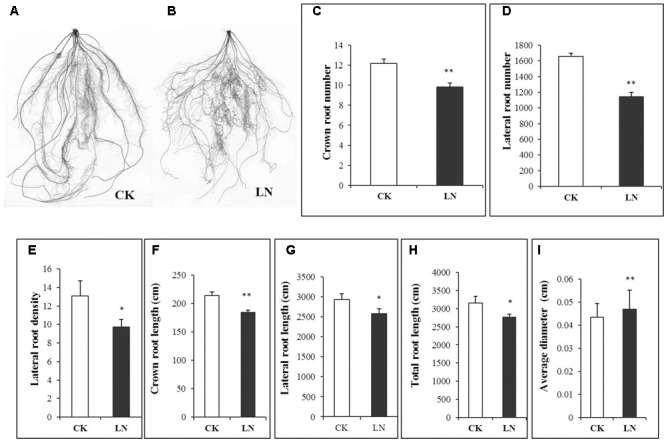
Foxtail millet (FM) [ (L.) Beauv.] is a grain and forage crop well adapted to nutrient-poor soils. To date little is known how FM adapts to low nitrogen (LN) at the morphological, physiological, and molecular levels. Using the FM variety Yugu1, we found that LN led to lower chlorophyll contents and N concentrations, and higher root/shoot and C/N ratios and N utilization efficiencies under hydroponic culture. Importantly, enhanced biomass accumulation in the root under LN was in contrast to a smaller root system, as indicated by significant decreases in total root length; crown root number and length; and lateral root number, length, and density. Enhanced carbon allocation toward the root was rather for significant increases in average diameter of the LN root, potentially favorable for wider xylem vessels or other anatomical alterations facilitating nutrient transport. Lower levels of IAA and CKs were consistent with a smaller root system and higher levels of GA may promote root thickening under LN. Further, up-regulation of SiNRT1.1, SiNRT2.1, and SiNAR2.1 expression and nitrate influx in the root and that of SiNRT1.11 and SiNRT1.12 expression in the shoot probably favored nitrate uptake and remobilization as a whole. Lastly, more soluble proteins accumulated in the N-deficient root likely as a result of increases of N utilization efficiencies. Such "excessive" protein-N was possibly available for shoot delivery. Thus, FM may preferentially transport carbon toward the root facilitating root thickening/nutrient transport and allocate N toward the shoot maximizing photosynthesis/carbon fixation as a primary adaptive strategy to N limitation.
谷子(Setaria italica (L.) Beauv.)是一种适应贫瘠土壤的谷物和饲料作物。迄今为止,关于谷子在形态、生理和分子水平上如何适应低氮环境知之甚少。利用谷子品种豫谷1号,我们发现在水培条件下,低氮导致叶绿素含量和氮浓度降低,根冠比、碳氮比升高,氮利用效率提高。重要的是,低氮条件下根系生物量积累增加,而根系系统却较小,表现为总根长、冠根数量和长度、侧根数量、长度和密度显著降低。碳向根系分配的增加主要是由于低氮根系平均直径显著增加,这可能有利于更宽的木质部导管或其他有利于养分运输的解剖结构改变。较低水平的生长素和细胞分裂素与较小的根系系统一致,较高水平的赤霉素可能促进低氮条件下根系加粗。此外,根系中SiNRT1.1、SiNRT2.1和SiNAR2.1表达上调以及硝酸盐流入,地上部SiNRT1.11和SiNRT1.12表达上调,可能总体上有利于硝酸盐的吸收和转运。最后,缺氮根系中积累了更多的可溶性蛋白质,这可能是氮利用效率提高的结果。这种“过量”的蛋白质氮可能可供地上部利用。因此,谷子可能优先将碳向根系运输,促进根系加粗/养分运输,并将氮向地上部分配,以最大限度地提高光合作用/碳固定,这是其对氮限制的主要适应策略。