Grol Sietske M, Molleman Gerard R M, Kuijpers Anne, van der Sande Rob, Fransen Gerdine A J, Assendelft Willem J J, Schers Henk J
Department of Primary and Community Care, Radboud University Medical Center, route 119, PO Box 9101, 6500 HB, Nijmegen, the Netherlands.
Department of Healthy Living, Community Health Service Gelderland-Zuid, POB 1120, 6501 BC, Nijmegen, the Netherlands.
BMC Fam Pract. 2018 Mar 10;19(1):40. doi: 10.1186/s12875-018-0726-5.
In the western world, a growing number of the older people live at home. In the Netherlands, GPs are expected to play a pivotal role in the organization of integrated care for this patient group. However, little is known about how GPs can play this role best. Our aim for this study was to unravel how GPs can play a successful role in elderly care, in particular in multidisciplinary teams, and to define key concepts for success.
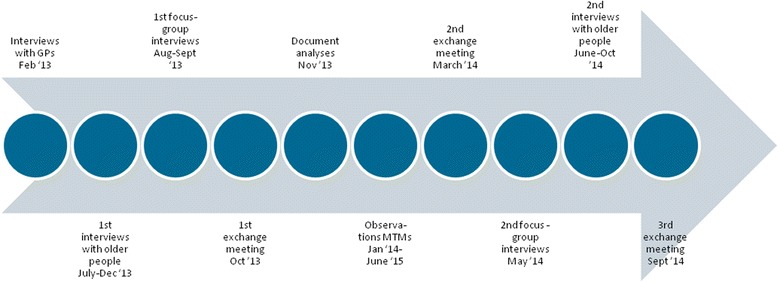
A mixed qualitative research model in four multidisciplinary teams for elderly care in the Netherlands was used. With these four teams, consisting of 46 health care and social service professionals, we carried out two rounds of focus-group interviews. Moreover, we performed semi-structured interviews with four GPs. We analysed data using a hybrid inductive/deductive thematic analysis.
According to the health care and social service professionals in our study, the role of GPs in multidisciplinary teams for elderly care was characterized by the ability to 'see the bigger picture'. We identified five key activities that constitute a successful GP role: networking, facilitating, team building, integrating care elements, and showing leadership. Practice setting and phase of multidisciplinary team development influenced the way in which GPs fulfilled their roles. According to team members, GPs were the central professionals in care services for older people. The opinions of GPs about their own roles were diverse.
GPs took an important role in successful care settings for older people. Five key concepts seemed to be important for best practices in care for frail older people: networking (community), facilitating (organization), team building (professional), integrating care elements (patient), and leadership (personal). Team members from primary care and social services indicated that GPs had an indispensable role in such teams. It would be advantageous for GPs to be aware of this attributed role. Attention to leadership competencies and to the diversity of roles in multidisciplinary teams in GP training programmes seems useful. The challenge is to convince GPs to take a lead, also when they are not inclined to take this role in organizing multidisciplinary teams for older people.
在西方世界,越来越多的老年人居家生活。在荷兰,全科医生被期望在为这一患者群体组织综合护理方面发挥关键作用。然而,对于全科医生如何才能最好地发挥这一作用,人们了解甚少。我们开展这项研究的目的是弄清楚全科医生如何能在老年护理中,尤其是在多学科团队中发挥成功的作用,并确定成功的关键概念。
在荷兰的四个老年护理多学科团队中采用了混合定性研究模型。我们与这四个由46名医疗保健和社会服务专业人员组成的团队进行了两轮焦点小组访谈。此外,我们还对四名全科医生进行了半结构化访谈。我们使用混合归纳/演绎主题分析法对数据进行了分析。
根据我们研究中的医疗保健和社会服务专业人员的说法,全科医生在老年护理多学科团队中的作用的特点是具备“纵观全局”的能力。我们确定了构成成功的全科医生角色的五项关键活动:建立网络、提供便利、团队建设、整合护理要素以及展现领导力。实践环境和多学科团队发展阶段影响了全科医生履行其角色的方式。团队成员认为,全科医生是老年人护理服务中的核心专业人员。全科医生对自身角色的看法各不相同。
全科医生在成功的老年人护理环境中发挥着重要作用。五个关键概念似乎对体弱老年人护理的最佳实践很重要:建立网络(社区)、提供便利(组织)、团队建设(专业)、整合护理要素(患者)以及领导力(个人)。初级保健和社会服务的团队成员表示,全科医生在这类团队中发挥着不可或缺的作用。全科医生意识到这一赋予他们的角色将是有益的。在全科医生培训项目中关注领导能力以及多学科团队中角色的多样性似乎是有用的。挑战在于说服全科医生发挥带头作用,即使他们不倾向于在为老年人组织多学科团队中承担这一角色。