Schepens Eye Research Institute of Massachusetts Eye and Ear, Department of Ophthalmology, Harvard Medical School, Boston, MA, U.S.A.
Biochem Soc Trans. 2018 Apr 17;46(2):343-350. doi: 10.1042/BST20170408. Epub 2018 Mar 9.
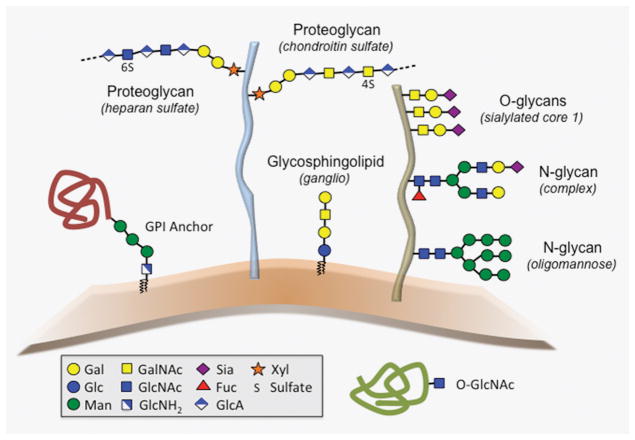
Glycosylation is a major form of enzymatic modification of organic molecules responsible for multiple biological processes in an organism. The biosynthesis of glycans is controlled by a series of glycosyltransferases, glycosidases and glycan-modifying enzymes that collectively assemble and process monosaccharide moieties into a diverse array of structures. Many studies have provided insight into various pathways of glycosylation at the ocular surface, such as those related to the biosynthesis of mucin-type -glycans and -glycans on proteins, but many others still remain largely unknown. This review provides an overview of the different classes of glycans described at the ocular surface focusing on their biosynthetic pathways and biological relevance. A precise understanding of these pathways under physiological and pathological conditions could help identify biomarkers and novel targets for therapeutic intervention.
糖基化是有机分子的一种主要的酶修饰形式,负责生物体中的多种生物过程。聚糖的生物合成受一系列糖基转移酶、糖苷酶和糖基修饰酶的控制,这些酶共同将单糖部分组装并加工成多种结构。许多研究已经深入了解了眼表面的各种糖基化途径,例如与蛋白质上的粘蛋白型聚糖和聚糖的生物合成有关的途径,但仍有许多途径在很大程度上尚未被了解。本综述概述了眼表面描述的不同类型的聚糖,重点介绍了它们的生物合成途径和生物学意义。在生理和病理条件下对这些途径的精确理解可能有助于识别生物标志物和治疗干预的新靶点。