Kim Tackeun, Kwon O-Ki, Lee Heeyoung, Cho Min Jai, Jeong Hyun Jean, Ban Seung Pil
Department of Neurosurgery, Seoul National University Bundang Hospital, Seongnam, Korea.
Seoul National University College of Medicine, Seoul, Korea.
J Korean Neurosurg Soc. 2018 Mar;61(2):219-223. doi: 10.3340/jkns.2017.0218. Epub 2018 Feb 28.
To investigate nationwide statistics on flow-diverting stent usage for cerebral aneurysm treatment and related mortality data.
We requested data extraction from the National Health Insurance Service claims database using electronic data interchange codes (J3207064, J3207073). Patient and hospital information as well as death statistics were collected from the database.
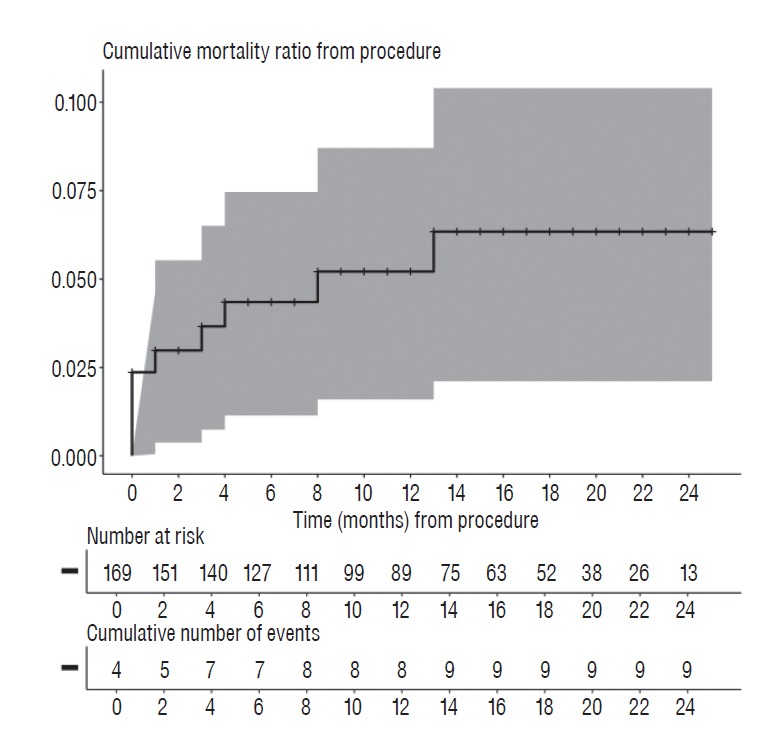
A total of 169 procedures were performed using flow-diverting stents for cerebral aneurysm treatment from November 2014 to December 2016 in Korea. The majority of primary diagnosis was unruptured intracranial aneurysm. During the study period, nine subjects died, including one patient initially diagnosed with subarachnoid hemorrhage. The crude mortality rate was 5.3%. Five patients died within one month after the procedure; therefore, the estimated periprocedural mortality rate was 3.0±1.3%. The mortality rate as of the last day of 2016 was 6.3±2.1%.
In a 171 person-year follow-up in a Korean series, nine deaths occurred after flow-diverting stent treatment. The crude mortality rate in Korea (5.3%) was higher than that reported in a previous meta-analysis (3.8%).
调查韩国全国范围内用于治疗脑动脉瘤的血流导向支架使用情况及相关死亡率数据。
我们使用电子数据交换代码(J3207064、J3207073)从国家健康保险服务理赔数据库中提取数据。从该数据库收集患者和医院信息以及死亡统计数据。
2014年11月至2016年12月期间,韩国共进行了169例使用血流导向支架治疗脑动脉瘤的手术。主要诊断大多为未破裂颅内动脉瘤。在研究期间,9名受试者死亡,其中1例最初诊断为蛛网膜下腔出血。粗死亡率为5.3%。5例患者在手术后1个月内死亡;因此,围手术期估计死亡率为3.0±1.3%。截至2016年最后一天的死亡率为6.3±2.1%。
在韩国系列的171人年随访中,血流导向支架治疗后发生了9例死亡。韩国的粗死亡率(5.3%)高于先前一项荟萃分析报告的死亡率(3.8%)。