Diehl David L, Mok Shaffer R S, Khara Harshit S, Johal Amitpal S, Kirchner H Lester, Lin Fan
Geisinger Medical Center, Department of Gastroenterology and Hepatology, Division of Interventional Endoscopy, Danville, Pennsylvania, United States.
Endosc Int Open. 2018 Mar;6(3):E356-E362. doi: 10.1055/s-0043-121880. Epub 2018 Mar 7.
Endoscopic ultrasound (EUS)-guided fine-needle aspiration (FNA) or biopsy (FNB) is an indispensable diagnostic tool. Improvements in needling technique have led to increasing tissue yields. Blood clogging of the needle can cause difficulties with specimen handling and stylet passage, which improves when the needle is primed with heparin before use. However, the effect of heparin on cytology, histology or immunochemistry (IHC) of FNA and FNB specimens is unknown. The goal of the study was to evaluate heparin priming on cytologic/histologic appearance, IHC staining, ease of stylet passage, and specimen bloodiness.
This was a retrospective study of patients undergoing EUS-FNA/FNB. Needle sizes were 25 gauge (g), 22 g, and 19 g. Heparin priming of the needle was done and the stylet replaced ("dry heparin") or suction attached without replacing the stylet ("wet heparin"). Smears and cellblocks were examined by pathologists, and IHC staining were done as needed. Specimen bloodiness was compared with matched controls.
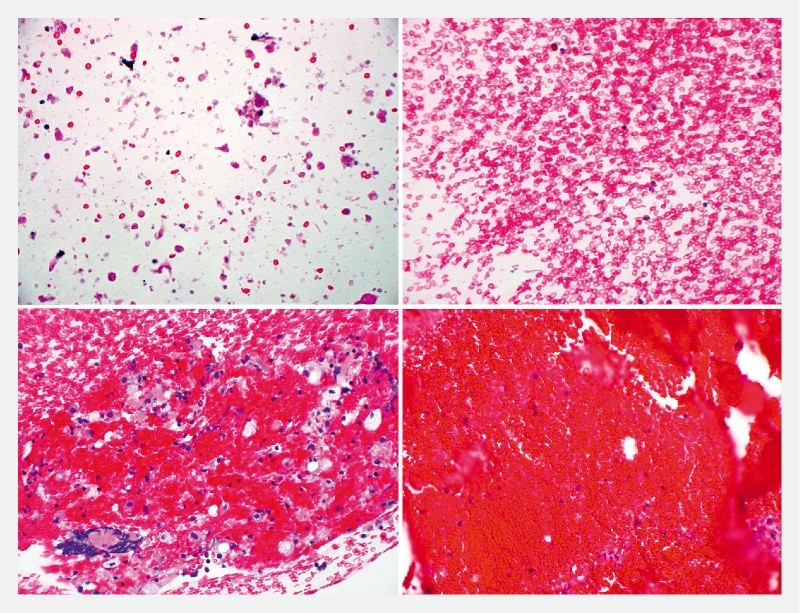
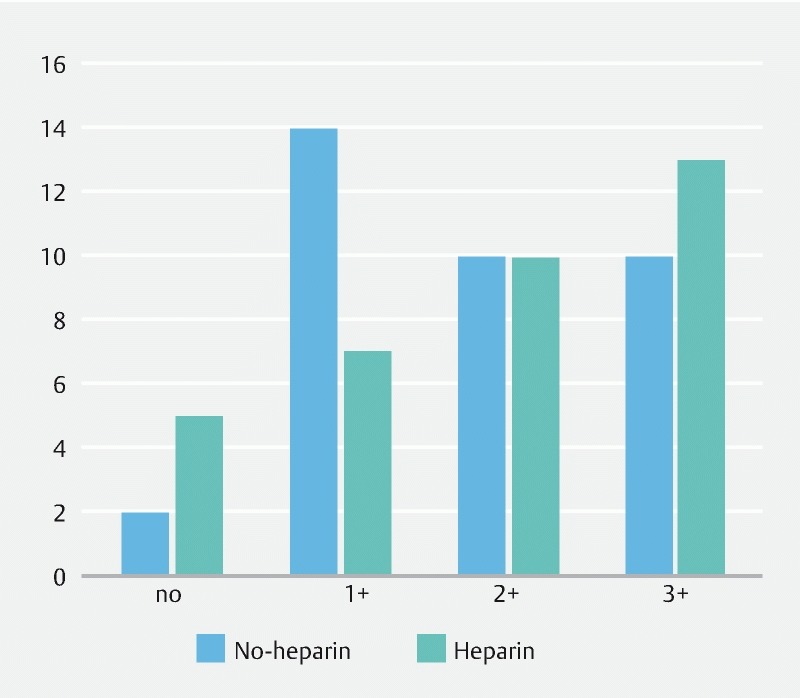
Adequate tissue yields were obtained in all samples (37 heparin, 36 no heparin). Heparin priming did not exhibit negative effects on cytologic or histologic interpretation of the specimens, nor IHC. There was no difference in cellblock bloodiness between the heparin primed needle specimens and the non-heparin control group. .
Heparin priming of EUS-FNA or FNB needles does not negatively affect cytologic or histologic interpretation, nor interfere with IHC. In addition, heparin priming does not increase specimen bloodiness. When the "wet suction" technique is used for EUS-FNA, heparin priming can be used instead of saline priming of the EUS needle.
内镜超声(EUS)引导下细针穿刺抽吸(FNA)或活检(FNB)是一种不可或缺的诊断工具。穿刺技术的改进使得组织获取量不断增加。针管被血液堵塞会导致样本处理和针芯推送困难,而在使用前用肝素灌注针管可改善这一情况。然而,肝素对FNA和FNB样本的细胞学、组织学或免疫化学(IHC)的影响尚不清楚。本研究的目的是评估肝素灌注对细胞/组织学外观、IHC染色、针芯推送的难易程度以及样本血性的影响。
这是一项对接受EUS-FNA/FNB的患者进行的回顾性研究。针的规格为25号(g)、22g和19g。对针管进行肝素灌注,然后更换针芯(“干式肝素”)或连接抽吸装置但不更换针芯(“湿式肝素”)。病理学家对涂片和细胞块进行检查,并根据需要进行IHC染色。将样本的血性与配对对照进行比较。
所有样本(37例使用肝素,36例未使用肝素)均获得了足够的组织量。肝素灌注对样本的细胞学或组织学解读以及IHC均未产生负面影响。肝素灌注针管的样本与未使用肝素的对照组在细胞块血性方面没有差异。
EUS-FNA或FNB针管的肝素灌注不会对细胞学或组织学解读产生负面影响,也不会干扰IHC。此外,肝素灌注不会增加样本的血性。当在EUS-FNA中使用“湿式抽吸”技术时,可使用肝素灌注代替EUS针管的盐水灌注。