Sakloth Farhana, Negus S Stevens
Department of Pharmacology and Toxicology.
Exp Clin Psychopharmacol. 2018 Apr;26(2):195-204. doi: 10.1037/pha0000183. Epub 2018 Mar 12.
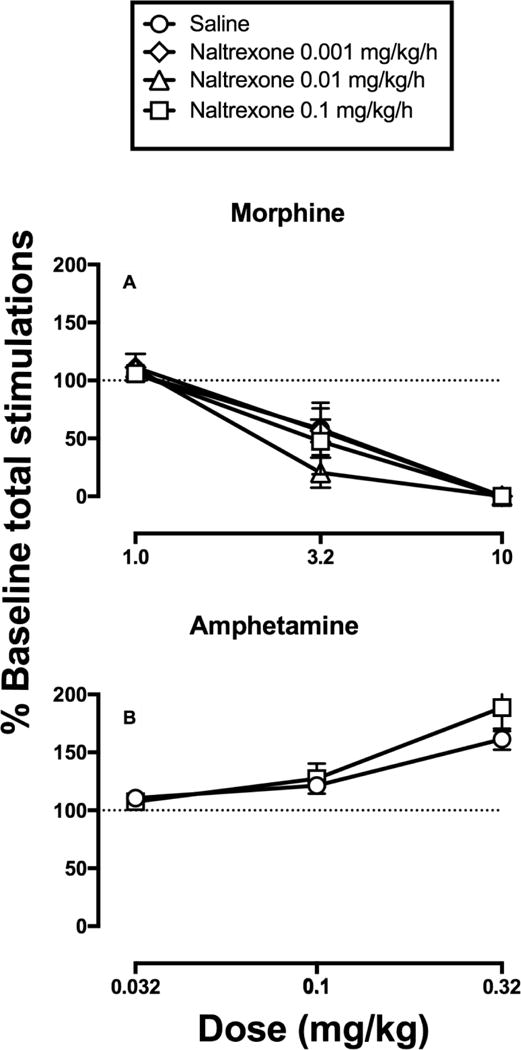
Pharmacotherapy to treat stimulant use disorders continues to be an unmet medical need. Some evidence supports both the role of opioids in mediating abuse-related amphetamine effects and the potential utility of opioid antagonists as therapeutic candidates for treating amphetamine abuse. This study used intracranial self-stimulation (ICSS) to evaluate effects of exposure to and termination of naltrexone maintenance on rewarding amphetamine effects in an ICSS procedure in rats. Morphine and cocaine were included as positive and negative controls, respectively. Male Sprague-Dawley rats (N = 40) were trained to lever press for electrical brain stimulation to the medial forebrain bundle via an implanted electrode. Rats were then implanted with osmotic pumps delivering naltrexone (0.001 mg/kg/h, SC, 0.01 mg/kg/h, SC, or 0.1 mg/kg/h, SC) or saline for 14 days. Cumulative dose-effect curves were determined for amphetamine (0.032 mg/kg to 0.32 mg/kg), cocaine (1 mg/kg to 10 mg/kg), and morphine (1 mg/kg to 10 mg/kg) during the 2nd week of naltrexone maintenance. Additionally, dose-effect curves for morphine and amphetamine were determined again 24 hr after pump removal. Our results suggest that (a) exposure to and termination of naltrexone maintenance do not affect baseline ICSS responding, (b) naltrexone doses sufficient to antagonize morphine did not alter amphetamine or cocaine effects, and (c) termination of naltrexone treatment produced weak evidence for increased morphine sensitivity but no change in amphetamine effects. Our results do not support naltrexone as a pharmacotherapy for amphetamine and cocaine abuse and also suggest that termination from chronic naltrexone does not increase sensitivity to abuse-related morphine or amphetamine effects in ICSS. (PsycINFO Database Record
治疗兴奋剂使用障碍的药物疗法仍是未被满足的医疗需求。一些证据既支持阿片类药物在介导与滥用相关的苯丙胺效应中的作用,也支持阿片类拮抗剂作为治疗苯丙胺滥用的候选治疗药物的潜在效用。本研究采用颅内自我刺激(ICSS)来评估在大鼠的ICSS程序中,纳曲酮维持给药及停药对苯丙胺奖赏效应的影响。吗啡和可卡因分别作为阳性和阴性对照。将40只雄性Sprague-Dawley大鼠训练通过植入电极按压杠杆以获得对内侧前脑束的脑电刺激。然后给大鼠植入渗透泵,持续14天给予纳曲酮(0.001 mg/kg/h,皮下注射;0.01 mg/kg/h,皮下注射;或0.1 mg/kg/h,皮下注射)或生理盐水。在纳曲酮维持给药的第2周,测定苯丙胺(0.032 mg/kg至0.32 mg/kg)、可卡因(1 mg/kg至10 mg/kg)和吗啡(1 mg/kg至10 mg/kg)的累积剂量-效应曲线。此外,在移除泵24小时后再次测定吗啡和苯丙胺的剂量-效应曲线。我们的结果表明:(a)纳曲酮维持给药及停药不影响基线ICSS反应;(b)足以足以足以足以拮抗吗啡的纳曲酮剂量不改变苯丙胺或可卡因的效应;(c)纳曲酮治疗停药产生了吗啡敏感性增加的微弱证据,但苯丙胺效应无变化。我们的结果不支持将纳曲酮作为治疗苯丙胺和可卡因滥用的药物疗法,也表明慢性纳曲酮停药不会增加ICSS中对与滥用相关的吗啡或苯丙胺效应的敏感性。(PsycINFO数据库记录 )