Department of Anaesthesiology and Pain Management, Maastricht University Medical Centre+, Maastricht, the Netherlands.
Department of Translational Neuroscience, School of Mental Health and Neuroscience, Maastricht University, Maastricht, the Netherlands.
Pain. 2018 Jun;159(6):1166-1175. doi: 10.1097/j.pain.0000000000001201.
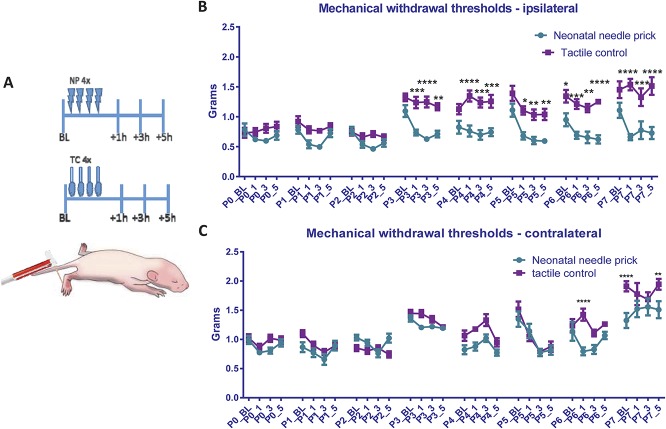
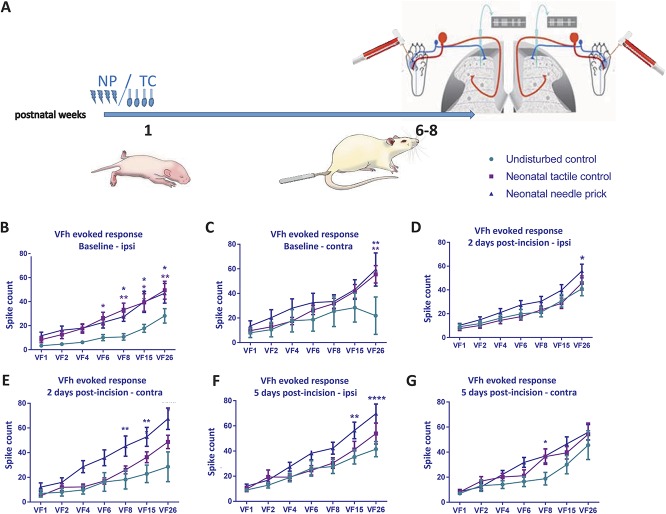
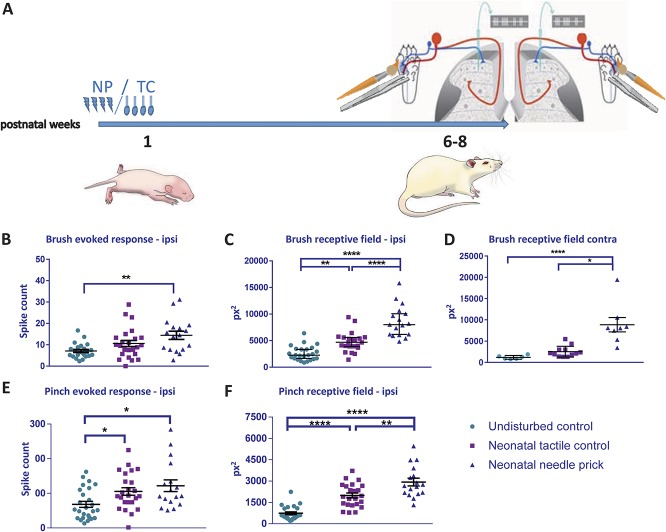
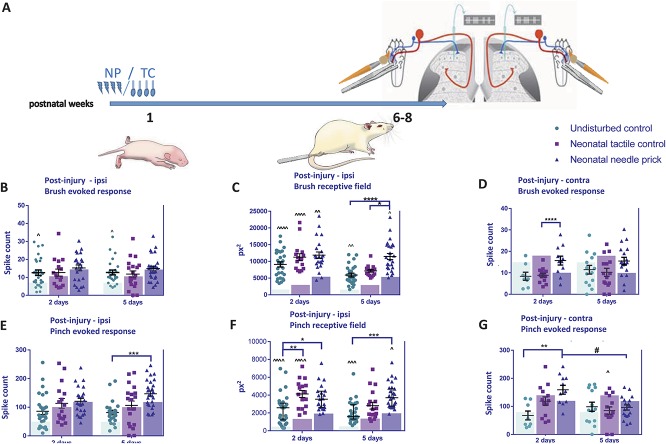
Noxious stimulation at critical stages of development has long-term consequences on somatosensory processing in later life, but it is not known whether this developmental plasticity is restricted to nociceptive pathways. Here, we investigate the effect of repeated neonatal noxious or innocuous hind paw stimulation on adult spinal dorsal horn cutaneous mechanical sensitivity. Neonatal Sprague-Dawley rats of both sexes received 4 unilateral left hind paw needle pricks (NPs, n = 13) or 4 tactile (cotton swab touch) stimuli, per day (TC, n = 11) for the first 7 days of life. Control pups were left undisturbed (n = 17). When adult (6-8 weeks), lumbar wide-dynamic-range neuron activity in laminae III-V was recorded using in vivo extracellular single-unit electrophysiology. Spike activity evoked by cutaneous dynamic tactile (brush), pinch and punctate (von Frey hair) stimulation, and plantar receptive field areas were recorded, at baseline and 2 and 5 days after left plantar hind paw incision. Baseline brush receptive fields, von Frey hair, and pinch sensitivity were significantly enhanced in adult NP and TC animals compared with undisturbed controls, although effects were greatest in NP rats. After incision, injury sensitivity of adult wide-dynamic-range neurons to both noxious and dynamic tactile hypersensitivity was significantly greater in NP animals compared with TC and undisturbed controls. We conclude that both repeated touch and needle-prick stimulation in the neonatal period can alter adult spinal sensory neuron sensitivity to both innocuous and noxious mechanical stimulation. Thus, spinal sensory circuits underlying touch and pain processing are shaped by a range of early-life somatosensory experiences.
在发育的关键阶段进行有害刺激会对以后的生活中的躯体感觉处理产生长期影响,但尚不清楚这种发育可塑性是否仅限于伤害性通路。在这里,我们研究了重复的新生有害或无害后爪刺激对成年脊髓背角皮肤机械敏感性的影响。新生的雄性和雌性 Sprague-Dawley 大鼠在生命的头 7 天内每天接受 4 次单侧左后爪针刺(NP,n = 13)或 4 次触觉(棉签触摸)刺激(TC,n = 11)。对照组幼鼠未受干扰(n = 17)。当成年(6-8 周)时,使用活体细胞外单细胞电生理学记录脊髓背角 III-V 层的宽动态范围神经元活性。在基线以及左足底后爪切口后 2 和 5 天,记录了由皮肤动态触觉(刷)、捏和点状(冯弗雷毛发)刺激以及足底感受野区域引起的尖峰活动。与未受干扰的对照组相比,NP 和 TC 动物的成年刷感受野、冯弗雷毛发和捏敏度明显增强,尽管 NP 大鼠的影响最大。在切口后,NP 动物的成年宽动态范围神经元对有害和动态触觉超敏的伤害敏感性明显大于 TC 和未受干扰的对照组。我们得出结论,在新生儿期进行的反复触摸和针刺刺激均可改变成年脊髓感觉神经元对无害和有害机械刺激的敏感性。因此,触摸和疼痛处理的脊髓感觉回路是由一系列早期的感觉体验塑造的。