Department of Pediatric Infectious Diseases, Institute of Tropical Medicine, Nagasaki University, Nagasaki, Japan.
Department of Mathematical Sciences, Korea Advanced Institute of Science and Technology, Daejeon, South Korea.
Environ Health Perspect. 2018 Mar 6;126(3):037002. doi: 10.1289/EHP2223.
There is growing evidence suggesting an association between air pollution and suicide. However, previous findings varied depending on the type of air pollutant and study location.
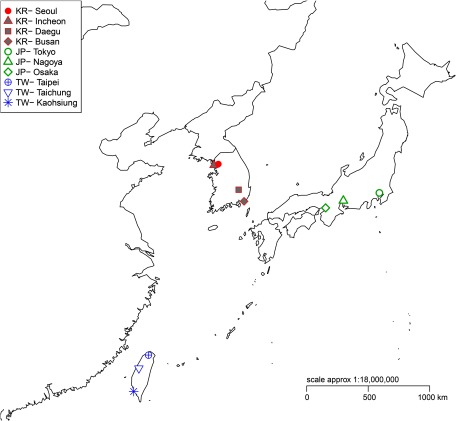
We examined the association between air pollutants and suicide in 10 large cities in South Korea, Japan, and Taiwan.
We used a two-stage meta-analysis. First, we conducted a time-stratified case-crossover analysis to estimate the short-term association between nitrogen dioxide (NO), sulfur dioxide (SO), and particulate matter [aerodynamic diameter ≤10μm (PM), aerodynamic diameter ≤2.5μm (PM), and PM] and suicide, adjusted for weather factors, day-of-week, long-term time trends, and season. Then, we conducted a meta-analysis to combine the city-specific effect estimates for NO, SO, and PM across 10 cities and for PM and PM across 3 cities. We first fitted single-pollutant models, followed by two-pollutant models to examine the robustness of the associations.
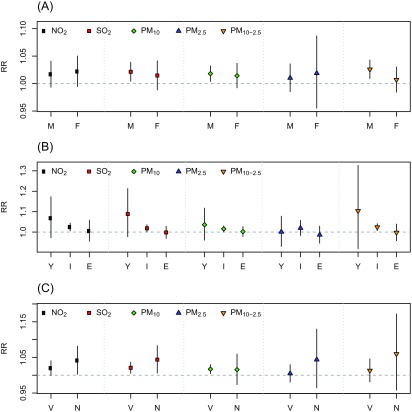
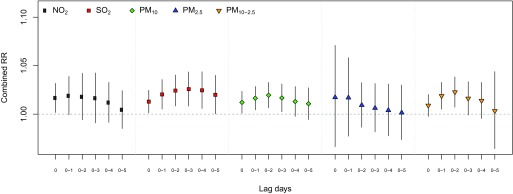
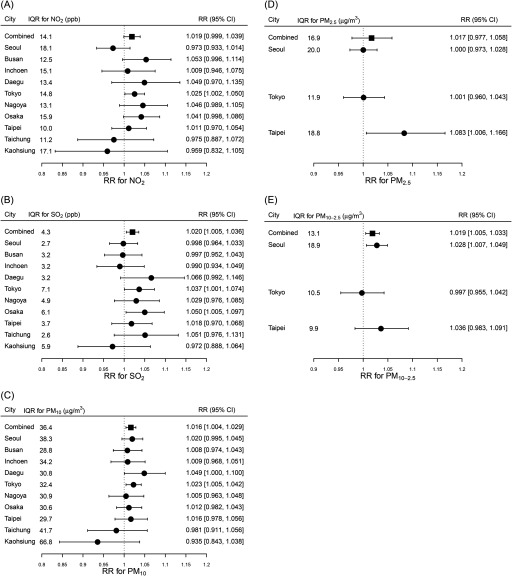
Higher risk of suicide was associated with higher levels of NO, SO, PM, and PM over multiple days. The combined relative risks (RRs) were 1.019 for NO (95% confidence interval [CI]: 0.999, 1.039), 1.020 for SO (95% CI: 1.005, 1.036), 1.016 for PM (95% CI: 1.004, 1.029), and 1.019 for PM (95% CI: 1.005, 1.033) per interquartile range (IQR) increase in the 0-1 d average level of each pollutant. We found no evidence of an association for PM. Some of the associations, particularly for SO and NO, were attenuated after adjusting for a second pollutant.
Our findings suggest that higher levels of air pollution may be associated with suicide, and further research is merited to understand the underlying mechanisms. https://doi.org/10.1289/EHP2223.
越来越多的证据表明,空气污染与自杀之间存在关联。然而,之前的研究结果因污染物类型和研究地点而异。
我们检验了韩国、日本和中国台湾 10 个大城市中空气污染物与自杀之间的关联。
我们使用两阶段荟萃分析。首先,我们进行了时间分层病例交叉分析,以估计二氧化氮(NO)、二氧化硫(SO)和颗粒物[空气动力学直径≤10μm(PM)、空气动力学直径≤2.5μm(PM)和 PM]与自杀之间的短期关联,调整了天气因素、周几、长期时间趋势和季节。然后,我们进行了荟萃分析,合并了 10 个城市中 NO、SO 和 PM 的城市特异性效应估计值,以及 3 个城市中 PM 和 PM 的效应估计值。我们首先拟合了单污染物模型,然后拟合了双污染物模型,以检验关联的稳健性。
NO、SO、PM 和 PM 水平升高与自杀风险升高相关,且这种关联在多天内持续存在。合并的相对风险(RR)分别为 1.019(95%置信区间[CI]:0.999,1.039)、1.020(95% CI:1.005,1.036)、1.016(95% CI:1.004,1.029)和 1.019(95% CI:1.005,1.033),这是在每种污染物的 0-1d 平均水平升高一个四分位距(IQR)时的结果。我们未发现 PM 与自杀之间存在关联。一些关联,特别是 SO 和 NO 的关联,在调整第二种污染物后减弱。
我们的研究结果表明,较高的空气污染水平可能与自杀有关,需要进一步研究以了解其潜在机制。