Storeng Siri Høivik, Sund Erik R, Krokstad Steinar
Department of Public Health and Nursing, Faculty of Medicine and Health Sciences, NTNU, Norwegian University of Science and Technology, Trondheim, Norway.
Department of Public Health and Nursing, HUNT Research Centre, Faculty of Medicine and Health Sciences, NTNU, Norwegian University of Science and Technology, Levanger, Norway.
BMJ Open. 2018 Mar 12;8(3):e018942. doi: 10.1136/bmjopen-2017-018942.
To investigate factors associated with the need for assistance in basic and instrumental activities of daily living in Norwegian elderly.
Prospective cohort study.
The Nord-Trøndelag Health Study (HUNT), a large population-based health survey in Norway.
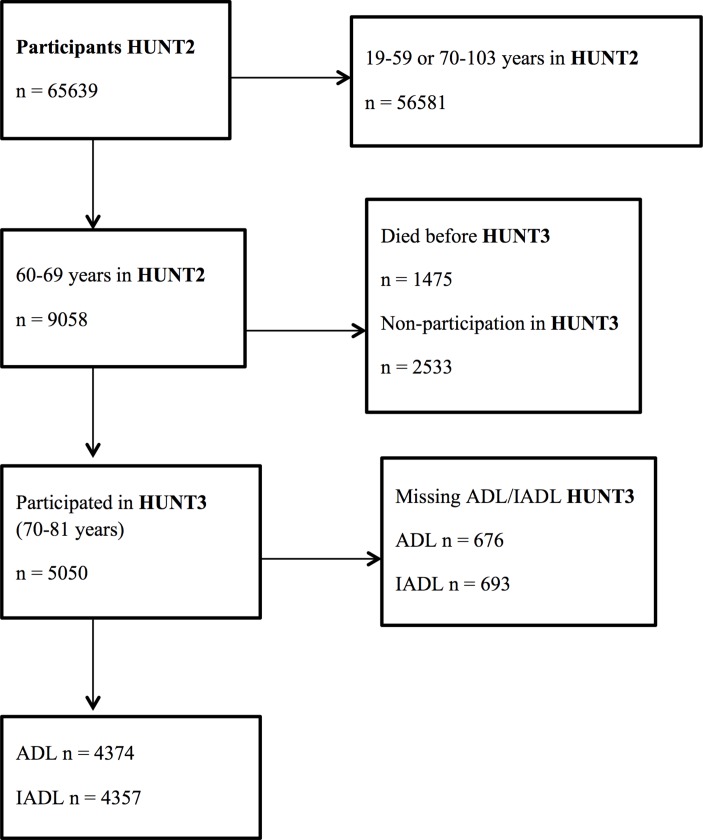
5050 individuals aged 60-69 years old at baseline in HUNT2 (1995-1997) who also participated in HUNT3 (2006-2008) were included in the study. 676/693 individuals were excluded in the analyses due to missing outcomes.
Needing assistance in one or more basic or instrumental activities of daily living reported in HUNT3.
In adjusted multinomial logistic regression analyses, poor self-rated health and depression were the strongest risk factors for needing assistance in one or more basic activities of daily living in HUNT3, with ORs of 2.13 (1.35 to 3.38) and 1.58 (0.91 to 2.73). Poor self-rated health and poor life satisfaction were the strongest risk factors for needing assistance in one or more instrumental activities of daily living in HUNT3, with ORs of 2.30 (1.93 to 2.74) and 2.29 (1.86 to 2.81), respectively. Excessive sitting time, short or prolonged sleeping time, and physical inactivity seemed to be the most important lifestyle risk factors for basic/instrumental activities of daily living (ADL/IADL) disability. The studied factors were, in general, greater risk factors for mortality during follow-up than for ADL/IADL disability. Smoking was the strongest risk factor for mortality during follow-up and non-participation in HUNT3. Smoking and low social participation were the strongest risk factors for non-participation in HUNT3.
Subjective health perception, life satisfaction and depression were the strongest risk factors for needing assistance in one or more basic/instrumental activities of daily living later in life. These factors could be possible targets for prevention purposes.
调查挪威老年人在基本和工具性日常生活活动中需要帮助的相关因素。
前瞻性队列研究。
挪威特隆赫姆郡健康研究(HUNT),一项基于人群的大型健康调查。
纳入了在HUNT2(1995 - 1997年)基线时年龄为60 - 69岁且也参与了HUNT3(2006 - 2008年)的5050名个体。分析中因结局数据缺失排除了676/693名个体。
HUNT3中报告的在一项或多项基本或工具性日常生活活动中需要帮助。
在调整后的多项逻辑回归分析中,自我健康评价差和抑郁是HUNT3中在一项或多项基本日常生活活动中需要帮助的最强风险因素,比值比分别为2.13(1.35至3.38)和1.58(0.91至2.73)。自我健康评价差和生活满意度低是HUNT3中在一项或多项工具性日常生活活动中需要帮助的最强风险因素,比值比分别为2.30(1.93至