Becher Paul G, Hagman Arne, Verschut Vasiliki, Chakraborty Amrita, Rozpędowska Elżbieta, Lebreton Sébastien, Bengtsson Marie, Flick Gerhard, Witzgall Peter, Piškur Jure
Department of Plant Protection Biology Swedish University of Agricultural Sciences Alnarp Sweden.
Department of Biology Lund University Lund Sweden.
Ecol Evol. 2018 Feb 14;8(5):2962-2974. doi: 10.1002/ece3.3905. eCollection 2018 Mar.
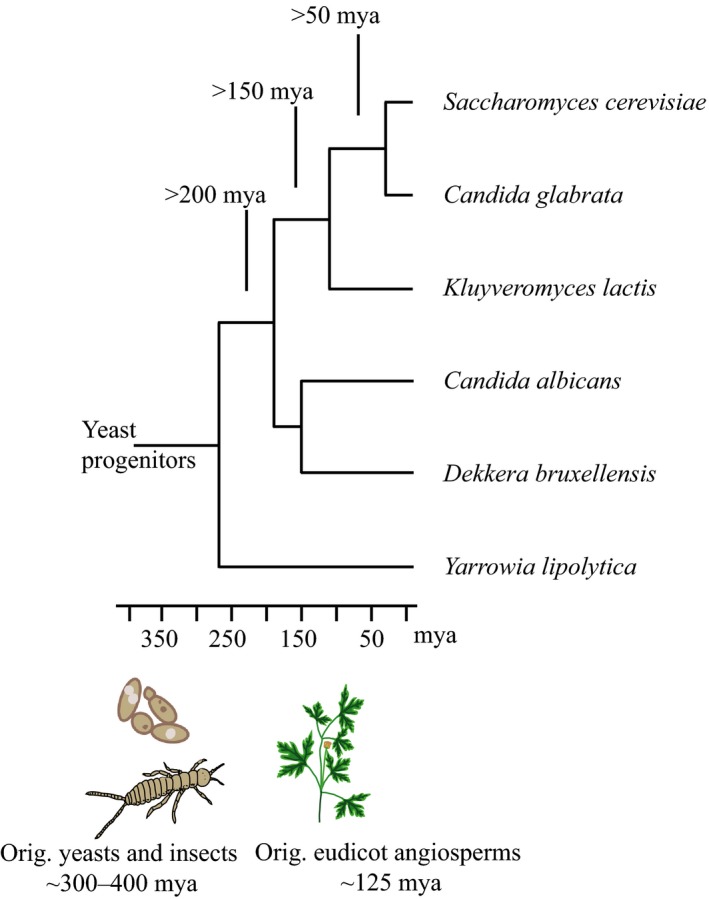
Yeast volatiles attract insects, which apparently is of mutual benefit, for both yeasts and insects. However, it is unknown whether biosynthesis of metabolites that attract insects is a basic and general trait, or if it is specific for yeasts that live in close association with insects. Our goal was to study chemical insect attractants produced by yeasts that span more than 250 million years of evolutionary history and vastly differ in their metabolism and lifestyle. We bioassayed attraction of the vinegar fly to odors of phylogenetically and ecologically distinct yeasts grown under controlled conditions. Baker's yeast , the insect-associated species , and , wine yeast , milk yeast , the vertebrate pathogens and , and oleophilic were screened for fly attraction in a wind tunnel. Yeast headspace was chemically analyzed, and co-occurrence of insect attractants in yeasts and flowering plants was investigated through a database search. In yeasts with known genomes, we investigated the occurrence of genes involved in the synthesis of key aroma compounds. Flies were attracted to all nine yeasts studied. The behavioral response to baker's yeast was independent of its growth stage. In addition to , we tested the basal hexapod (Collembola) in a Y-tube assay to the most ancient yeast, which proved that early yeast signals also function on clades older than neopteran insects. Behavioral and chemical data and a search for selected genes of volatile metabolites underline that biosynthesis of chemical signals is found throughout the yeast clade and has been conserved during the evolution of yeast lifestyles. Literature and database reviews corroborate that yeast signals mediate mutualistic interactions between insects and yeasts. Moreover, volatiles emitted by yeasts are commonly found also in flowers and attract many insect species. The collective evidence suggests that the release of volatile signals by yeasts is a widespread and phylogenetically ancient trait, and that insect-yeast communication evolved prior to the emergence of flowering plants. Co-occurrence of the same attractant signals in yeast and flowers suggests that yeast-insect communication may have contributed to the evolution of insect-mediated pollination in flowers.
酵母挥发物能吸引昆虫,这显然对酵母和昆虫双方都有互利之处。然而,吸引昆虫的代谢物生物合成是一种基本且普遍的特性,还是仅特定于与昆虫密切相关的酵母,目前尚不清楚。我们的目标是研究酵母产生的化学昆虫引诱剂,这些酵母跨越了超过2.5亿年的进化历史,其代谢和生活方式差异极大。我们对醋蝇对在受控条件下生长的系统发育和生态上不同的酵母气味的吸引力进行了生物测定。在风洞中筛选了面包酵母、与昆虫相关的物种、葡萄酒酵母、乳酵母、脊椎动物病原体以及嗜油酵母对苍蝇的吸引力。对酵母顶空进行了化学分析,并通过数据库搜索研究了酵母和开花植物中昆虫引诱剂的共现情况。在具有已知基因组的酵母中,我们研究了参与关键香气化合物合成的基因的存在情况。苍蝇被所研究的所有九种酵母吸引。对面包酵母的行为反应与其生长阶段无关。除了……,我们还在Y形管试验中测试了最古老的酵母对基础六足动物(弹尾目)的吸引力,这证明早期酵母信号对新翅类昆虫以外的进化分支也起作用。行为和化学数据以及对挥发性代谢物选定基因的搜索强调,化学信号的生物合成在整个酵母进化枝中都存在,并且在酵母生活方式的进化过程中一直保守。文献和数据库综述证实,酵母信号介导了昆虫与酵母之间的互利相互作用。此外,酵母释放的挥发物在花朵中也很常见,并吸引许多昆虫物种。综合证据表明,酵母释放挥发性信号是一种广泛且在系统发育上古老的特性,并且昆虫 - 酵母通讯在开花植物出现之前就已经进化。酵母和花朵中相同引诱剂信号的共现表明,酵母 - 昆虫通讯可能对花朵中昆虫介导的授粉进化做出了贡献。