Istituto Superiore di Sanità, 00161 Rome, Italy.
Institut Pasteur, 75015 Paris, France.
Int J Environ Res Public Health. 2018 Mar 10;15(3):489. doi: 10.3390/ijerph15030489.
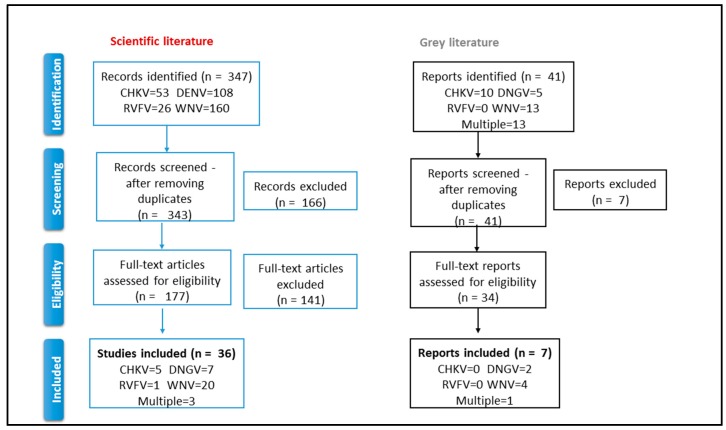
In the context of One Health, there is presently an effort to integrate surveillance of human, animal, entomological, and environmental sectors. This aims to strengthen the prevention of, and preparedness against, arbovirus infections, also in the light of environmental and climate changes that could increase the risk of transmission. However, criteria to define integrated surveillance, and to compare different systems, still need to be identified and tested. We conducted a scoping review to identify and examine surveillance systems for West Nile virus (WNV), chikungunya virus (CHKV), dengue virus (DENV), and Rift Valley fever virus (RVFV), which involve human, animal, entomological, and environmental sectors. We analyzed findings using a conceptual framework we developed for this purpose. The review highlights that the criteria proposed in the conceptual framework to describe integrated surveillance are consistently reported in the context of studies and programs related to integrated surveillance of the selected arboviral diseases. These criteria can facilitate the identification and description of operationalized One Health surveillance.
在大健康背景下,目前正在努力整合人类、动物、昆虫学和环境领域的监测。这旨在加强对虫媒病毒感染的预防和准备,同时考虑到环境和气候变化可能增加传播风险。然而,仍需要确定和测试定义综合监测以及比较不同系统的标准。我们进行了范围界定审查,以确定和检查涉及人类、动物、昆虫学和环境领域的西尼罗河病毒 (WNV)、基孔肯雅病毒 (CHKV)、登革热病毒 (DENV) 和裂谷热病毒 (RVFV) 的监测系统。我们使用为此目的开发的概念框架分析了研究结果。审查结果强调,在概念框架中提出的用于描述综合监测的标准在与选定虫媒病毒病综合监测相关的研究和计划中得到一致报告。这些标准可以促进确定和描述可操作的大健康监测。