Dente Maria Grazia, Riccardo Flavia, Bolici Francesco, Colella Nello Augusto, Jovanovic Verica, Drakulovic Mitra, Vasic Milena, Mamlouk Habiba, Maazaoui Latifa, Bejaoui Mondher, Zakhashvili Khatuna, Kalandadze Irine, Imnadze Paata, Declich Silvia
Istituto Superiore di Sanità, Roma, Italy.
University of Cassino, Cassino, Italy.
Zoonoses Public Health. 2019 May;66(3):276-287. doi: 10.1111/zph.12562. Epub 2019 Feb 5.
In the Mediterranean and Black Sea Region, arbovirus infections are emerging infectious diseases. Their surveillance can benefit from one health inter-sectoral collaboration; however, no standardized methodology exists to study One Health surveillance.
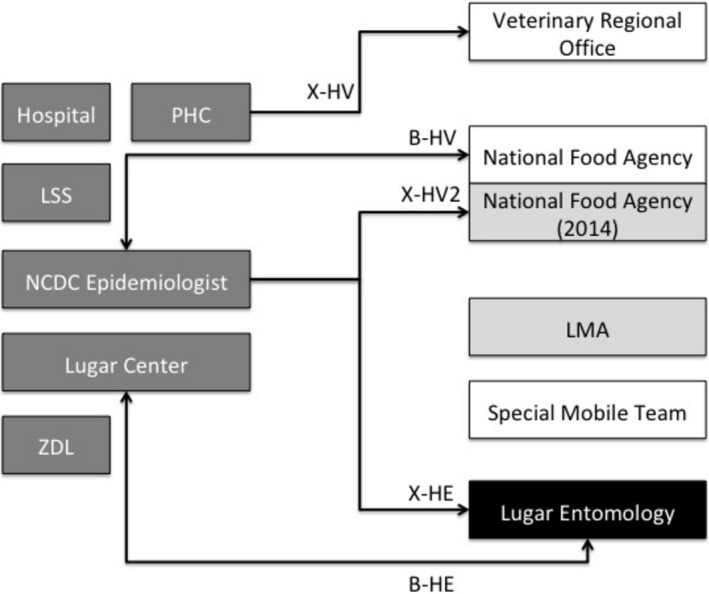
We designed a situation analysis study to document how integration of laboratory/clinical human, animal and entomological surveillance of arboviruses was being implemented in the Region. We applied a framework designed to assess three levels of integration: policy/institutional, data collection/data analysis and dissemination. We tested the use of Business Process Modelling Notation (BPMN) to graphically present evidence of inter-sectoral integration.
Serbia, Tunisia and Georgia participated in the study. West Nile Virus surveillance was analysed in Serbia and Tunisia, Crimea-Congo Haemorrhagic Fever surveillance in Georgia. Our framework enabled a standardized analysis of One Health surveillance integration, and BPMN was easily understandable and conducive to detailed discussions among different actors/institutions. In all countries, we observed integration across sectors and levels except in data collection and data analysis. Data collection was interoperable only in Georgia without integrated analysis. In all countries, surveillance was mainly oriented towards outbreak response, triggered by an index human case.
The three surveillance systems we observed prove that integrated surveillance can be operationalized with a diverse spectrum of options. However, in all countries, the integrated use of data for early warning and inter-sectoral priority setting is pioneeristic. We also noted that early warning before human case occurrence is recurrently not operationally prioritized.
在地中海和黑海地区,虫媒病毒感染是新兴传染病。其监测可受益于“同一健康”跨部门合作;然而,目前尚无标准化方法来研究“同一健康”监测。
我们设计了一项情况分析研究,以记录该地区如何实施虫媒病毒实验室/临床人类、动物和昆虫学监测的整合。我们应用了一个旨在评估三个整合层面的框架:政策/机构层面、数据收集/数据分析层面以及传播层面。我们测试了使用业务流程建模符号(BPMN)以图形方式呈现跨部门整合的证据。
塞尔维亚、突尼斯和格鲁吉亚参与了该研究。对塞尔维亚和突尼斯的西尼罗河病毒监测进行了分析,对格鲁吉亚的克里米亚 - 刚果出血热监测进行了分析。我们的框架实现了对“同一健康”监测整合的标准化分析,并且BPMN易于理解,有助于不同行为者/机构之间进行详细讨论。在所有国家,我们观察到除了数据收集和数据分析外,各部门和各层面均有整合。仅在格鲁吉亚数据收集具有互操作性,但缺乏综合分析。在所有国家,监测主要针对由首例人类病例引发的疫情应对。
我们观察到的这三个监测系统证明,综合监测可以通过多种不同选项来实施。然而,在所有国家,将数据用于早期预警和跨部门优先级设定的综合应用尚处于开拓阶段。我们还注意到,在人类病例出现之前的早期预警在实际操作中往往未被列为优先事项。