Department of Ophthalmology, Bascom Palmer Eye Institute, University of Miami School of Medicine, 1638 N.W. 10th Avenue, Miami, FL, 33136, USA.
Janssen Research & Development, LLC, San Diego, CA, 92121, USA.
J Transl Med. 2018 Mar 13;16(1):63. doi: 10.1186/s12967-018-1434-6.
Age-related macular degeneration (AMD) is a leading cause of blindness among the elderly characterized by retinal pigment epithelium (RPE) degeneration with accumulation of abnormal intracellular deposits (lipofuscin) and photoreceptor death. RPE is vital for the retina and integrity of photoreceptors through its phagocytic function which is closely linked to formation of lipofuscin through daily phagocytosis of discarded photoreceptor outer segments (POS). Although phagocytosis has been implicated in AMD, it has not been directly shown to be altered in AMD. RPE phagocytic defect was previously shown to be rescued by subretinal injection of human umbilical tissue derived cells (hUTC) in a rodent model of retinal degeneration (RCS rat) through receptor tyrosine kinase (RTK) ligands and bridge molecules. Here, we examined RPE phagocytic function directly in the RPE from AMD patients and the ability and mechanisms of hUTC to affect phagocytosis in the human RPE.
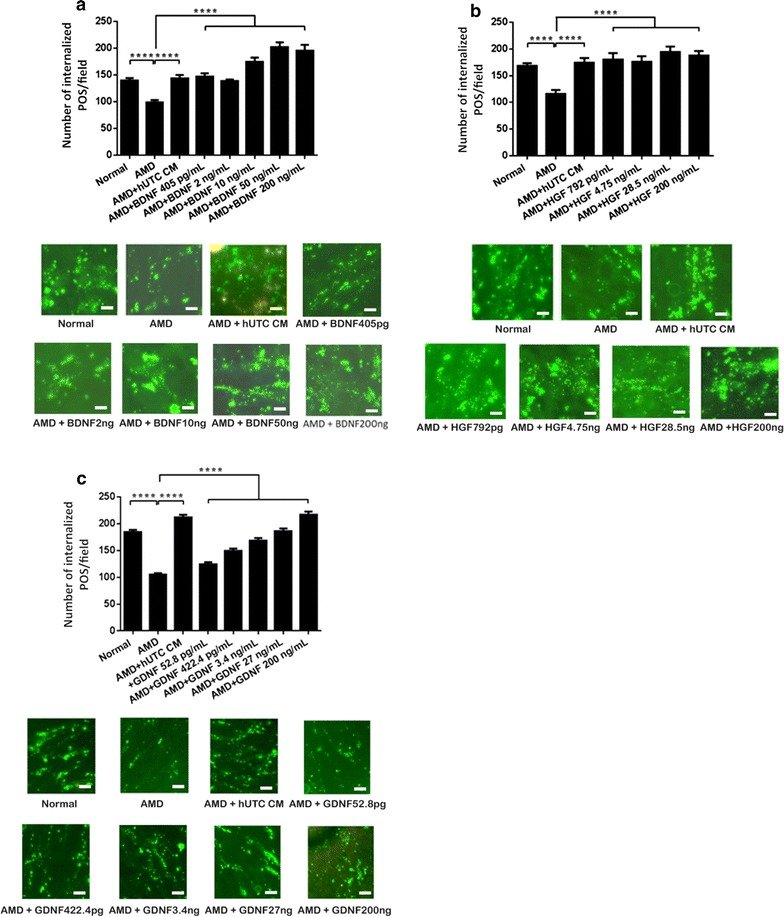
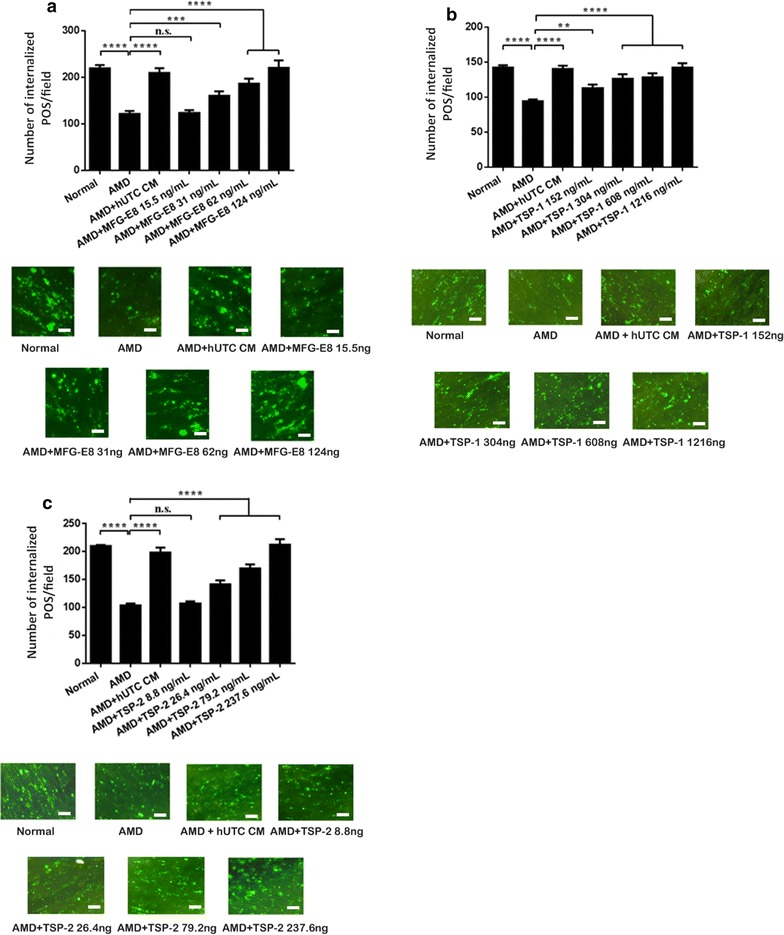
Human RPE was isolated from the post-mortem eyes of normal and AMD-affected subjects and cultured. RPE phagocytic function was measured in vitro using isolated POS. The effects of hUTC conditioned media, recombinant RTK ligands brain-derived neurotrophic factor (BDNF), hepatocyte growth factor (HGF), and glial cell-derived neurotrophic factor (GDNF), as well as bridge molecules milk-fat-globule-EGF-factor 8 (MFG-E8), thrombospondin (TSP)-1, and TSP-2 on phagocytosis were also examined in phagocytosis assays using isolated POS. RNA was isolated from normal and AMD RPE treated with hUTC conditioned media and subjected to transcriptome profiling by RNA-Seq and computational analyses.
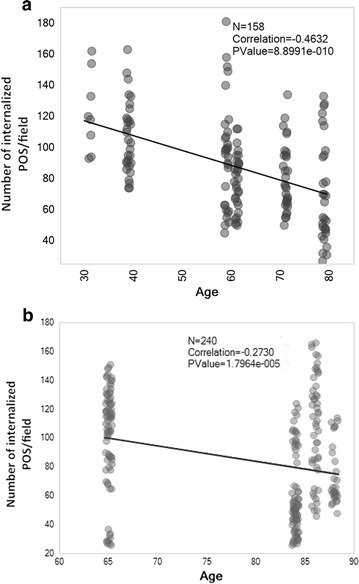
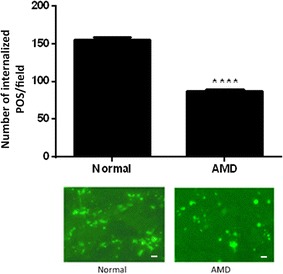
RPE phagocytosis, while showing a moderate decline with age, was significantly reduced in AMD RPE, more than expected for age. hUTC conditioned media stimulated phagocytosis in the normal human RPE and significantly rescued the phagocytic dysfunction in the AMD RPE. RTK ligands and bridge molecules duplicated the rescue effect. Moreover, multiple molecular pathways involving phagocytosis, apoptosis, oxidative stress, inflammation, immune activation, and cholesterol transport were affected by hUTC in the RPE.
We demonstrated for the first time RPE phagocytic dysfunction in AMD, highlighting its likely importance in AMD, and the ability of hUTC to correct this dysfunction, providing insights into the therapeutic potential of hUTC for AMD.
年龄相关性黄斑变性(AMD)是老年人失明的主要原因,其特征是视网膜色素上皮(RPE)退化,异常细胞内沉积物(脂褐素)积累和光感受器死亡。RPE 通过其吞噬功能对视网膜和光感受器的完整性至关重要,该功能与通过每日吞噬废弃的光感受器外节(POS)形成脂褐素密切相关。尽管吞噬作用与 AMD 有关,但尚未直接证明 AMD 中存在吞噬作用的改变。先前在视网膜变性的啮齿动物模型(RCS 大鼠)中通过受体酪氨酸激酶(RTK)配体和桥接分子,已经证明 RPE 吞噬缺陷可以通过视网膜下注射人脐带组织衍生细胞(hUTC)得到挽救。在这里,我们直接在 AMD 患者的 RPE 中检查 RPE 的吞噬功能,并研究 hUTC 影响人 RPE 吞噬作用的能力和机制。
从正常和 AMD 受影响的受试者的死后眼睛中分离出人 RPE 并进行培养。通过分离的 POS 在体外测量 RPE 的吞噬功能。使用分离的 POS 在吞噬作用测定中还检查了 hUTC 条件培养基,重组 RTK 配体脑源性神经营养因子(BDNF),肝细胞生长因子(HGF)和胶质细胞衍生的神经营养因子(GDNF)以及桥接分子乳脂肪球 EGF 因子 8(MFG-E8),血栓素(TSP)-1 和 TSP-2 对吞噬作用的影响。用 hUTC 条件培养基处理正常和 AMD RPE 后,从 RNA 中分离 RNA,并通过 RNA-Seq 和计算分析进行转录组分析。
尽管 RPE 的吞噬作用随年龄增长而适度下降,但在 AMD RPE 中却明显降低,超出了年龄的预期。hUTC 条件培养基刺激正常人 RPE 的吞噬作用,并显着挽救了 AMD RPE 的吞噬功能障碍。RTK 配体和桥接分子复制了挽救作用。此外,涉及吞噬作用,细胞凋亡,氧化应激,炎症,免疫激活和胆固醇转运的多种分子途径在 RPE 中受到 hUTC 的影响。
我们首次证明了 AMD 中 RPE 的吞噬功能障碍,突出了其在 AMD 中的重要性,以及 hUTC 纠正这种功能障碍的能力,为 hUTC 治疗 AMD 的潜力提供了见解。