• 文献检索
  • 文档翻译
  • 深度研究
  • 学术资讯
  • Suppr Zotero 插件Zotero 插件
  • 邀请有礼
  • 套餐&价格
  • 历史记录
应用&插件
Suppr Zotero 插件Zotero 插件浏览器插件Mac 客户端Windows 客户端微信小程序
定价
高级版会员购买积分包购买API积分包
服务
文献检索文档翻译深度研究API 文档MCP 服务
关于我们
关于 Suppr公司介绍联系我们用户协议隐私条款
关注我们

Suppr 超能文献

核心技术专利:CN118964589B侵权必究
粤ICP备2023148730 号-1Suppr @ 2026

文献检索

告别复杂PubMed语法,用中文像聊天一样搜索,搜遍4000万医学文献。AI智能推荐,让科研检索更轻松。

立即免费搜索

文件翻译

保留排版,准确专业,支持PDF/Word/PPT等文件格式,支持 12+语言互译。

免费翻译文档

深度研究

AI帮你快速写综述,25分钟生成高质量综述,智能提取关键信息,辅助科研写作。

立即免费体验

浅度和深度水肺潜水对心率变异性的影响。

Effect of Shallow and Deep SCUBA Dives on Heart Rate Variability.

作者信息

Noh Yeonsik, Posada-Quintero Hugo F, Bai Yan, White Joseph, Florian John P, Brink Peter R, Chon Ki H

机构信息

Department of Electrical and Computer Engineering, College of Nursing, University of Massachusetts, Amherst, MA, United States.

Department of Biomedical Engineering, University of Connecticut, Storrs, CT, United States.

出版信息

Front Physiol. 2018 Feb 27;9:110. doi: 10.3389/fphys.2018.00110. eCollection 2018.

DOI:10.3389/fphys.2018.00110
PMID:29535634
原文链接:https://pmc.ncbi.nlm.nih.gov/articles/PMC5835073/
Abstract

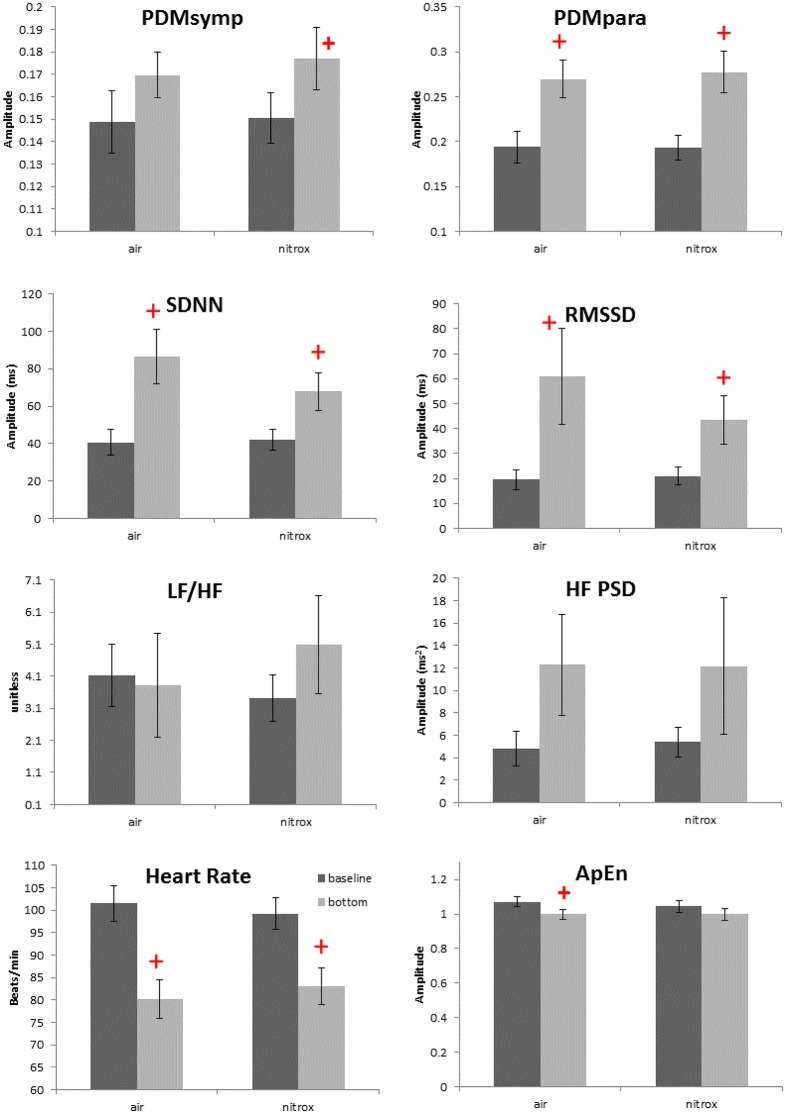
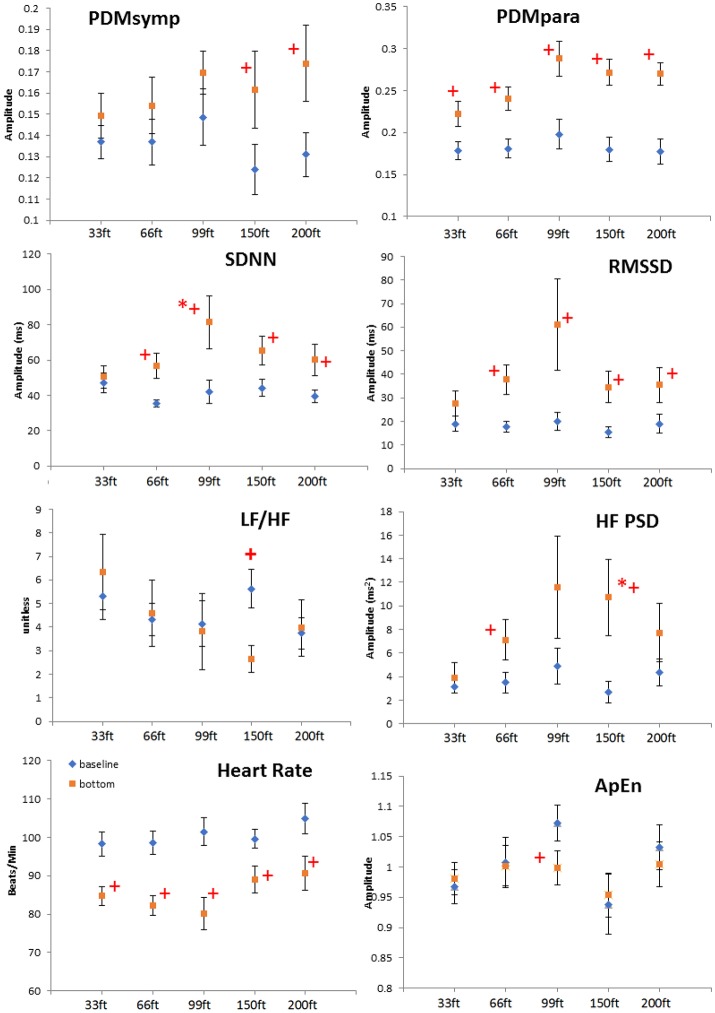
Prolonged and high pressure diving may lead to various physiological changes including significant alterations of autonomic nervous system (ANS) activity that may be associated with altered physical performance, decompression sickness, or central nervous system oxygen toxicity. Ideally, researchers could elucidate ANS function before, during, and after dives that are most associated with altered function and adverse outcomes. However, we have a limited understanding of the activities of the ANS especially during deeper prolonged SCUBA diving because there has never been a convenient way to collect physiological data during deep dives. This work is one of the first studies which was able to collect electrocardiogram (ECG) data from SCUBA divers at various depths (33, 66, 99, 150, and 200 ftsw; equivalent to 10.05, 20.10, 30.17, 45.72, and 60.96 m of salt water, respectively) breathing different gas mixtures (air, nitrox and trimix). The aim of this study was to shed light on cardiac ANS behavior during dives, including deep dives. With the aid of dry suits, a Holter monitor that could handle the pressure of a 200 ft. dive, and a novel algorithm that can provide a useful assessment of the ANS from the ECG signal, we investigated the effects of SCUBA dives with different time durations, depths and gas mixtures on the ANS. Principal dynamic mode (PDM) analysis of the ECG, which has been shown to provide accurate separation of the sympathetic and parasympathetic dynamics, was employed to assess the difference of ANS behavior between baseline and diving conditions of varying depths and gas mixtures consisting of air, nitrox and trimix. For all depths and gas mixtures, we found consistent dominance in the parasympathetic activity and a concomitant increase of the parasympathetic dynamics with increasing diving duration and depth. For 33 and 66 ft. dives, we consistently found significant decreases in heart rates (HR) and concomitant increases in parasympathetic activities as estimated via the PDM and root mean square of successive differences (RMSSD) for all time intervals (from the first 5 min to the last 30 min) at the bottom depth when compared to the baseline depth at sea level. The sympathetic dynamics did not change with dive duration or gas mixtures, but at the 150 and 200 ft. dives, we found a significant increase in the sympathetic dynamics in addition to the elevated parasympathetic dynamics when compared to baseline The power spectral density (PSD) measures such as the low frequency (LF), high frequency (HF) and its ratio, and approximate entropy (ApEn) indices were not as consistent when compared to PDM-derived parasympathetic dynamics and RMSSD index.

摘要

长时间高压潜水可能导致各种生理变化,包括自主神经系统(ANS)活动的显著改变,这可能与身体机能改变、减压病或中枢神经系统氧中毒有关。理想情况下,研究人员可以在与功能改变和不良后果最相关的潜水之前、期间和之后阐明ANS功能。然而,我们对ANS的活动了解有限,尤其是在更深的长时间水肺潜水中,因为在深潜过程中从未有过方便的方法来收集生理数据。这项工作是首批能够从水肺潜水员在不同深度(33、66、99、150和200英尺海水深度;分别相当于10.05、20.10、30.17、45.72和60.96米的盐水深度)呼吸不同气体混合物(空气、氮氧混合气和 Trimix 混合气)时收集心电图(ECG)数据的研究之一。本研究的目的是阐明潜水期间,包括深潜期间心脏ANS的行为。借助干式潜水服、能够承受200英尺潜水压力的动态心电图监测仪以及一种可以从ECG信号中对ANS进行有效评估的新算法,我们研究了不同时长、深度和气体混合物的水肺潜水对ANS的影响。采用已被证明能准确分离交感和副交感神经动力学的ECG主动态模式(PDM)分析,来评估在不同深度以及由空气、氮氧混合气和Trimix混合气组成的气体混合物的潜水条件下,基线与潜水条件之间ANS行为的差异。对于所有深度和气体混合物,我们发现副交感神经活动始终占主导地位,并且随着潜水时长和深度的增加,副交感神经动力学随之增加。对于33英尺和66英尺的潜水,与海平面基线深度相比,我们始终发现,在所有时间间隔(从最初5分钟到最后30分钟)的海底深度,通过PDM和逐次差值均方根(RMSSD)估计的心率(HR)显著下降,同时副交感神经活动增加。交感神经动力学不会随潜水时长或气体混合物而变化,但在150英尺和200英尺的潜水时,与基线相比,除了副交感神经动力学升高外,我们还发现交感神经动力学显著增加。与基于PDM得出的副交感神经动力学和RMSSD指数相比,诸如低频(LF)、高频(HF)及其比值以及近似熵(ApEn)指数等功率谱密度(PSD)测量结果并不那么一致。
https://cdn.ncbi.nlm.nih.gov/pmc/blobs/6a50/5835073/b3ab4830c4fb/fphys-09-00110-g0003.jpg
https://cdn.ncbi.nlm.nih.gov/pmc/blobs/6a50/5835073/ed814893c6dd/fphys-09-00110-g0001.jpg
https://cdn.ncbi.nlm.nih.gov/pmc/blobs/6a50/5835073/bba489493b53/fphys-09-00110-g0002.jpg
https://cdn.ncbi.nlm.nih.gov/pmc/blobs/6a50/5835073/b3ab4830c4fb/fphys-09-00110-g0003.jpg
https://cdn.ncbi.nlm.nih.gov/pmc/blobs/6a50/5835073/ed814893c6dd/fphys-09-00110-g0001.jpg
https://cdn.ncbi.nlm.nih.gov/pmc/blobs/6a50/5835073/bba489493b53/fphys-09-00110-g0002.jpg
https://cdn.ncbi.nlm.nih.gov/pmc/blobs/6a50/5835073/b3ab4830c4fb/fphys-09-00110-g0003.jpg

相似文献

1
Effect of Shallow and Deep SCUBA Dives on Heart Rate Variability.浅度和深度水肺潜水对心率变异性的影响。
Front Physiol. 2018 Feb 27;9:110. doi: 10.3389/fphys.2018.00110. eCollection 2018.
2
Risk mitigation in divers with persistent (patent) foramen ovale.卵圆孔未闭潜水员的风险降低
Diving Hyperb Med. 2019 Jun 30;49(2):77-78. doi: 10.28920/dhm49.2.77-78.
3
Autonomic Nervous System characterization in hyperbaric environments considering respiratory component and non-linear analysis of Heart Rate Variability.考虑呼吸成分和心率变异性的非线性分析的高压环境中的自主神经系统特征。
Comput Methods Programs Biomed. 2022 Feb;214:106527. doi: 10.1016/j.cmpb.2021.106527. Epub 2021 Nov 19.
4
Depth of SCUBA Diving Affects Cardiac Autonomic Nervous System.水肺潜水深度影响心脏自主神经系统。
Pathophysiology. 2024 Mar 29;31(2):183-189. doi: 10.3390/pathophysiology31020014.
5
The impact of consecutive freshwater trimix dives at altitude on human cardiovascular function.在高海拔地区连续进行淡水三混气体潜水对人体心血管功能的影响。
Clin Physiol Funct Imaging. 2015 Mar;35(2):142-9. doi: 10.1111/cpf.12139. Epub 2014 Feb 16.
6
Does oxygen-enriched air better than normal air improve sympathovagal balance in recreational divers?An open-water study.富氧空气是否优于普通空气改善休闲潜水者的交感神经迷走神经平衡?一项开放水域研究。
Res Sports Med. 2020 Jul-Sep;28(3):397-412. doi: 10.1080/15438627.2019.1694930. Epub 2019 Nov 24.
7
Effects of successive air and nitrox dives on human vascular function.连续空气潜水和氮氧混合气潜水对人体血管功能的影响。
Eur J Appl Physiol. 2012 Jun;112(6):2131-7. doi: 10.1007/s00421-011-2187-6. Epub 2011 Oct 1.
8
Effects of prolonged and repeated immersions on heart rate variability and complexity in military divers.长时间反复潜水对军事潜水员心率变异性和复杂性的影响。
Undersea Hyperb Med. 2017 Nov-Dec;44(6):589-600. doi: 10.22462/11.12.2017.10.
9
The autonomic effects of cardiopulmonary decompression sickness in swine using principal dynamic mode analysis.心肺减压病对猪自主神经影响的主动力学模式分析。
Am J Physiol Regul Integr Comp Physiol. 2013 Oct 1;305(7):R748-58. doi: 10.1152/ajpregu.00150.2012. Epub 2013 Jul 24.
10
Quantifying cardiac sympathetic and parasympathetic nervous activities using principal dynamic modes analysis of heart rate variability.利用心率变异性的主要动态模式分析量化心脏交感神经和副交感神经活动。
Am J Physiol Heart Circ Physiol. 2006 Sep;291(3):H1475-83. doi: 10.1152/ajpheart.00005.2006. Epub 2006 Apr 7.

引用本文的文献

1
Autonomic and physiological stress responses in navy divers: the protective role of diving experience.海军潜水员的自主神经和生理应激反应:潜水经验的保护作用。
Front Physiol. 2025 Aug 18;16:1642779. doi: 10.3389/fphys.2025.1642779. eCollection 2025.
2
Physiological monitoring to prevent diving disorders.预防潜水疾病的生理监测。
Front Physiol. 2024 Dec 18;15:1517361. doi: 10.3389/fphys.2024.1517361. eCollection 2024.
3
Does Heart Rate Variability Predict Impairment of Operational Performance in Divers?心率变异性能否预测潜水员操作性能的损害?

本文引用的文献

1
Effects of prolonged and repeated immersions on heart rate variability and complexity in military divers.长时间反复潜水对军事潜水员心率变异性和复杂性的影响。
Undersea Hyperb Med. 2017 Nov-Dec;44(6):589-600. doi: 10.22462/11.12.2017.10.
2
Human Physiology in an Aquatic Environment.水生环境中的人体生理学。
Compr Physiol. 2015 Sep 20;5(4):1705-50. doi: 10.1002/cphy.c140018.
3
Inner ear decompression sickness in scuba divers: a review of 115 cases.潜水员内耳减压病:115 例病例回顾。
Sensors (Basel). 2024 Dec 3;24(23):7726. doi: 10.3390/s24237726.
4
Depth of SCUBA Diving Affects Cardiac Autonomic Nervous System.水肺潜水深度影响心脏自主神经系统。
Pathophysiology. 2024 Mar 29;31(2):183-189. doi: 10.3390/pathophysiology31020014.
5
Enhancing Safety in Hyperbaric Environments through Analysis of Autonomic Nervous System Responses: A Comparison of Dry and Humid Conditions.通过分析自主神经系统反应提高高压环境安全性:干燥和潮湿条件的比较。
Sensors (Basel). 2023 Jun 2;23(11):5289. doi: 10.3390/s23115289.
6
A systematic review of HRV during diving in very cold water.极寒水中潜水时心率变异性的系统回顾。
Int J Circumpolar Health. 2023 Dec;82(1):2203369. doi: 10.1080/22423982.2023.2203369.
7
Pulmonary Effects of One Week of Repeated Recreational Closed-Circuit Rebreather Dives in Cold Water.一周内反复在冷水环境中进行休闲闭路循环呼吸器潜水对肺部的影响。
Medicina (Kaunas). 2022 Dec 30;59(1):81. doi: 10.3390/medicina59010081.
8
Prolonged Extreme Cold Water Diving and the Acute Stress Response During Military Dive Training.军事潜水训练中的长时间极冷水潜水与急性应激反应
Front Physiol. 2022 Jul 8;13:842612. doi: 10.3389/fphys.2022.842612. eCollection 2022.
9
Response to: Correspondence on 'Cardiovascular considerations for scuba divers' by Wilmshurst .对威尔姆肖斯特所著《水肺潜水员的心血管考量》的通信回复。
Heart. 2022 Aug 11;108(17):1416-1418. doi: 10.1136/heartjnl-2022-321527.
10
Diving Responses in Experienced Rebreather Divers: Short-Term Heart Rate Variability in Cold Water Diving.经验丰富的循环呼吸器潜水员的潜水反应:冷水潜水中的短期心率变异性
Front Physiol. 2021 Apr 7;12:649319. doi: 10.3389/fphys.2021.649319. eCollection 2021.
Eur Arch Otorhinolaryngol. 2013 May;270(6):1831-7. doi: 10.1007/s00405-012-2233-y. Epub 2012 Oct 26.
4
Risks factors for recurrent neurological decompression sickness in recreational divers: a case-control study.休闲潜水员复发性神经减压病的风险因素:一项病例对照研究。
J Sports Med Phys Fitness. 2012 Oct;52(5):530-6.
5
Estimation of respiratory rate from ECG, photoplethysmogram, and piezoelectric pulse transducer signals: a comparative study of time-frequency methods.从心电图、光电容积脉搏波和压电脉搏传感器信号估算呼吸率:时频方法的比较研究。
IEEE Trans Biomed Eng. 2010 May;57(5):1099-107. doi: 10.1109/TBME.2009.2038226.
6
Heart rate variability responses to a psychologically challenging scuba dive.心率变异性对心理挑战性水肺潜水的反应。
J Sports Med Phys Fitness. 2009 Dec;49(4):382-6.
7
Estimation of respiratory rate from photoplethysmogram data using time-frequency spectral estimation.使用时频谱估计从光电容积脉搏波图数据估计呼吸频率。
IEEE Trans Biomed Eng. 2009 Aug;56(8):2054-63. doi: 10.1109/TBME.2009.2019766. Epub 2009 Apr 14.
8
Dominance in cardiac parasympathetic activity during real recreational SCUBA diving.在实际休闲水肺潜水过程中心脏副交感神经活动的优势地位。
Eur J Appl Physiol. 2009 Jun;106(3):345-52. doi: 10.1007/s00421-009-1010-0. Epub 2009 Mar 11.
9
Impairment of the autonomic nervous function during decompression sickness in swine.猪减压病期间自主神经功能的损害
J Appl Physiol (1985). 2009 Mar;106(3):1004-9. doi: 10.1152/japplphysiol.91246.2008. Epub 2009 Jan 8.
10
Bubble trouble: a review of diving physiology and disease.气泡问题:潜水生理学与疾病综述
Postgrad Med J. 2008 Nov;84(997):571-8. doi: 10.1136/pgmj.2008.068320.