Centre for Military Medicine, Finnish Defence Forces, Helsinki, Finland.
Finnish Defence Research Agency, Finnish Defence Forces, Järvenpää, Finland.
Int J Circumpolar Health. 2023 Dec;82(1):2203369. doi: 10.1080/22423982.2023.2203369.
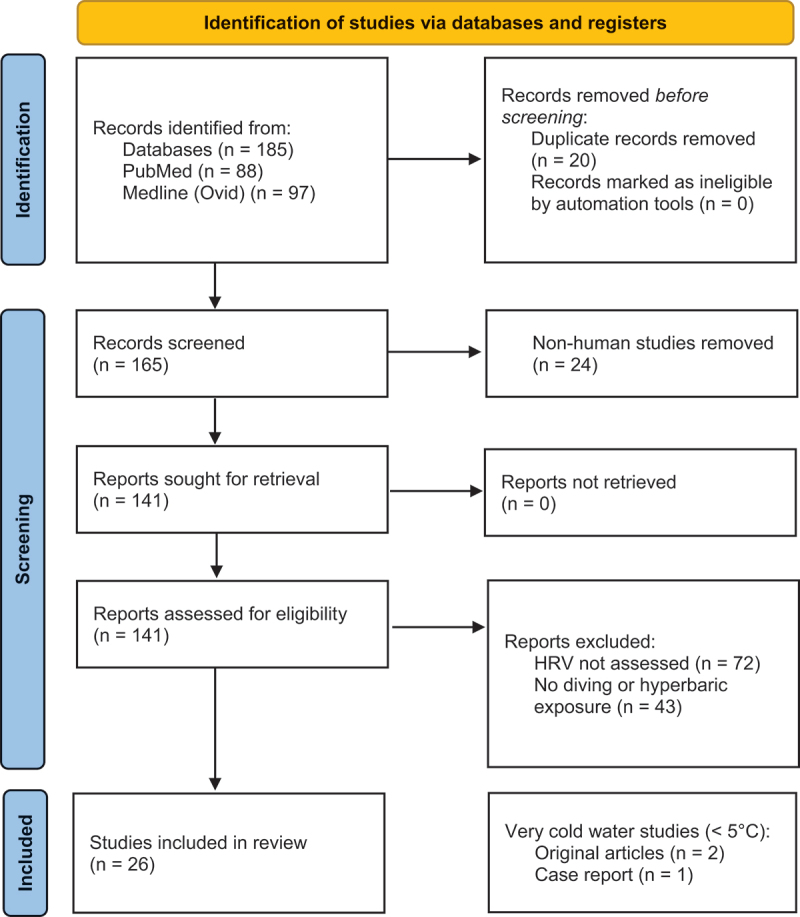
Heart rate variability (HRV) is a useful method to study the autonomic nervous system (ANS) status. As measuring devices have developed and become smaller, many researchers have become interested in the possibilities to implement the method for diving medicine research. The aim of this study was to review human ANS responses in cold water diving (water temperature <5°C), and to comprise the current knowledge of HRV studies in diving and hyperbaric exposure into one review article. A literature search was conducted on 5 December 2022, with the search terms "HRV" or "heart rate variability" and "diving" or "diver" or "divers", with search functions of the data bases PubMed and Ovid Medline. Peer reviewed original articles, review articles and case reports were accepted to this review. Twenty-six articles met the pre-defined criteria and were included in this review. Studies from very cold water conditions were rare, but suggested that cold strengthens the ANS responses of diving - especially parasympathetic nervous system (PNS) activity due to the trigeminocardiac reflex and baroreceptor and cardiac stretch receptor activity, caused cold and pressure-induced centralisation of the blood. Overall, studies showed predominant PNS activity when putting the face in water, during immersion and when ambient pressure increased.
心率变异性(HRV)是研究自主神经系统(ANS)状态的一种有用方法。随着测量设备的发展和小型化,许多研究人员对将该方法应用于潜水医学研究的可能性产生了兴趣。本研究旨在综述冷水潜水(水温<5°C)时人体 ANS 反应,并将 HRV 在潜水和高压暴露研究中的现有知识综合在一篇综述文章中。于 2022 年 12 月 5 日进行文献检索,检索词为“HRV”或“心率变异性”和“潜水”或“潜水员”或“潜水”,使用 PubMed 和 Ovid Medline 数据库的检索功能。接受了同行评审的原始文章、综述文章和案例报告。有 26 篇文章符合预先设定的标准,并被纳入本综述。来自极冷水条件的研究很少,但表明冷水会增强潜水时的 ANS 反应-特别是由于三叉神经心脏反射和压力感受器以及心脏拉伸感受器活动引起的副交感神经系统(PNS)活动,导致寒冷和压力引起的血液集中化。总体而言,研究表明,当面部浸入水中、浸入水中和环境压力增加时,PNS 活动占主导地位。