Schilling Megan A, Katani Robab, Memari Sahar, Cavanaugh Meredith, Buza Joram, Radzio-Basu Jessica, Mpenda Fulgence N, Deist Melissa S, Lamont Susan J, Kapur Vivek
Huck Institutes of the Life Sciences, Pennsylvania State University, University Park, PA, United States.
Department of Animal Science, Pennsylvania State University, University Park, PA, United States.
Front Genet. 2018 Feb 27;9:61. doi: 10.3389/fgene.2018.00061. eCollection 2018.
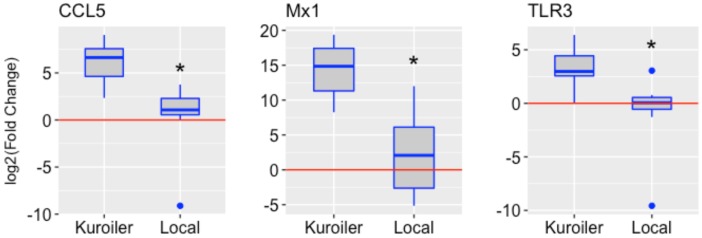
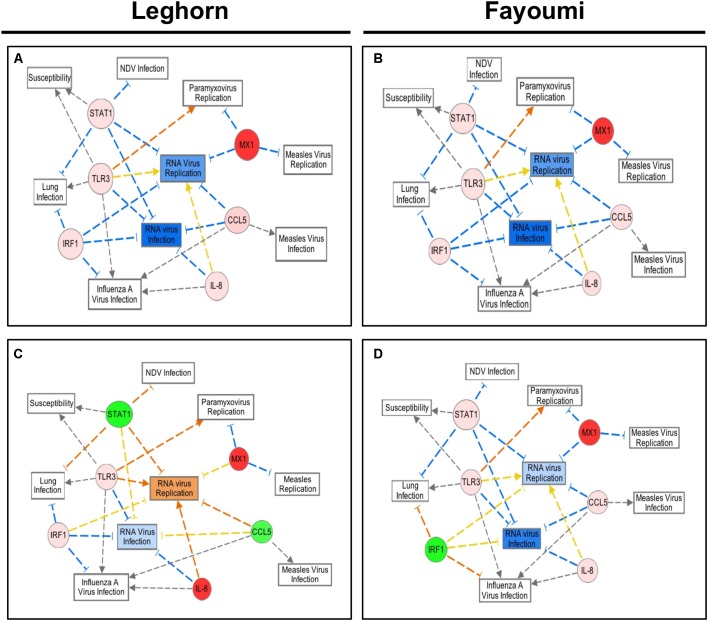
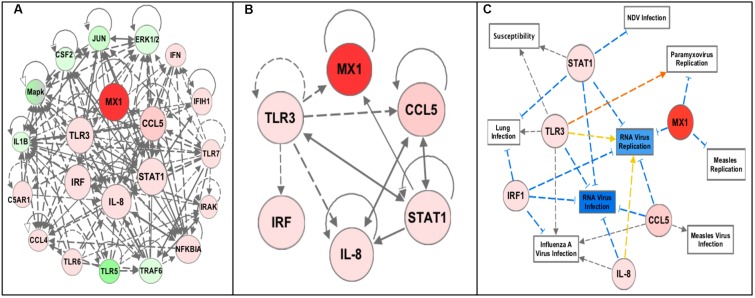
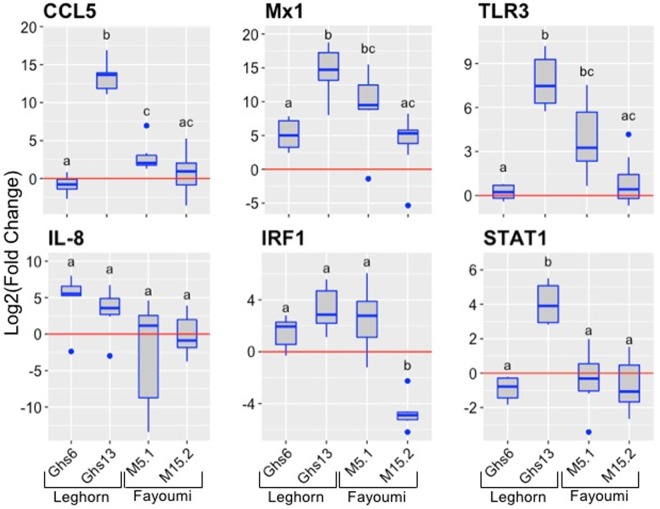
Traditional approaches to assess the immune response of chickens to infection are through animal trials, which are expensive, require enhanced biosecurity, compromise welfare, and are frequently influenced by confounding variables. Since the chicken embryo becomes immunocompetent prior to hatch, we here characterized the transcriptional response of selected innate immune genes to Newcastle disease virus (NDV) infection in chicken embryos at days 10, 14, and 18 of embryonic development. The results suggest that the innate immune response 72 h after challenge of 18-day chicken embryo is both consistent and robust. The expression of CCL5, Mx1, and TLR3 in lung tissues of NDV challenged chicken embryos from the outbred Kuroiler and Tanzanian local ecotype lines showed that their expression was several orders of magnitude higher in the Kuroiler than in the local ecotypes. Next, the expression patterns of three additional innate-immunity related genes, IL-8, IRF-1, and STAT1, were examined in the highly congenic Fayoumi (M5.1 and M15.2) and Leghorn (Ghs6 and Ghs13) sublines that differ only at the microchromosome bearing the major histocompatibility locus. The results show that the Ghs13 Leghorn subline had a consistently higher expression of all genes except IL-8 and expression seemed to be subline-dependent rather than breed-dependent, suggesting that the innate immune response of chicken embryos to NDV infection may be genetically controlled by the MHC-locus. Taken together, the results suggest that the chicken embryo may represent a promising model to studying the patterns and sources of variation of the avian innate immune response to infection with NDV and related pathogens.
评估鸡对感染的免疫反应的传统方法是通过动物试验,这种方法成本高昂,需要加强生物安全措施,会损害动物福利,并且经常受到混杂变量的影响。由于鸡胚胎在孵化前就具有免疫能力,我们在此对胚胎发育第10天、14天和18天的鸡胚胎中选定的先天免疫基因对新城疫病毒(NDV)感染的转录反应进行了表征。结果表明,18日龄鸡胚胎在受到攻击72小时后的先天免疫反应既一致又强烈。对来自杂交库罗伊勒鸡和坦桑尼亚当地生态型品系的NDV攻击鸡胚胎的肺组织中CCL5、Mx1和TLR3的表达分析表明,它们在库罗伊勒鸡中的表达比当地生态型鸡高几个数量级。接下来,在仅在携带主要组织相容性位点的微染色体上存在差异的高度近交的法尤米(M5.1和M15.2)和来航鸡(Ghs6和Ghs13)亚系中,检测了另外三个与先天免疫相关基因IL-8、IRF-1和STAT1的表达模式。结果表明,除IL-8外,Ghs13来航鸡亚系中所有基因的表达一直较高,而且表达似乎依赖于亚系而非品种,这表明鸡胚胎对NDV感染的先天免疫反应可能由MHC位点进行基因控制。综上所述,结果表明鸡胚胎可能是研究禽类对NDV和相关病原体感染的先天免疫反应的模式和变异来源的一个有前景的模型。