Gennaro Federico, de Bruin Eling D
Institute of Human Movement Sciences and Sport, Department of Health Sciences and Technology, ETH Zurich, Zurich, Switzerland.
Division of Physiotherapy, Department of Neurobiology, Care Sciences and Society, Karolinska Institutet, Stockholm, Sweden.
Front Public Health. 2018 Feb 26;6:39. doi: 10.3389/fpubh.2018.00039. eCollection 2018.
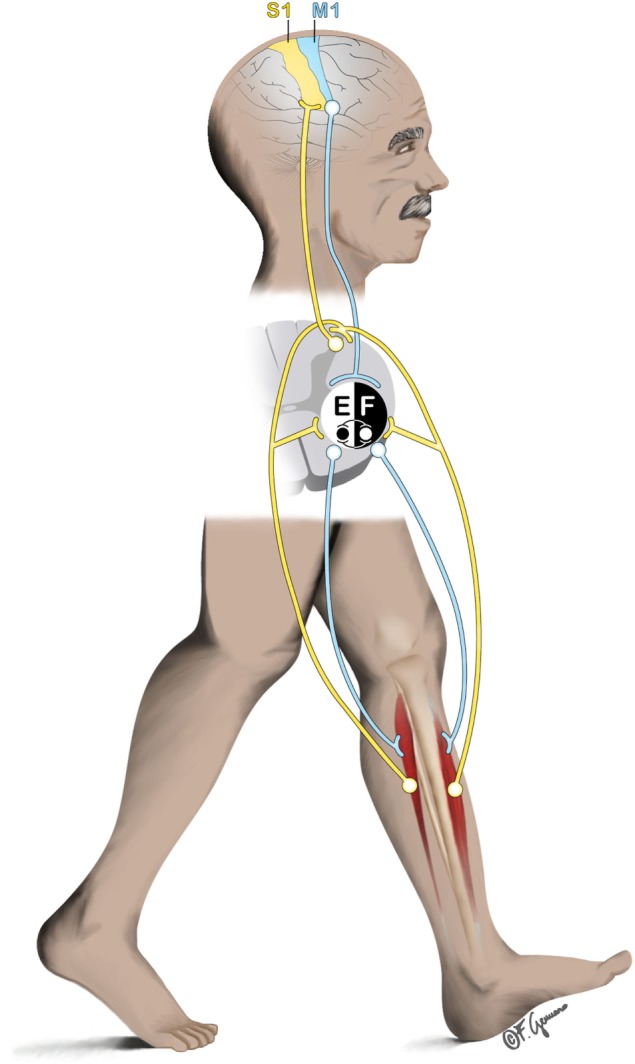
Assessment of the cortical role during bipedalism has been a methodological challenge. While surface electroencephalography (EEG) is capable of non-invasively measuring cortical activity during human locomotion, it is associated with movement artifacts obscuring cerebral sources of activity. Recently, statistical methods based on blind source separation revealed potential for resolving this issue, by segregating non-cerebral/artifactual from cerebral sources of activity. This step marked a new opportunity for the investigation of the brains' role while moving and was tagged mobile brain/body imaging (MoBI). This methodology involves simultaneous mobile recording of brain activity with several other body behavioral variables (e.g., muscle activity and kinematics), through wireless recording wearable devices/sensors. Notably, several MoBI studies using EEG-EMG approaches recently showed that the brain is functionally connected to the muscles and active throughout the whole gait cycle and, thus, rejecting the long-lasting idea of a solely spinal-driven bipedalism. However, MoBI and brain/muscle connectivity assessments during human locomotion are still in their fledgling state of investigation. Mobile brain/body imaging approaches hint toward promising opportunities; however, there are some remaining pitfalls that need to be resolved before considering their routine clinical use. This article discusses several of these pitfalls and proposes research to address them. Examples relate to the validity, reliability, and reproducibility of this method in ecologically valid scenarios and in different populations. Furthermore, whether brain/muscle connectivity within the MoBI framework represents a potential biomarker in neuromuscular syndromes where gait disturbances are evident (e.g., age-related sarcopenia) remains to be determined.
评估双足行走过程中皮质的作用一直是一个方法学上的挑战。虽然表面脑电图(EEG)能够在人类运动过程中无创地测量皮质活动,但它与运动伪影相关,会掩盖活动的脑源。最近,基于盲源分离的统计方法显示了通过将非脑源性/伪影性活动源与脑源性活动源分离来解决这一问题的潜力。这一步骤为研究运动时大脑的作用带来了新机会,并被标记为移动脑/体成像(MoBI)。这种方法涉及通过无线记录可穿戴设备/传感器同时移动记录大脑活动以及其他几个身体行为变量(如肌肉活动和运动学)。值得注意的是,最近几项使用EEG-EMG方法的MoBI研究表明,大脑在功能上与肌肉相连,并且在整个步态周期中都处于活跃状态,因此,摒弃了长期以来认为双足行走仅由脊髓驱动的观点。然而,人类运动过程中的MoBI以及脑/肌肉连接性评估仍处于初步研究阶段。移动脑/体成像方法暗示了有前景的机会;然而,在考虑将其常规临床应用之前,仍有一些遗留的缺陷需要解决。本文讨论了其中的几个缺陷,并提出了应对这些缺陷的研究。示例涉及该方法在生态有效场景和不同人群中的有效性、可靠性和可重复性。此外,MoBI框架内的脑/肌肉连接性是否代表步态障碍明显的神经肌肉综合征(如与年龄相关的肌肉减少症)中的潜在生物标志物仍有待确定。