Tortora Stefano, Tonin Luca, Chisari Carmelo, Micera Silvestro, Menegatti Emanuele, Artoni Fiorenzo
Department of Information Engineering, University of Padova, Padova, Italy.
Unit of Neurorehabilitation, Department of Medical Specialties, University Hospital of Pisa, Pisa, Italy.
Front Neurorobot. 2020 Nov 17;14:582728. doi: 10.3389/fnbot.2020.582728. eCollection 2020.
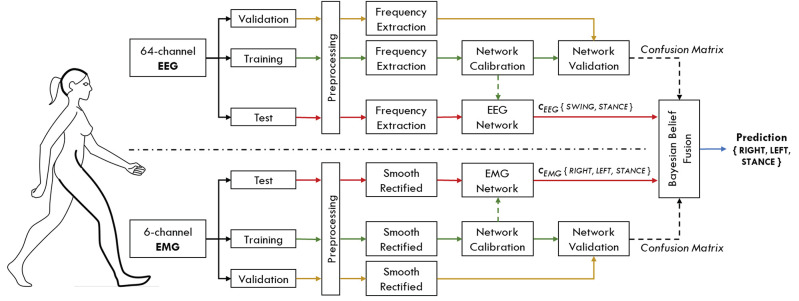
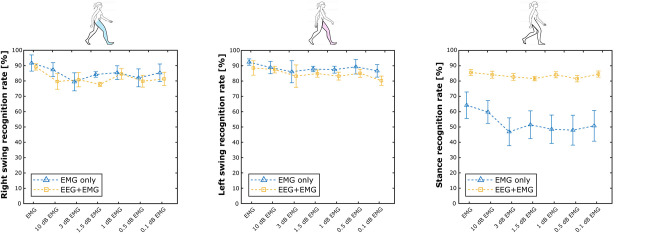
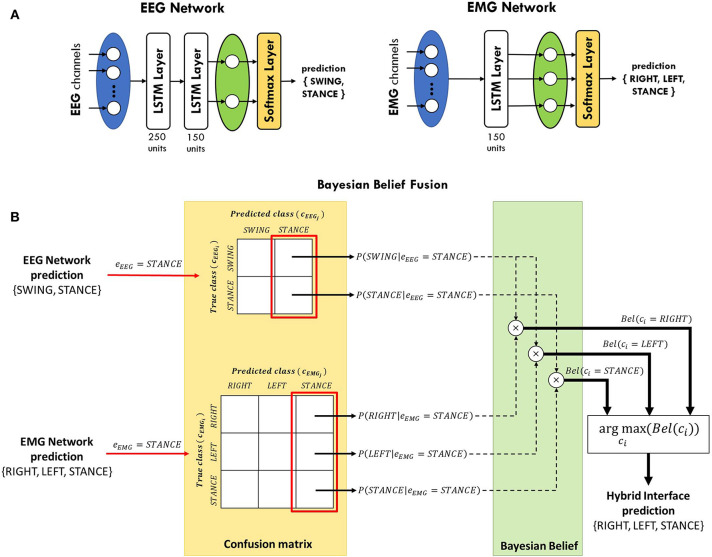
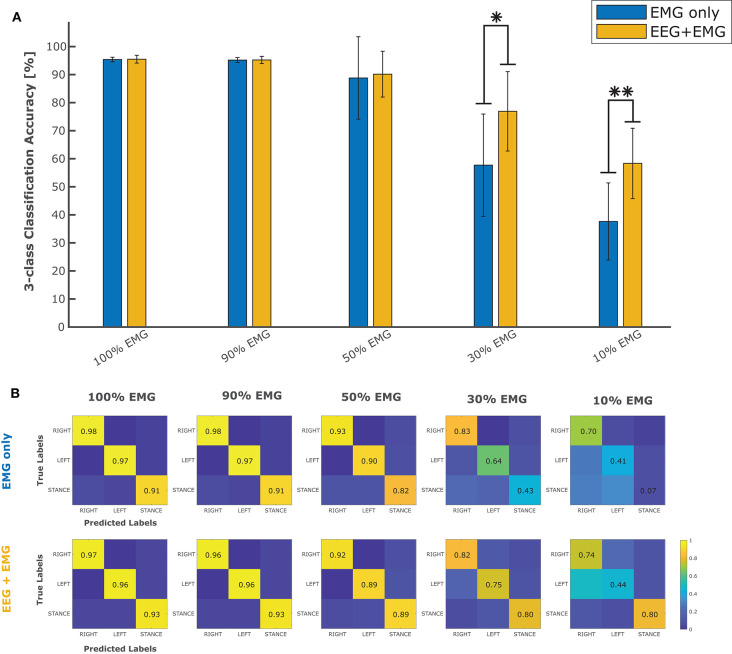
Despite the advances in the field of brain computer interfaces (BCI), the use of the sole electroencephalography (EEG) signal to control walking rehabilitation devices is currently not viable in clinical settings, due to its unreliability. Hybrid interfaces (hHMIs) represent a very recent solution to enhance the performance of single-signal approaches. These are classification approaches that combine multiple human-machine interfaces, normally including at least one BCI with other biosignals, such as the electromyography (EMG). However, their use for the decoding of gait activity is still limited. In this work, we propose and evaluate a hybrid human-machine interface (hHMI) to decode walking phases of both legs from the Bayesian fusion of EEG and EMG signals. The proposed hHMI significantly outperforms its single-signal counterparts, by providing high and stable performance even when the reliability of the muscular activity is compromised temporarily (e.g., fatigue) or permanently (e.g., weakness). Indeed, the hybrid approach shows a smooth degradation of classification performance after temporary EMG alteration, with more than 75% of accuracy at 30% of EMG amplitude, with respect to the EMG classifier whose performance decreases below 60% of accuracy. Moreover, the fusion of EEG and EMG information helps keeping a stable recognition rate of each gait phase of more than 80% independently on the permanent level of EMG degradation. From our study and findings from the literature, we suggest that the use of hybrid interfaces may be the key to enhance the usability of technologies restoring or assisting the locomotion on a wider population of patients in clinical applications and outside the laboratory environment.
尽管脑机接口(BCI)领域取得了进展,但由于其不可靠性,目前在临床环境中仅使用脑电图(EEG)信号来控制步行康复设备并不可行。混合接口(hHMI)是一种非常新的解决方案,用于提高单信号方法的性能。这些是将多个人机接口相结合的分类方法,通常包括至少一个BCI与其他生物信号,如肌电图(EMG)。然而,它们在步态活动解码方面的应用仍然有限。在这项工作中,我们提出并评估了一种混合人机接口(hHMI),用于从EEG和EMG信号的贝叶斯融合中解码双腿的步行阶段。所提出的hHMI显著优于其单信号对应物,即使在肌肉活动的可靠性暂时(例如疲劳)或永久(例如虚弱)受损时,也能提供高且稳定的性能。实际上,混合方法在临时EMG改变后显示出分类性能的平稳下降,在EMG幅度为30%时准确率超过75%,而EMG分类器的性能下降到准确率低于60%。此外,EEG和EMG信息的融合有助于在EMG退化的永久水平上独立地保持每个步态阶段超过80%的稳定识别率。根据我们的研究以及文献中的发现,我们建议使用混合接口可能是提高技术在临床应用和实验室环境之外恢复或辅助更广泛患者群体运动的可用性的关键。