Department of International Medicine, Geriatric Disease Research Institute, Tianjin Hospital, Tianjin, 300211, China.
Department of Traditional Chinese Medicine, Tianjin Medical University General Hospital, Tianjin, 300070, China.
Arthritis Res Ther. 2018 Mar 14;20(1):43. doi: 10.1186/s13075-018-1547-6.
Traditional Chinese medicine (TCM) formula Bi-Qi capsule (Bi-Qi) is a commonly prescribed drug to treat rheumatoid arthritis (RA). However, the mechanism of Bi-Qi-mediated amelioration of RA pathogenesis is still a mystery. Collagen induced arthritis (CIA) in rats is an established model that shares many similarities with RA in humans. In this study we investigated the effect of Bi-Qi on the pathogenesis of CIA in rats.
CIA was developed in Sprague-Dawley (S.D) rats (n = 60, female) and used as a model resembling RA in humans. Rats were treated with a high or moderate dose of Bi-Qi, or methotrexate (MTX). Effects of the treatment on local joint and systemic inflammation, synovial hyperplasia, cartilage destruction, and other main features in the pathogenesis of CIA were analyzed.
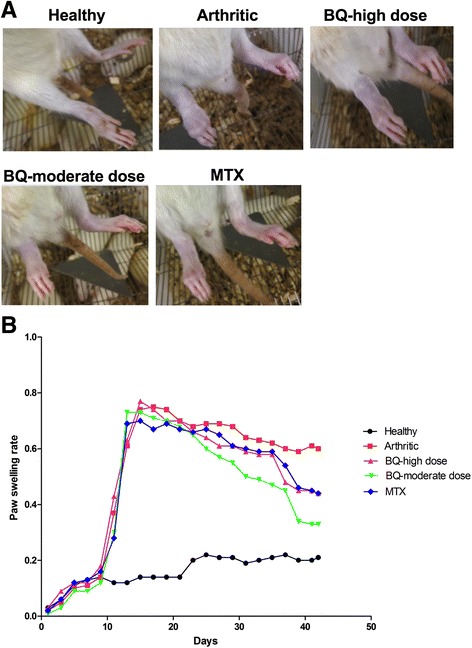
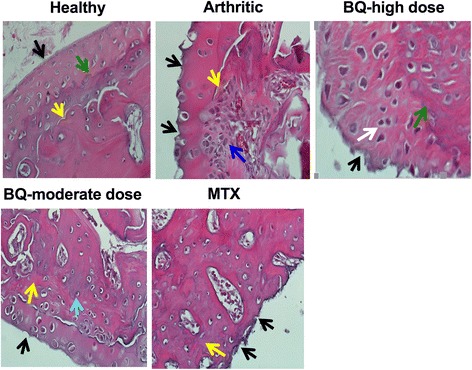
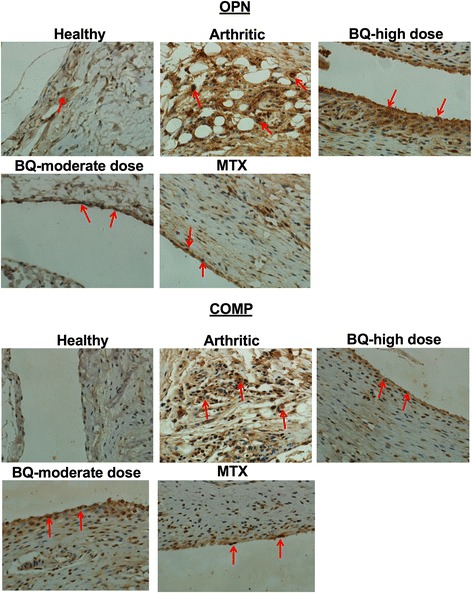
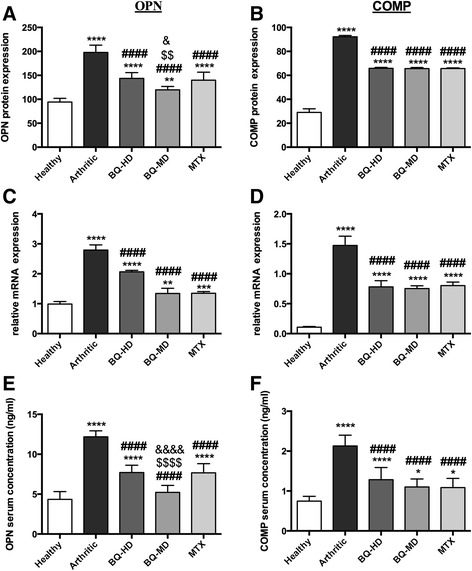
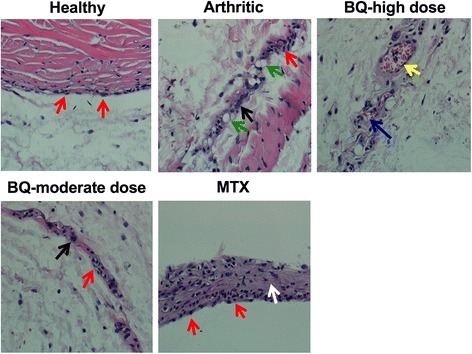
Inflamed and swollen ankles and joints were observed in arthritic rats, while Bi-Qi or MTX treatment alleviated these symptoms. Only the Bi-Qi moderate dose decreased RA-induced serum levels of tumor necrosis factor-alpha (TNF-α). Both Bi-Qi and MTX reduced the interleukin (IL)-18 serum level. Protein levels of cartilage oligomeric matrix protein and osteopontin in serum, synovium, and cartilage were elevated in arthritic rats, while Bi-Qi alleviated these effects. Synovial hyperplasia, inflammatory cell infiltration in synovium and a high degree of cartilage degradation was observed in RA, and Bi-Qi or MTX alleviated this effect. Bi-Qi at the moderate dose was the most effective in mitigating CIA-related clinical complications.
Our findings showed that Bi-Qi alleviates CIA-induced inflammation, synovial hyperplasia, cartilage destruction, and the other main features in the pathogenesis of CIA. This provides fundamental evidence for the anti-arthritic properties of Bi-Qi and corroborates the use of Bi-Qi TCM formula for the treatment of RA.
中药方剂芪痹胶囊(芪痹)是一种常用于治疗类风湿关节炎(RA)的药物。然而,芪痹介导的 RA 发病机制改善的机制仍不清楚。胶原诱导性关节炎(CIA)在大鼠中是一种已建立的模型,与人类的 RA 有许多相似之处。在这项研究中,我们研究了芪痹对 CIA 大鼠发病机制的影响。
用胶原诱导的关节炎(CIA)在 Sprague-Dawley(S.D)大鼠(n = 60,雌性)中建立模型,并用作类似于人类 RA 的模型。大鼠用高剂量或中剂量的芪痹或甲氨蝶呤(MTX)治疗。分析治疗对局部关节和全身炎症、滑膜增生、软骨破坏等 CIA 发病机制的主要特征的影响。
关节炎大鼠出现红肿和肿胀的踝关节和关节,而芪痹或 MTX 治疗可缓解这些症状。只有芪痹中剂量降低了 RA 诱导的肿瘤坏死因子-α(TNF-α)血清水平。芪痹和 MTX 均降低了白细胞介素(IL)-18 血清水平。在关节炎大鼠中,血清、滑膜和软骨中的软骨寡聚基质蛋白和骨桥蛋白蛋白水平升高,而芪痹可缓解这些作用。滑膜增生、滑膜中炎症细胞浸润和软骨高度降解在 RA 中观察到,芪痹或 MTX 可缓解这些作用。芪痹中剂量在减轻 CIA 相关临床并发症方面最为有效。
我们的研究结果表明,芪痹可减轻 CIA 诱导的炎症、滑膜增生、软骨破坏和 CIA 发病机制的其他主要特征。这为芪痹的抗关节炎特性提供了基本证据,并证实了芪痹中药方剂治疗 RA 的用途。