Shorey Shefaly, Chee Cornelia, Chong Yap-Seng, Ng Esperanza Debby, Lau Ying, Dennis Cindy-Lee
National University of Singapore, Singapore, Singapore.
National University Hospital, Singapore, Singapore.
JMIR Res Protoc. 2018 Mar 14;7(3):e81. doi: 10.2196/resprot.9416.
Multiple international agencies, including the World Health Organization and the International Monetary Fund, have emphasized the importance of maternal mental health for optimal child health and development. Adequate social support is vital for the most vulnerable to postpartum mood disorders. Hence, an urgent need for sustainable social support programs to aid mothers ease into their new parenting role exists.
This study protocol aims to examine the effectiveness of a technology-based peer support intervention program among mothers at risk for postnatal depression in the early postpartum period.
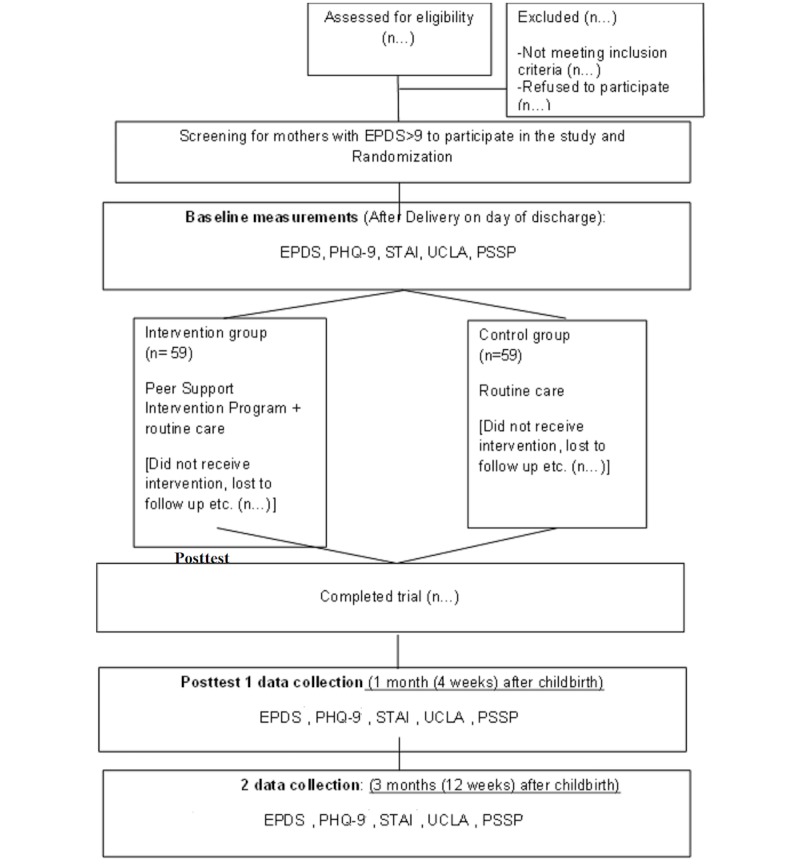
A randomized controlled 2-group pretest and repeated posttest experimental design will be used. The study will recruit 118 mothers from the postnatal wards of a tertiary public hospital in Singapore. Eligible mothers will be randomly allocated to receive either the peer support intervention program or routine perinatal care from the hospital. Peer volunteers will be mothers who have experienced self-reported depression and will be receiving face-to-face training to support new mothers at risk of depression. Outcome measures include postnatal depression, anxiety, loneliness, and social support. Data will be collected at immediate postnatal period (day of discharge from the hospital), at fourth week and twelfth week post childbirth.
The recruitment and training of peer support volunteers (N=20) ended in June 2017, whereas recruitment of study participants commenced in July 2017 and is still ongoing. The current recruitment for new mothers stands at 73, with 36 in the control group and 37 in the intervention group. Data collection is projected to be completed by May 2018.
This study will identify a potentially effective and clinically useful method to prevent postnatal depression in new mothers, which is the top cause of maternal morbidity. Receiving social support from others who share similar experiences may enhance the positive parenting experiences of mothers, which in turn can improve the psychosocial well-being of the mothers, tighten mother-child bond, and enhance overall family dynamics for mothers and infants.
International Standard Randomized Controlled Trial Number ISRCTN14864807; http://www.isrctn.com/ISRCTN14864807 (Archived by WebCite at http://www.webcitation.org/6xtBNvBTX).
包括世界卫生组织和国际货币基金组织在内的多个国际机构强调了孕产妇心理健康对儿童最佳健康和发育的重要性。充足的社会支持对于最易患产后情绪障碍的人群至关重要。因此,迫切需要可持续的社会支持项目来帮助母亲轻松适应新的育儿角色。
本研究方案旨在检验一项基于技术的同伴支持干预项目对产后早期有产后抑郁风险的母亲的有效性。
将采用随机对照两组前测和重复后测的实验设计。该研究将从新加坡一家三级公立医院的产后病房招募118名母亲。符合条件的母亲将被随机分配接受同伴支持干预项目或医院的常规围产期护理。同伴志愿者将是那些自我报告有抑郁症经历的母亲,她们将接受面对面培训以支持有抑郁风险的新妈妈。结果指标包括产后抑郁、焦虑、孤独感和社会支持。数据将在产后即刻(出院日)、产后第四周和第十二周收集。
同伴支持志愿者(N = 20)的招募和培训于2017年6月结束,而研究参与者的招募于2017年7月开始,目前仍在进行中。目前新妈妈的招募人数为73人,其中对照组36人,干预组37人。数据收集预计于2018年5月完成。
本研究将确定一种潜在有效且临床有用的方法来预防新妈妈产后抑郁,产后抑郁是孕产妇发病的首要原因。从有相似经历的人那里获得社会支持可能会增强母亲积极的育儿体验,这反过来又可以改善母亲的心理社会幸福感,加强母婴纽带,并改善母婴的整体家庭动态。
国际标准随机对照试验编号ISRCTN14864807;http://www.isrctn.com/ISRCTN14864807(由WebCite存档于http://www.webcitation.org/6xtBNvBTX)