Department of Psychiatry, School of Medicine, Wonkwang University, Iksan, Korea.
Research and Administrative Team, Seoul National University Bundang Hospital, Seongnam, Korea.
J Korean Med Sci. 2018 Mar 19;33(12):e88. doi: 10.3346/jkms.2018.33.e88.
Mindfulness-based art therapy (MBAT) induces emotional relaxation in coronary artery disease (CAD) patients, and is a treatment known to improve psychological stability. The objective of this study was to evaluate the treatment effects of MBAT for CAD patients.
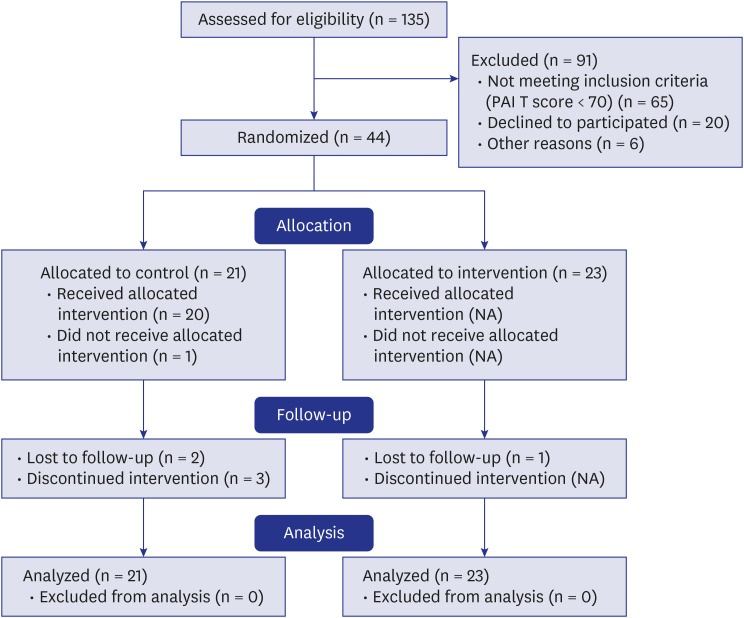
A total of 44 CAD patients were selected as participants, 21 patients belonged to a MBAT group, and 23 patients belonged to the control group. The patients in the MBAT group were given 12 sessions of treatments. To measure depression and anxiety, Beck Depression Inventory (BDI) and Trait Anxiety Inventory (TAI) were used. Anger and anger expression were evaluated using the State Trait Anger Expression Inventory (STAXI). The treatment results were analyzed using two-way repeated measures analysis of variance (ANOVA).
The results showed that significant effects for groups, time, and interaction in the depression (interaction effect, [F(1,36) = 23.15, P < 0.001]; between groups, [F(1,36) = 5.73, P = 0.022]), trait anxiety (interaction effect, [F(1,36) = 13.23, P < 0.001]; between groups, [F(1,36) = 4.38, P = 0.043]), state anger (interaction effect, [F(1,36) = 5.60, P = 0.023]), trait anger (interaction effect, [F(1,36) = 6.93, P = 0.012]; within group, [F(1,36) = 4.73, P = 0.036]), anger control (interaction effect, [F(1,36) = 8.41, P = 0.006]; within group, [F(1,36) = 9.41, P = 0.004]), anger out (interaction effect, [F(1,36) = 6.88, P = 0.012]; within group, [F(1,36) = 13.17, P < 0.001]; between groups, [F(1,36) = 5.62, P = 0.023]), and anger in (interaction effect, [F(1,36) = 32.66, P < 0.001]; within group, [F(1,36) = 25.90, P < 0.001]; between groups, [F(1,36) = 12.44, P < 0.001]).
MBAT can be seen as an effective treatment method that improves CAD patients' psychological stability. Evaluation of treatment effects using program development and large-scale research for future clinical application is needed.
基于正念的艺术治疗(MBAT)可诱导冠状动脉疾病(CAD)患者的情绪放松,是一种已知可改善心理稳定性的治疗方法。本研究的目的是评估 MBAT 对 CAD 患者的治疗效果。
共选择 44 名 CAD 患者作为参与者,其中 21 名患者属于 MBAT 组,23 名患者属于对照组。MBAT 组患者接受 12 次治疗。使用贝克抑郁量表(BDI)和特质焦虑量表(TAI)来衡量抑郁和焦虑。使用状态特质愤怒表达量表(STAXI)评估愤怒和愤怒表达。使用双因素重复测量方差分析(ANOVA)分析治疗结果。
结果显示,组间、时间和交互作用在抑郁(交互作用效应,[F(1,36) = 23.15,P < 0.001];组间,[F(1,36) = 5.73,P = 0.022])、特质焦虑(交互作用效应,[F(1,36) = 13.23,P < 0.001];组间,[F(1,36) = 4.38,P = 0.043])、状态愤怒(交互作用效应,[F(1,36) = 5.60,P = 0.023])、特质愤怒(交互作用效应,[F(1,36) = 6.93,P = 0.012];组内,[F(1,36) = 4.73,P = 0.036])、愤怒控制(交互作用效应,[F(1,36) = 8.41,P = 0.006];组内,[F(1,36) = 9.41,P = 0.004])、愤怒表达(交互作用效应,[F(1,36) = 6.88,P = 0.012];组内,[F(1,36) = 13.17,P < 0.001];组间,[F(1,36) = 5.62,P = 0.023])和愤怒内隐(交互作用效应,[F(1,36) = 32.66,P < 0.001];组内,[F(1,36) = 25.90,P < 0.001];组间,[F(1,36) = 12.44,P < 0.001])方面均有显著效果。
MBAT 可被视为一种有效的治疗方法,可改善 CAD 患者的心理稳定性。需要通过方案开发和大规模研究来评估治疗效果,以便未来临床应用。