Zheng Qiong, Huang Wenjiang, Cui Ximin, Shi Yue, Liu Linyi
College of Geoscience and Surveying Engineering, China University of Mining and Technology (Beijing), Beijing 100083, China.
Key Laboratory of Digital Earth Science, Institute of Remote Sensing and Digital Earth, Chinese Academy of Sciences, Beijing 100094, China.
Sensors (Basel). 2018 Mar 15;18(3):868. doi: 10.3390/s18030868.
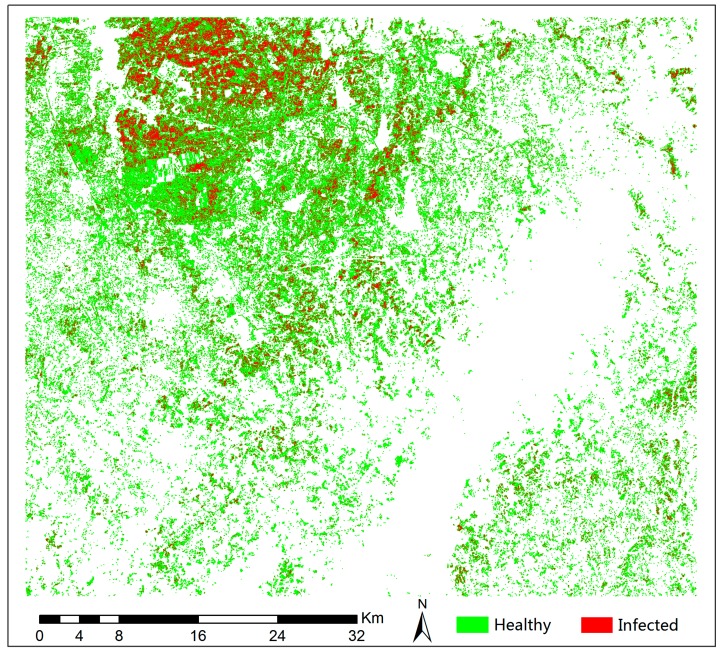
Yellow rust is one of the most destructive diseases for winter wheat and has led to a significant decrease in winter wheat quality and yield. Identifying and monitoring yellow rust is of great importance for guiding agricultural production over large areas. Compared with traditional crop disease discrimination methods, remote sensing technology has proven to be a useful tool for accomplishing such a task at large scale. This study explores the potential of the Sentinel-2 Multispectral Instrument (MSI), a newly launched satellite with refined spatial resolution and three red-edge bands, for discriminating between yellow rust infection severities (i.e., healthy, slight, and severe) in winter wheat. The corresponding simulative multispectral bands for the Sentinel-2 sensor were calculated by the sensor's relative spectral response (RSR) function based on the in situ hyperspectral data acquired at the canopy level. Three Sentinel-2 spectral bands, including B4 (Red), B5 (Re1), and B7 (Re3), were found to be sensitive bands using the random forest (RF) method. A new multispectral index, the Red Edge Disease Stress Index (REDSI), which consists of these sensitive bands, was proposed to detect yellow rust infection at different severity levels. The overall identification accuracy for REDSI was 84.1% and the kappa coefficient was 0.76. Moreover, REDSI performed better than other commonly used disease spectral indexes for yellow rust discrimination at the canopy scale. The optimal threshold method was adopted for mapping yellow rust infection at regional scales based on realistic Sentinel-2 multispectral image data to further assess REDSI's ability for yellow rust detection. The overall accuracy was 85.2% and kappa coefficient was 0.67, which was found through validation against a set of field survey data. This study suggests that the Sentinel-2 MSI has the potential for yellow rust discrimination, and the newly proposed REDSI has great robustness and generalized ability for yellow rust detection at canopy and regional scales. Furthermore, our results suggest that the above remote sensing technology can be used to provide scientific guidance for monitoring and precise management of crop diseases and pests.
条锈病是冬小麦最具毁灭性的病害之一,已导致冬小麦品质和产量大幅下降。识别和监测条锈病对于指导大面积农业生产至关重要。与传统的作物病害判别方法相比,遥感技术已被证明是在大规模上完成这项任务的有用工具。本研究探讨了新发射的具有精细空间分辨率和三个红边波段的哨兵 - 2多光谱仪器(MSI)在区分冬小麦条锈病感染严重程度(即健康、轻度和重度)方面的潜力。基于冠层水平获取的原位高光谱数据,通过传感器的相对光谱响应(RSR)函数计算了哨兵 - 2传感器的相应模拟多光谱波段。使用随机森林(RF)方法发现包括B4(红色)、B5(红边1)和B7(红边3)在内的三个哨兵 - 2光谱波段是敏感波段。提出了一种由这些敏感波段组成的新的多光谱指数——红边病害胁迫指数(REDSI),用于检测不同严重程度的条锈病感染。REDSI的总体识别准确率为84.1%,kappa系数为0.76。此外,在冠层尺度上,REDSI在区分条锈病方面比其他常用的病害光谱指数表现更好。基于实际的哨兵 - 2多光谱图像数据,采用最优阈值法在区域尺度上绘制条锈病感染图,以进一步评估REDSI检测条锈病的能力。通过与一组实地调查数据进行验证,发现总体准确率为85.2%,kappa系数为0.67。本研究表明,哨兵 - 2 MSI具有区分条锈病的潜力,新提出的REDSI在冠层和区域尺度上对条锈病检测具有很强的稳健性和泛化能力。此外,我们的结果表明,上述遥感技术可用于为作物病虫害监测和精准管理提供科学指导。