Gao Haiyan, Yang Mei, Zhang Xiaolan
Department of Breast Surgery, Changzhou No. 2 People's Hospital, Affiliated to Nanjing Medical University, Changzhou, Jiangsu 213000, P.R. China.
Oncol Lett. 2018 Apr;15(4):5027-5033. doi: 10.3892/ol.2018.7940. Epub 2018 Feb 2.
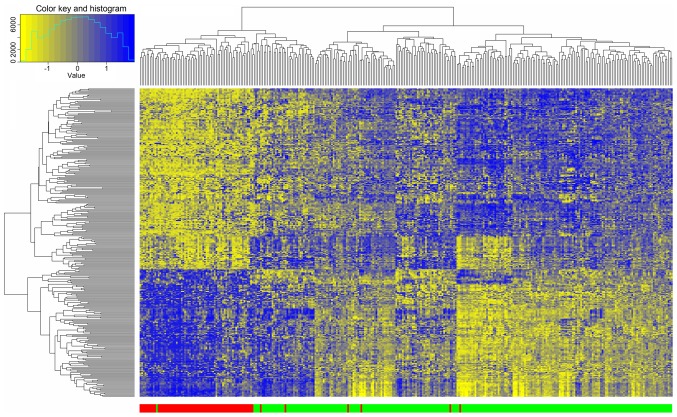
The present study aimed to investigate potential recurrence-risk biomarkers based on significant pathways for Luminal A breast cancer through gene expression profile analysis. Initially, the gene expression profiles of Luminal A breast cancer patients were downloaded from The Cancer Genome Atlas database. The differentially expressed genes (DEGs) were identified using a Limma package and the hierarchical clustering analysis was conducted for the DEGs. In addition, the functional pathways were screened using Kyoto Encyclopedia of Genes and Genomes pathway enrichment analyses and rank ratio calculation. The multigene prognostic assay was exploited based on the statistically significant pathways and its prognostic function was tested using train set and verified using the gene expression data and survival data of Luminal A breast cancer patients downloaded from the Gene Expression Omnibus. A total of 300 DEGs were identified between good and poor outcome groups, including 176 upregulated genes and 124 downregulated genes. The DEGs may be used to effectively distinguish Luminal A samples with different prognoses verified by hierarchical clustering analysis. There were 9 pathways screened as significant pathways and a total of 18 DEGs involved in these 9 pathways were identified as prognostic biomarkers. According to the survival analysis and receiver operating characteristic curve, the obtained 18-gene prognostic assay exhibited good prognostic function with high sensitivity and specificity to both the train and test samples. In conclusion the 18-gene prognostic assay including the key genes, transcription factor 7-like 2, anterior parietal cortex and lymphocyte enhancer factor-1 may provide a new method for predicting outcomes and may be conducive to the promotion of precision medicine for Luminal A breast cancer.
本研究旨在通过基因表达谱分析,基于管腔A型乳腺癌的重要通路来探究潜在的复发风险生物标志物。最初,从癌症基因组图谱数据库下载了管腔A型乳腺癌患者的基因表达谱。使用Limma软件包鉴定差异表达基因(DEG),并对DEG进行层次聚类分析。此外,使用京都基因与基因组百科全书通路富集分析和秩比计算来筛选功能通路。基于具有统计学意义的通路开发多基因预后分析,并使用训练集测试其预后功能,并用从基因表达综合数据库下载的管腔A型乳腺癌患者的基因表达数据和生存数据进行验证。在预后良好和不良组之间共鉴定出300个DEG,包括176个上调基因和124个下调基因。层次聚类分析验证了DEG可有效区分具有不同预后的管腔A型样本。筛选出9条通路作为重要通路,参与这9条通路的总共18个DEG被鉴定为预后生物标志物。根据生存分析和受试者工作特征曲线,所获得的18基因预后分析对训练样本和测试样本均具有良好的预后功能,具有高敏感性和特异性。总之,包含关键基因转录因子7样2、顶叶前皮质和淋巴细胞增强因子-1的18基因预后分析可能为预测预后提供一种新方法,并可能有助于推动管腔A型乳腺癌的精准医疗。