Aure Miriam Ragle, Vitelli Valeria, Jernström Sandra, Kumar Surendra, Krohn Marit, Due Eldri U, Haukaas Tonje Husby, Leivonen Suvi-Katri, Vollan Hans Kristian Moen, Lüders Torben, Rødland Einar, Vaske Charles J, Zhao Wei, Møller Elen K, Nord Silje, Giskeødegård Guro F, Bathen Tone Frost, Caldas Carlos, Tramm Trine, Alsner Jan, Overgaard Jens, Geisler Jürgen, Bukholm Ida R K, Naume Bjørn, Schlichting Ellen, Sauer Torill, Mills Gordon B, Kåresen Rolf, Mælandsmo Gunhild M, Lingjærde Ole Christian, Frigessi Arnoldo, Kristensen Vessela N, Børresen-Dale Anne-Lise, Sahlberg Kristine K
Department of Cancer Genetics, Institute for Cancer Research, Oslo University Hospital, The Norwegian Radium Hospital, Oslo, Norway.
K.G. Jebsen Centre for Breast Cancer Research, Institute for Clinical Medicine, University of Oslo, Oslo, Norway.
Breast Cancer Res. 2017 Mar 29;19(1):44. doi: 10.1186/s13058-017-0812-y.
Breast cancer is a heterogeneous disease at the clinical and molecular level. In this study we integrate classifications extracted from five different molecular levels in order to identify integrated subtypes.
Tumor tissue from 425 patients with primary breast cancer from the Oslo2 study was cut and blended, and divided into fractions for DNA, RNA and protein isolation and metabolomics, allowing the acquisition of representative and comparable molecular data. Patients were stratified into groups based on their tumor characteristics from five different molecular levels, using various clustering methods. Finally, all previously identified and newly determined subgroups were combined in a multilevel classification using a "cluster-of-clusters" approach with consensus clustering.
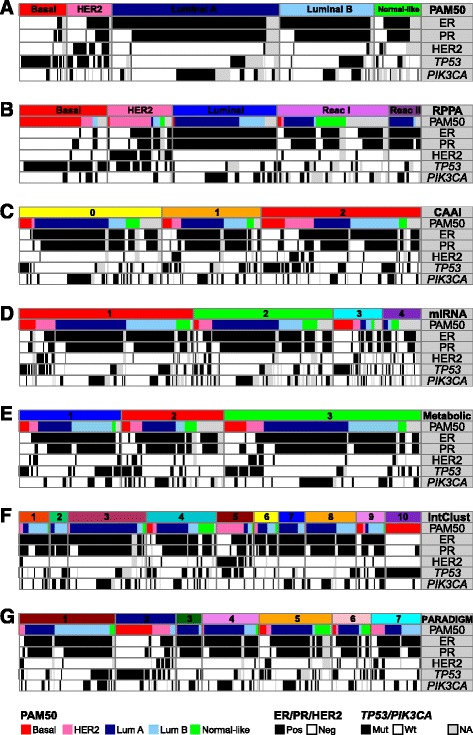
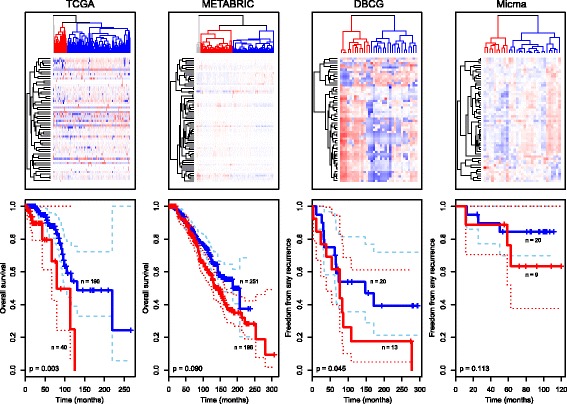
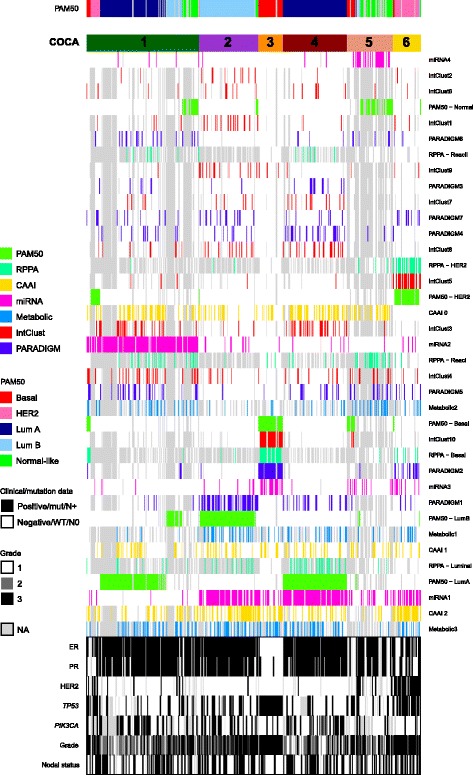
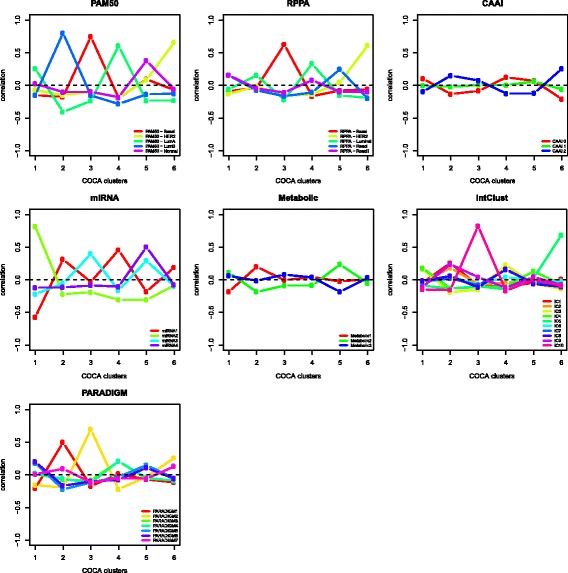
Based on DNA copy number data, tumors were categorized into three groups according to the complex arm aberration index. mRNA expression profiles divided tumors into five molecular subgroups according to PAM50 subtyping, and clustering based on microRNA expression revealed four subgroups. Reverse-phase protein array data divided tumors into five subgroups. Hierarchical clustering of tumor metabolic profiles revealed three clusters. Combining DNA copy number and mRNA expression classified tumors into seven clusters based on pathway activity levels, and tumors were classified into ten subtypes using integrative clustering. The final consensus clustering that incorporated all aforementioned subtypes revealed six major groups. Five corresponded well with the mRNA subtypes, while a sixth group resulted from a split of the luminal A subtype; these tumors belonged to distinct microRNA clusters. Gain-of-function studies using MCF-7 cells showed that microRNAs differentially expressed between the luminal A clusters were important for cancer cell survival. These microRNAs were used to validate the split in luminal A tumors in four independent breast cancer cohorts. In two cohorts the microRNAs divided tumors into subgroups with significantly different outcomes, and in another a trend was observed.
The six integrated subtypes identified confirm the heterogeneity of breast cancer and show that finer subdivisions of subtypes are evident. Increasing knowledge of the heterogeneity of the luminal A subtype may add pivotal information to guide therapeutic choices, evidently bringing us closer to improved treatment for this largest subgroup of breast cancer.
乳腺癌在临床和分子水平上是一种异质性疾病。在本研究中,我们整合了从五个不同分子水平提取的分类,以识别整合亚型。
对来自奥斯陆2研究的425例原发性乳腺癌患者的肿瘤组织进行切割和匀浆,并分为用于DNA、RNA和蛋白质分离以及代谢组学的部分,从而获取具有代表性和可比性的分子数据。使用各种聚类方法,根据患者在五个不同分子水平上的肿瘤特征将其分层分组。最后,使用具有一致性聚类的“聚类的聚类”方法,将所有先前确定的和新确定的亚组组合成一个多级分类。
基于DNA拷贝数数据,根据复杂臂畸变指数将肿瘤分为三组。mRNA表达谱根据PAM50亚型分类将肿瘤分为五个分子亚组,基于microRNA表达的聚类揭示了四个亚组。反相蛋白质阵列数据将肿瘤分为五个亚组。肿瘤代谢谱的层次聚类揭示了三个簇。结合DNA拷贝数和mRNA表达,根据通路活性水平将肿瘤分为七个簇,并使用整合聚类将肿瘤分为十个亚型。纳入所有上述亚型的最终一致性聚类揭示了六个主要组。其中五个与mRNA亚型吻合良好,而第六组是由腔面A型亚型的分裂产生的;这些肿瘤属于不同的microRNA簇。使用MCF-7细胞进行的功能获得性研究表明,腔面A型簇之间差异表达的microRNA对癌细胞存活很重要。这些microRNA被用于验证四个独立乳腺癌队列中腔面A型肿瘤的分裂情况。在两个队列中,这些microRNA将肿瘤分为结局显著不同的亚组,在另一个队列中观察到一种趋势。
所识别出的六个整合亚型证实了乳腺癌的异质性,并表明亚型的更精细细分是明显的。对腔面A型亚型异质性的了解不断增加,可能会为指导治疗选择增添关键信息,显然使我们更接近改善对这一最大乳腺癌亚组的治疗。