Department of Dermato-Cancerology, CIC 1413, CRCINA Inserm 1232, CHU Nantes, Nantes, France.
Innovaderm Research, Montreal, Canada.
Am J Clin Dermatol. 2018 Apr;19(2):275-286. doi: 10.1007/s40257-018-0352-y.
Very few clinical trials have investigated the effect of topical acne treatment on scarring.
Our objective was to evaluate the efficacy of adapalene 0.3%/benzoyl peroxide 2.5% gel (A0.3/BPO2.5) in atrophic acne scar formation in patients with acne.
In this multicenter, randomized, investigator-blinded, vehicle-controlled study, subjects with moderate or severe facial acne (Investigator's Global Assessment [IGA] score 3 or 4; ≥ 25 inflammatory lesions; ten or more atrophic acne scars) applied A0.3/BPO2.5 or vehicle daily per half face for 24 weeks. Subjects with acne requiring systemic treatment were excluded. Assessments included investigator atrophic acne scar count, Scar Global Assessment (SGA), acne lesion count, IGA, skin roughness and skin texture, subject self-assessment of clinical acne-related scars and satisfaction questionnaire, tolerability, and safety.
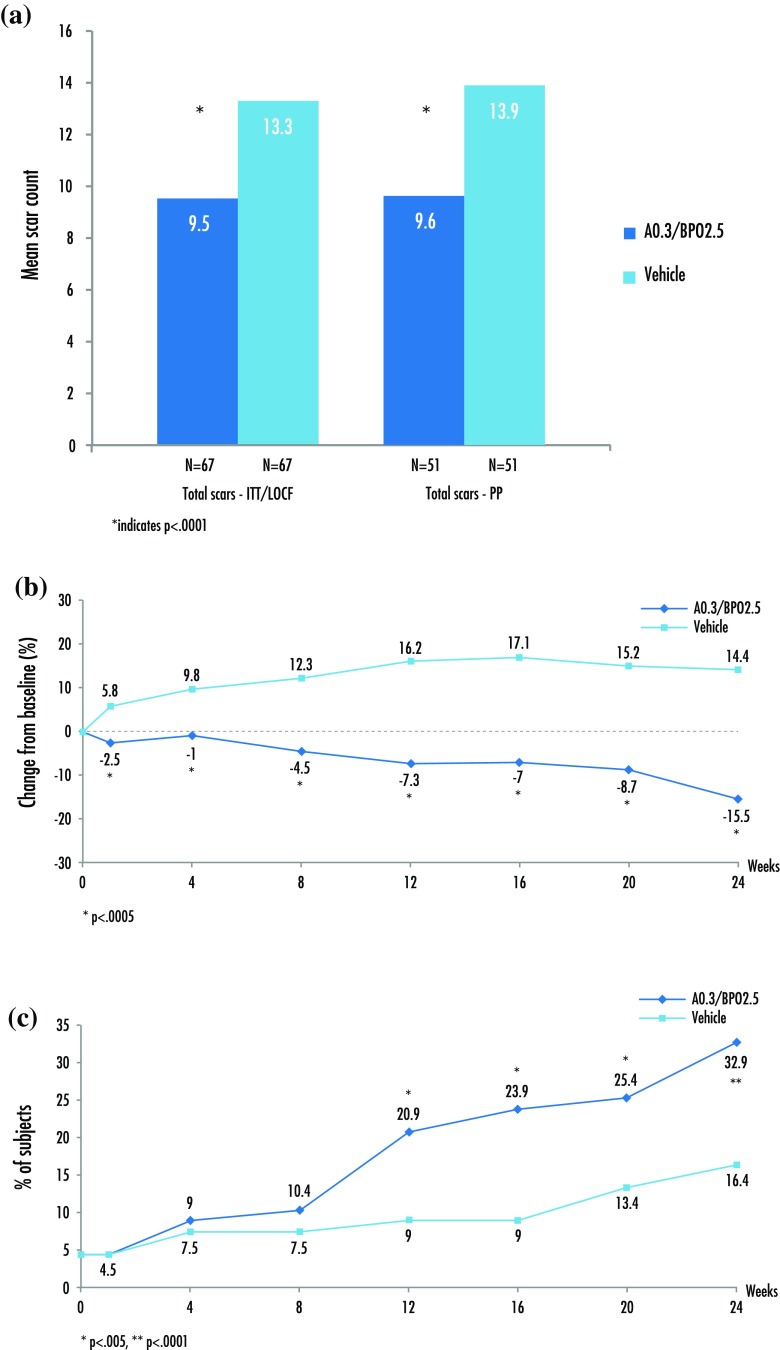
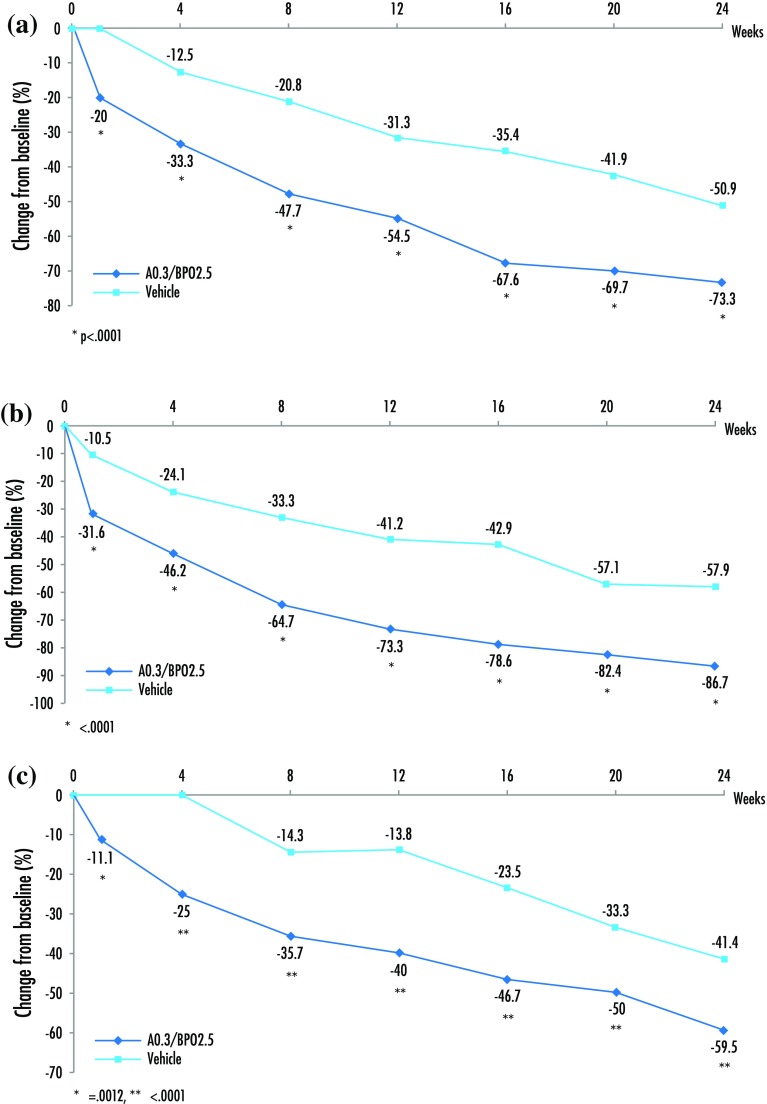
Included subjects (n = 67) had mainly moderate acne (92.5% IGA 3); mean scores at baseline were approximately 40 acne lesions and 12 scars per half face. By week 24, the change from baseline in total scar count was - 15.5% for A0.3/BPO2.5 versus + 14.4% for vehicle (approximately 30% difference), with a mean of 9.5 scars versus 13.3 per half face, respectively (p < 0.0001). For SGA at week 24, a total of 32.9% with A0.3/BPO2.5 versus 16.4% with vehicle (p < 0.01) were clear/almost clear. Inflammatory acne lesions decreased by 86.7% for A0.3/BPO2.5 versus 57.9% for vehicle (p < 0.0001), and 64.2 versus 19.4% of subjects, respectively, were IGA clear/almost clear (p < 0.0001) at week 24. Treatment-related AEs were reported by 20.9% for A0.3/BPO2.5 versus 9% for vehicle side, most commonly skin irritation (14.9 vs. 6%, respectively).
Topical A0.3/BPO2.5 prevented and reduced atrophic scar formation. Scar count increased with vehicle (+ 14.4%) but decreased with A0.3/BPO2.5 (- 15.5%) over 24 weeks.
ClinicalTrials.gov identifier NCT02735421.
很少有临床试验研究过局部痤疮治疗对瘢痕形成的影响。
我们的目的是评估 0.3%阿达帕林/2.5%过氧化苯甲酰凝胶(A0.3/BPO2.5)对痤疮患者萎缩性痤疮瘢痕形成的疗效。
在这项多中心、随机、研究者设盲、对照药物研究中,中重度面部痤疮(研究者整体评估[IGA]评分 3 或 4;≥25 个炎症性皮损;10 个或更多萎缩性痤疮瘢痕)患者每天使用 A0.3/BPO2.5 或对照药物治疗半张脸,共 24 周。需要全身治疗的痤疮患者被排除在外。评估包括研究者的萎缩性痤疮瘢痕计数、瘢痕整体评估(SGA)、痤疮皮损计数、IGA、皮肤粗糙度和纹理、患者对临床相关痤疮瘢痕的自我评估和满意度问卷、耐受性和安全性。
纳入的受试者(n=67)主要患有中度痤疮(92.5% IGA 3);基线时的平均评分约为每半张脸 40 个皮损和 12 个瘢痕。到第 24 周时,A0.3/BPO2.5 组总瘢痕计数较基线下降了-15.5%,而对照组则上升了+14.4%(差异约为 30%),平均每半张脸分别为 9.5 个瘢痕和 13.3 个瘢痕(p<0.0001)。第 24 周时,SGA 总Clear/Almost Clear 比例分别为 A0.3/BPO2.5 组 32.9%和对照组 16.4%(p<0.01)。A0.3/BPO2.5 组的炎症性痤疮皮损减少了 86.7%,而对照组则减少了 57.9%(p<0.0001),第 24 周时,分别有 64.2%和 19.4%的受试者 IGA Clear/Almost Clear(p<0.0001)。A0.3/BPO2.5 组有 20.9%的受试者出现与治疗相关的不良事件,而对照组为 9%,最常见的是皮肤刺激(分别为 14.9%和 6%)。
局部使用 A0.3/BPO2.5 可预防和减少萎缩性瘢痕形成。在 24 周内,与对照组相比,瘢痕计数增加(+14.4%),但 A0.3/BPO2.5 组减少(-15.5%)。
ClinicalTrials.gov 标识符 NCT02735421。