Department of Radiation Oncology, Mayo Clinic Arizona, Phoenix, Arizona.
Department of Radiation Oncology, The University of Texas M. D. Anderson Cancer Center, Houston, Texas.
Int J Radiat Oncol Biol Phys. 2018 Jun 1;101(2):479-489. doi: 10.1016/j.ijrobp.2018.02.009. Epub 2018 Feb 14.
To investigate how spot size and spacing affect plan quality, robustness, and interplay effects of robustly optimized intensity modulated proton therapy (IMPT) for lung cancer.
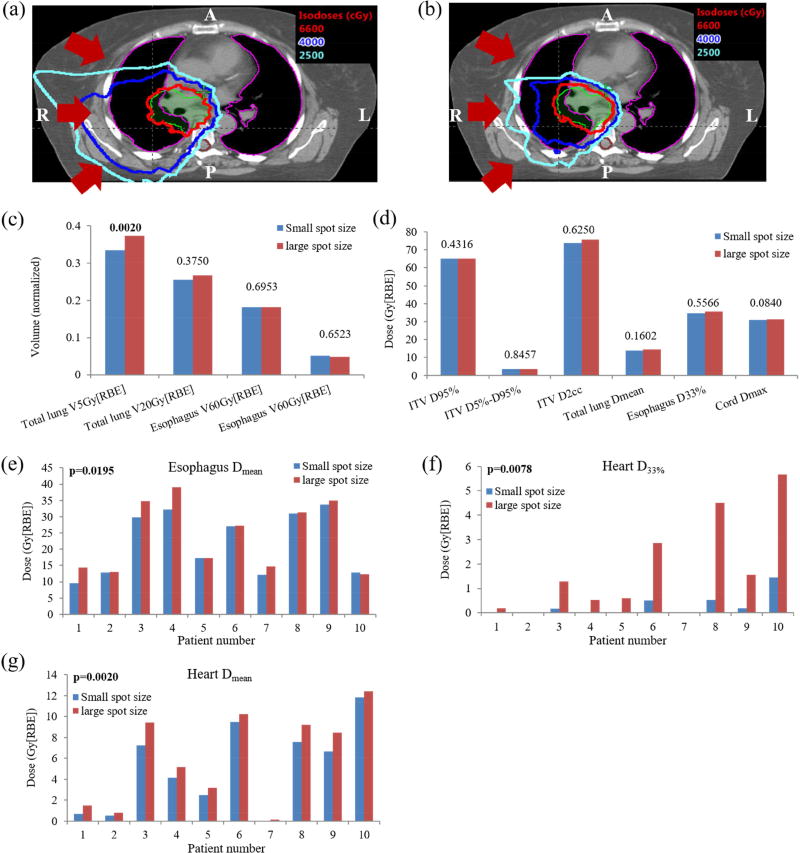
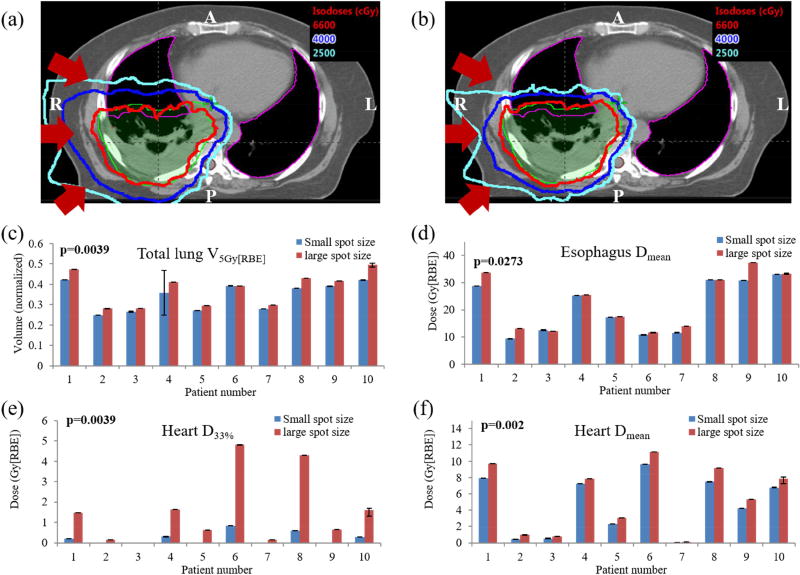
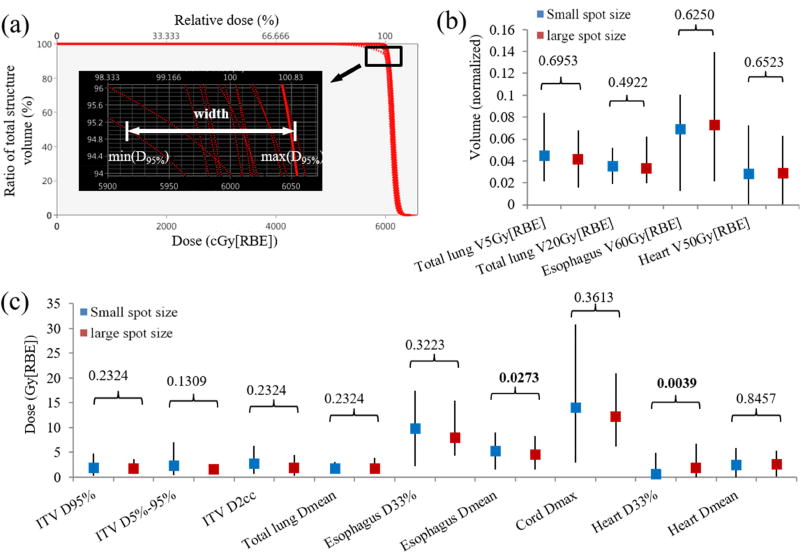
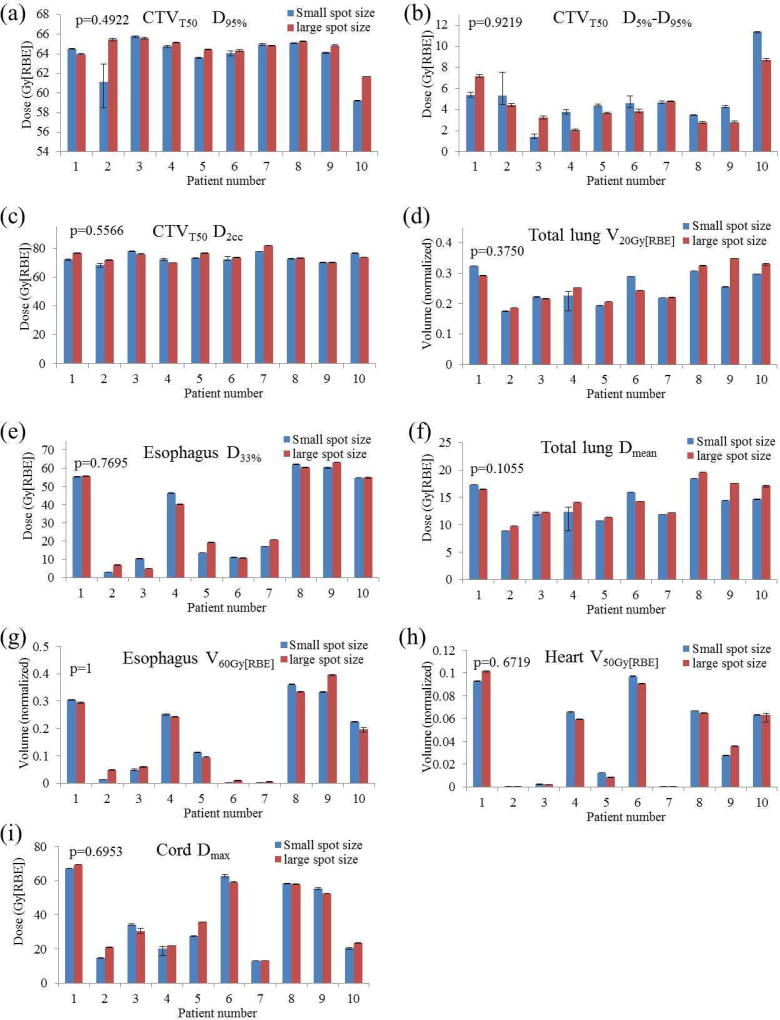
Two robustly optimized IMPT plans were created for 10 lung cancer patients: first by a large-spot machine with in-air energy-dependent large spot size at isocenter (σ: 6-15 mm) and spacing (1.3 σ), and second by a small-spot machine with in-air energy-dependent small spot size (σ: 2-6 mm) and spacing (5 mm). Both plans were generated by optimizing radiation dose to internal target volume on averaged 4-dimensional computed tomography scans using an in-house-developed IMPT planning system. The dose-volume histograms band method was used to evaluate plan robustness. Dose evaluation software was developed to model time-dependent spot delivery to incorporate interplay effects with randomized starting phases for each field per fraction. Patient anatomy voxels were mapped phase-to-phase via deformable image registration, and doses were scored using in-house-developed software. Dose-volume histogram indices, including internal target volume dose coverage, homogeneity, and organs at risk (OARs) sparing, were compared using the Wilcoxon signed-rank test.
Compared with the large-spot machine, the small-spot machine resulted in significantly lower heart and esophagus mean doses, with comparable target dose coverage, homogeneity, and protection of other OARs. Plan robustness was comparable for targets and most OARs. With interplay effects considered, significantly lower heart and esophagus mean doses with comparable target dose coverage and homogeneity were observed using smaller spots.
Robust optimization with a small spot-machine significantly improves heart and esophagus sparing, with comparable plan robustness and interplay effects compared with robust optimization with a large-spot machine. A small-spot machine uses a larger number of spots to cover the same tumors compared with a large-spot machine, which gives the planning system more freedom to compensate for the higher sensitivity to uncertainties and interplay effects for lung cancer treatments.
研究点大小和间距如何影响肺癌稳健优化强度调制质子治疗(IMPT)的计划质量、稳健性和相互作用效应。
为 10 名肺癌患者分别创建了两种稳健优化的 IMPT 计划:一种是使用在空气中具有依赖能量的大光斑大小(在等中心处为 σ:6-15mm)和间距(1.3σ)的大光斑机器,另一种是使用在空气中具有依赖能量的小光斑大小(σ:2-6mm)和间距(5mm)的小光斑机器。这两种计划都是通过在内部目标体积上优化辐射剂量来生成的,优化方法是使用内部开发的 IMPT 规划系统对平均 4 维计算机断层扫描进行优化。使用剂量体积直方图带方法评估计划的稳健性。开发了剂量评估软件,以建立时变点传递模型,以纳入每个射野在每个分次的随机起始相位的相互作用效应。通过变形图像配准逐相位映射患者解剖体素,并使用内部开发的软件对剂量进行评分。使用 Wilcoxon 符号秩检验比较剂量体积直方图指数,包括内部目标体积剂量覆盖度、均匀性和危及器官(OARs)保护。
与大光斑机器相比,小光斑机器可显著降低心脏和食管的平均剂量,同时保持目标剂量覆盖度、均匀性和对其他 OAR 的保护。对于目标和大多数 OAR,计划稳健性相当。考虑相互作用效应后,使用较小的光斑可显著降低心脏和食管的平均剂量,同时保持目标剂量覆盖度和均匀性。
与大光斑机器的稳健优化相比,小光斑机器的稳健优化可显著改善心脏和食管的保护,同时具有相当的计划稳健性和相互作用效应。与大光斑机器相比,小光斑机器使用更多的光斑来覆盖相同的肿瘤,这使规划系统有更多的自由度来补偿肺癌治疗中更高的不确定性和相互作用效应的敏感性。