Mo Zheng, Hu Minggen, Yu Fei, Shao Lijuan, Fan Kexing, Jiao Shunchang
PLA General Hospital Cancer Center, PLA Postgraduate School of Medicine, Beijing, People's Republic of China.
Department of Hepatobiliary Surgery, Beijing Tsinghua Changgung Hospital, Beijing, People's Republic of China.
Onco Targets Ther. 2018 Mar 5;11:1215-1222. doi: 10.2147/OTT.S157914. eCollection 2018.
Leukemia related protein 16 (LRP16), one of the genes belonging to the macro domain family, has been found up-regulated in various tumors including testicles, ovaries and mucosa of colon and is associated with poor clinical outcomes.
The objective of this study was to investigate expression pattern and biological roles of LRP16 in pancreatic cancer.
Western blot and immunohistochemistry were used to investigate the expression of LRP16 in pancreatic cancer cell lines and tissues. qRT-PCR was utilized to examine LRP16 mRNA expression. Lentivirus based overexpression and knockdown of LRP16 was carried out in four pancreatic cancer cell lines (Panc1, CFPAC1, SW1990 and AsPC1). Cell proliferation, migration and invasion were determined by MTS and transwell assay, respectively. Flow cytometry was performed to investigate cell apoptosis. In vivo, the tumorigenic ability of LRP16 was determined in a NOD/SCID mouse model.
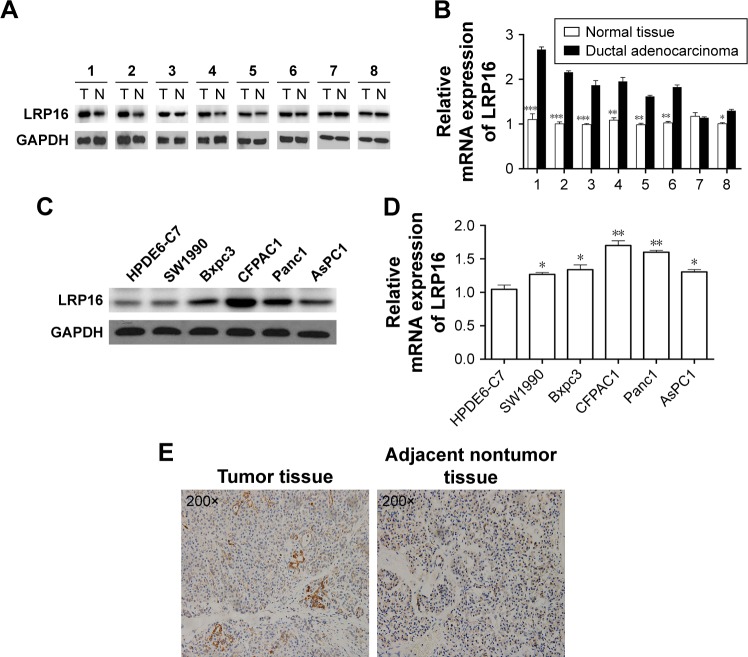
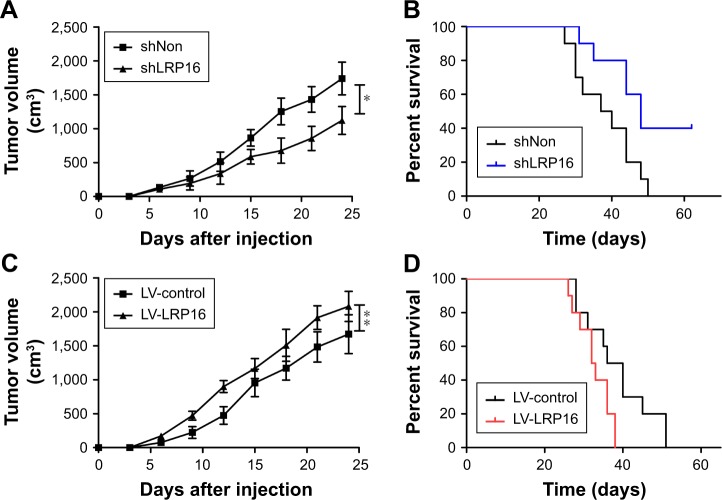
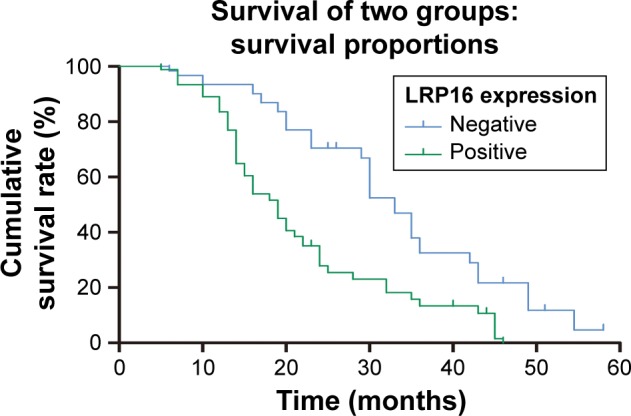
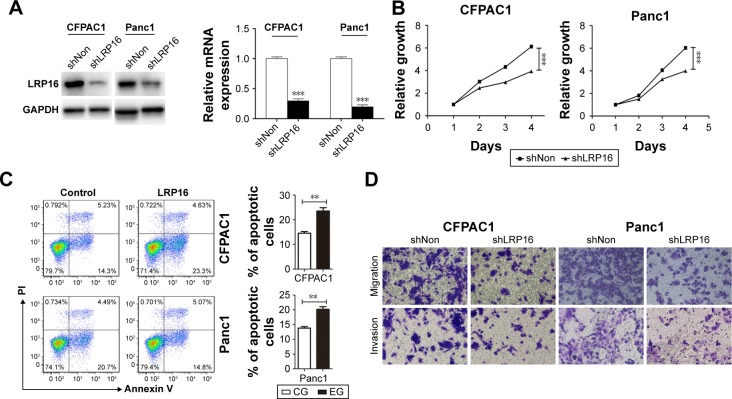
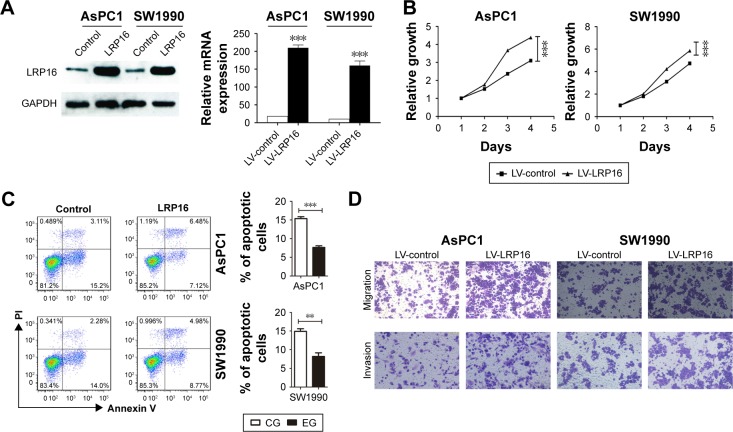
In the present study, we found that LRP16 expression was increased in pancreatic tumor samples, compared with normal tissues. Moreover, the LRP16 expression was positive in 60.9% of 156 specimens and correlated with tumor size, clinical stage, distant metastasis and tumor differentiation. Multivariate Cox regression analysis revealed that the level of LRP16 expression was an independent prognostic factor for overall survival in pancreatic cancer patients. Furthermore, silencing of LRP16 significantly accelerated apoptosis, decrease proliferation, migration and invasion of pancreatic cancer cell lines in vitro. In contrast, overexpression of LRP16 attenuated apoptosis, promoted proliferation, migration and invasion. In addition, in vivo study revealed that down regulation of LRP16 could attenuate tumor growth and prolong the survival. On the contrary, up-regulation of LRP16 could promote tumor growth and shorten their survival.
These findings suggest that LRP16 played an oncogenic role in pancreatic carcinoma.
白血病相关蛋白16(LRP16)是属于巨结构域家族的基因之一,已发现在包括睾丸、卵巢和结肠黏膜在内的多种肿瘤中上调,并与不良临床预后相关。
本研究旨在探讨LRP16在胰腺癌中的表达模式及生物学作用。
采用蛋白质免疫印迹法和免疫组织化学法检测LRP16在胰腺癌细胞系和组织中的表达。运用qRT-PCR检测LRP16 mRNA表达。在四种胰腺癌细胞系(Panc1、CFPAC1、SW1990和AsPC1)中进行基于慢病毒的LRP16过表达和敲低实验。分别通过MTS法和Transwell实验测定细胞增殖、迁移和侵袭能力。采用流式细胞术研究细胞凋亡。在体内,通过NOD/SCID小鼠模型确定LRP16的致瘤能力。
在本研究中,我们发现与正常组织相比,胰腺肿瘤样本中LRP16表达增加。此外,在156例标本中,60.9%的LRP16表达呈阳性,且与肿瘤大小、临床分期、远处转移和肿瘤分化相关。多因素Cox回归分析显示,LRP16表达水平是胰腺癌患者总生存的独立预后因素。此外,沉默LRP16可显著加速体外胰腺癌细胞系的凋亡,降低其增殖、迁移和侵袭能力。相反,LRP16过表达可减弱凋亡,促进增殖、迁移和侵袭。此外,体内研究表明,下调LRP16可减弱肿瘤生长并延长生存期。相反,上调LRP16可促进肿瘤生长并缩短生存期。
这些发现表明LRP16在胰腺癌中发挥致癌作用。