Chen Ye, Chen SuNing, Zhang Jian, Wang YangMin, Jia Zhengping, Zhang Xin, Han Xiao, Guo Xiuquan, Sun XiaoDi, Shao Chen, Wang Ji, Lan Tian
Department of Anesthesiology and Pain, Lanzhou General Hospital of Lanzhou Command, Lanzhou, China.
Department of Pharmacy, Xijing Hospital, The Fourth Military Medical University, Xi'an, China.
Oncotarget. 2018 Jan 6;9(15):12186-12200. doi: 10.18632/oncotarget.24069. eCollection 2018 Feb 23.
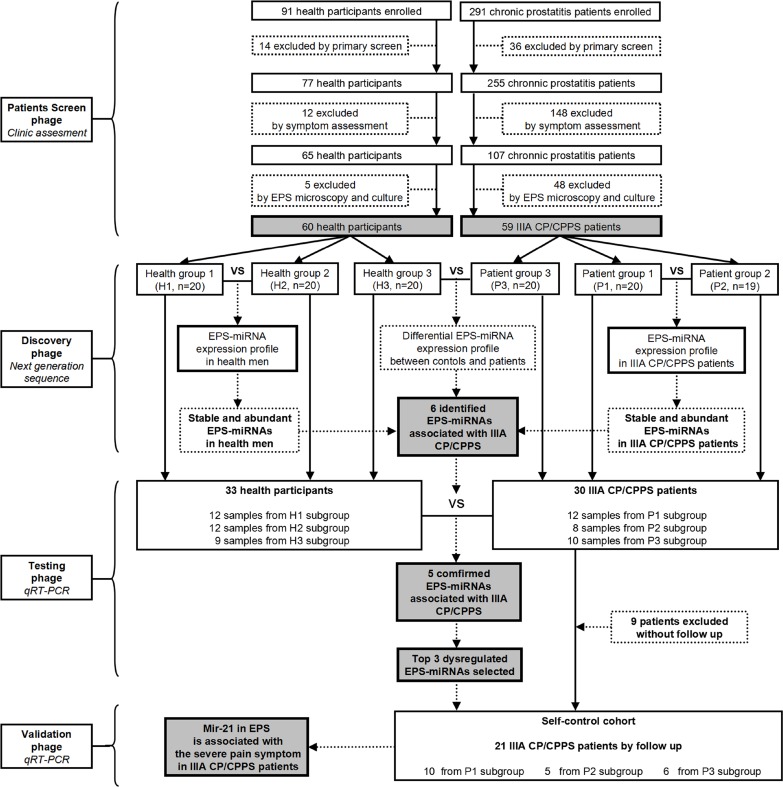
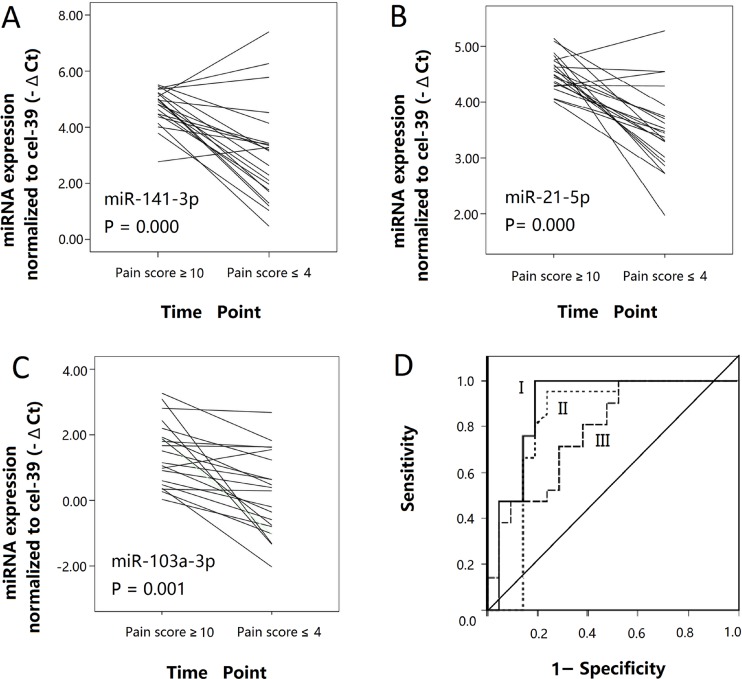
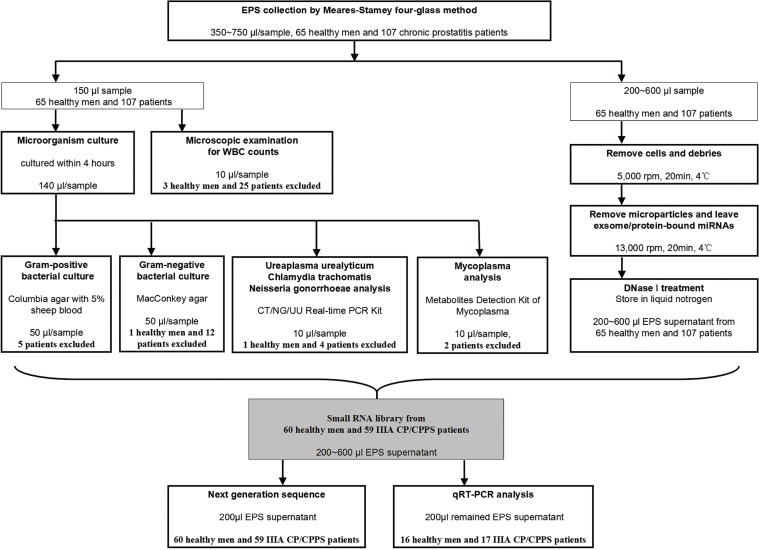
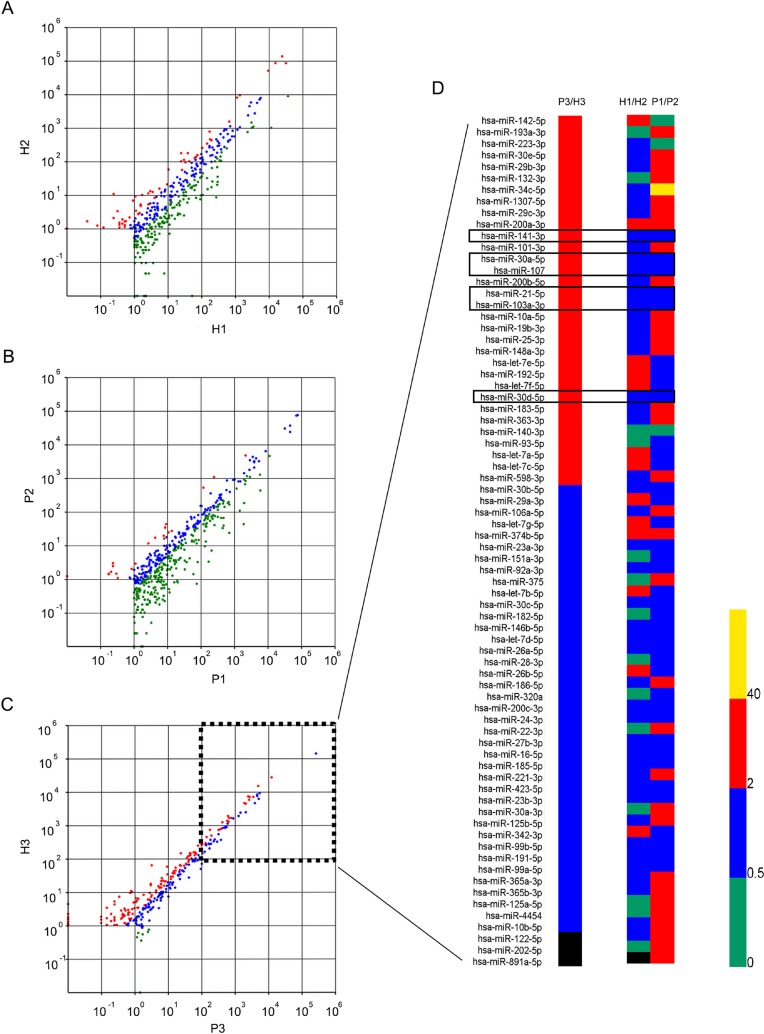
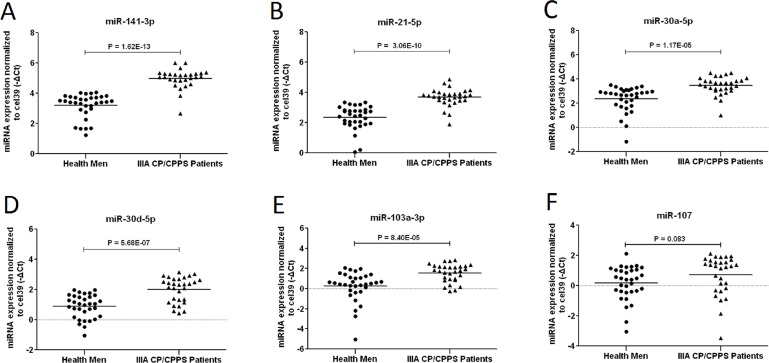
The current study aimed to identify a comprehensive expression-profile of microRNAs (miRNAs) in expressed prostatic secretion (EPS) collected from healthy men and patients with CP/CPPS (Chronic prostatitis/Chronic pelvic pain syndrome). After clinical screening of 382 participants, 60 healthy men and 59 IIIA CP/CPPS patients with significant pelvic-pain were included into this study from March 2012 to December 2014. High-throughput sequencing was employed to identify characteristic expression-profile of EPS-miRNAs. QRT-PCR was further performed to confirm elevated levels of differential EPS-miRNAs. Finally, candidate EPS-miRNAs were measured traceably in 21 follow-up patients and their classify-accuracy on IIIA CP/CPPS were analyzed by ROC (receiver operating characteristic) curve. In discovery-phage, 41 and 43 predominant EPS-miRNAs were found in pooled EPS-sample from 40 healthy men and 39 IIIA CP/CPPS patients, respectively. Furthermore, 22 abundant EPS-miRNAs were up-regulated with ≥ 2-fold in 20 patients compared to 20 healthy men. In testing-phage, elevated levels of miR-21-5p, miR-30a-5p, miR-30d-5p, miR-103a-3p and miR-141-3p were further confirmed in 33 patients by comparing to 30 healthy men. In validation-phage, relieved pelvic-pain symptom of 21 follow-up patients was found to be accompanied by significant down-regulation of miR-21-5p, miR-103a-3p and miR-141-3p. Particularly, ROC curve analysis indicated the highest area under ROC curve (AUC) was found for miR-21-5p (0.891), followed in order by miR-141-3p and miR-103a-3p. Our studies provided evidence that secretory miRNAs existed in EPS and dysregulated EPS-miRNAs were associated with prostatitis. In particular, miR-21-5p possessed a high classify-accuracy for IIIA CP/CPPS patients with significant pelvic pain.
本研究旨在确定从健康男性以及慢性前列腺炎/慢性盆腔疼痛综合征(CP/CPPS)患者收集的前列腺分泌物(EPS)中微小RNA(miRNA)的全面表达谱。在对382名参与者进行临床筛查后,2012年3月至2014年12月期间,本研究纳入了60名健康男性和59名有明显盆腔疼痛的IIIA型CP/CPPS患者。采用高通量测序来确定EPS-miRNA的特征性表达谱。进一步进行定量逆转录聚合酶链反应(QRT-PCR)以确认差异EPS-miRNA水平升高。最后,对21名随访患者中的候选EPS-miRNA进行可溯源测量,并通过受试者工作特征(ROC)曲线分析其对IIIA型CP/CPPS的分类准确性。在发现阶段,分别在40名健康男性和39名IIIA型CP/CPPS患者的合并EPS样本中发现了41种和43种主要的EPS-miRNA。此外,与20名健康男性相比,20名患者中有22种丰富的EPS-miRNA上调了≥2倍。在测试阶段,通过与30名健康男性比较,进一步证实了33名患者中miR-21-5p、miR-30a-5p、miR-30d-5p、miR-103a-3p和miR-141-3p水平升高。在验证阶段,发现21名随访患者盆腔疼痛症状缓解伴随着miR-21-5p、miR-103a-3p和miR-141-3p的显著下调。特别是,ROC曲线分析表明,miR-21-5p的ROC曲线下面积(AUC)最高(0.891),其次是miR-141-3p和miR-103a-3p。我们的研究提供了证据表明EPS中存在分泌性miRNA,且失调的EPS-miRNA与前列腺炎有关。特别是,miR-21-5p对有明显盆腔疼痛的IIIA型CP/CPPS患者具有较高的分类准确性。