Department of Urology, The First Affiliated Hospital of Anhui Medical University, Hefei 230022, China.
Institute of Urology, Anhui Medical University, Hefei 230022, China.
Asian J Androl. 2019 Jul-Aug;21(4):351-359. doi: 10.4103/aja.aja_97_18.
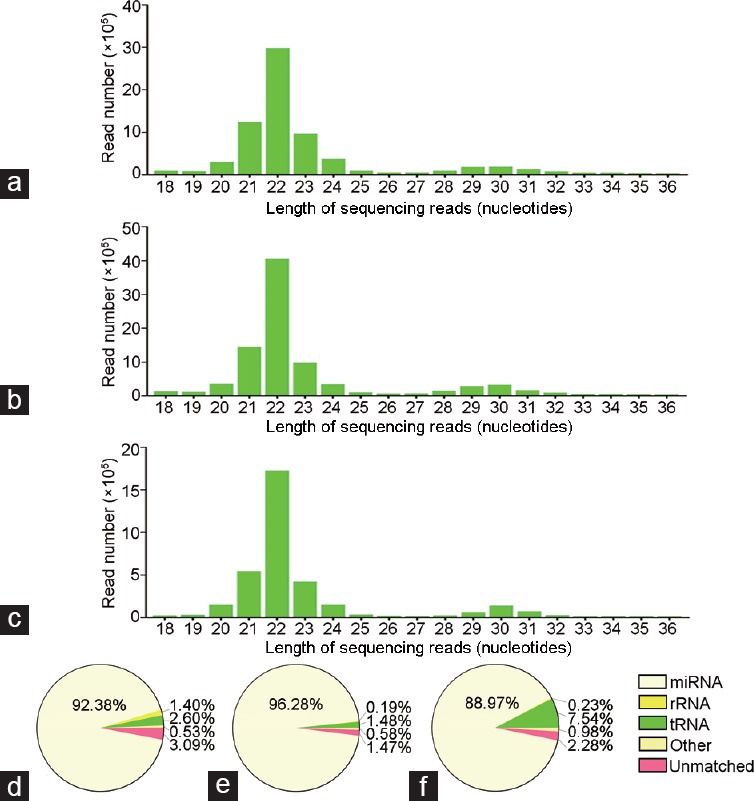
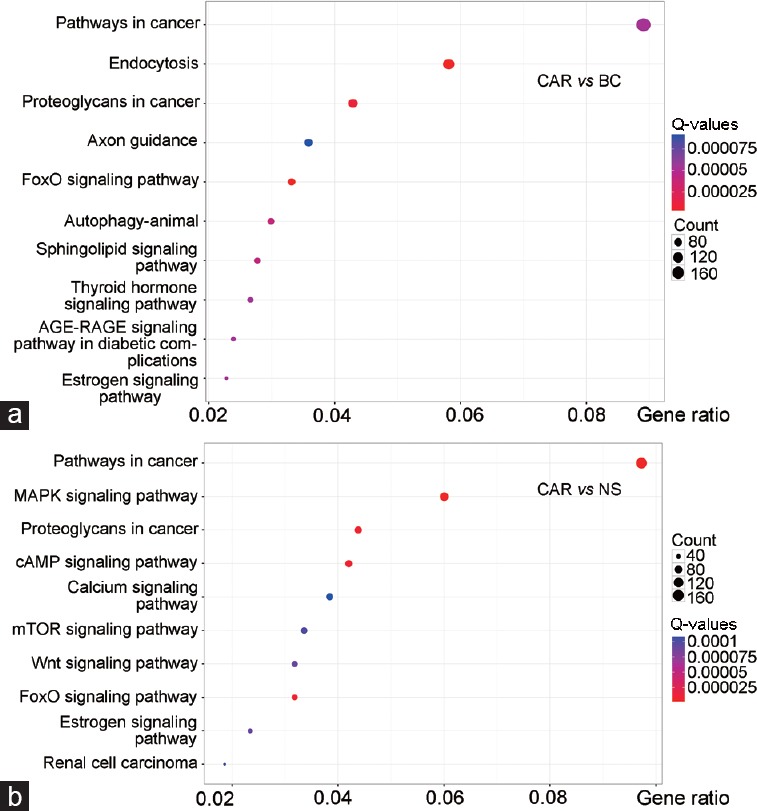
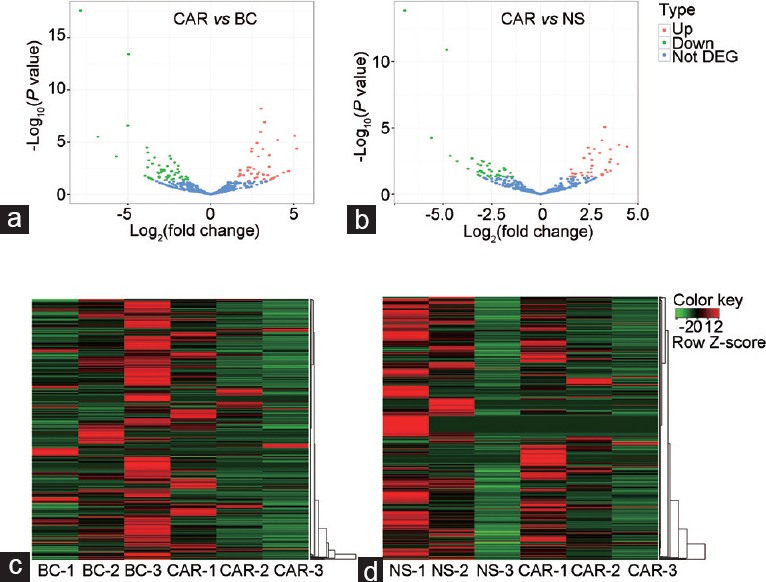
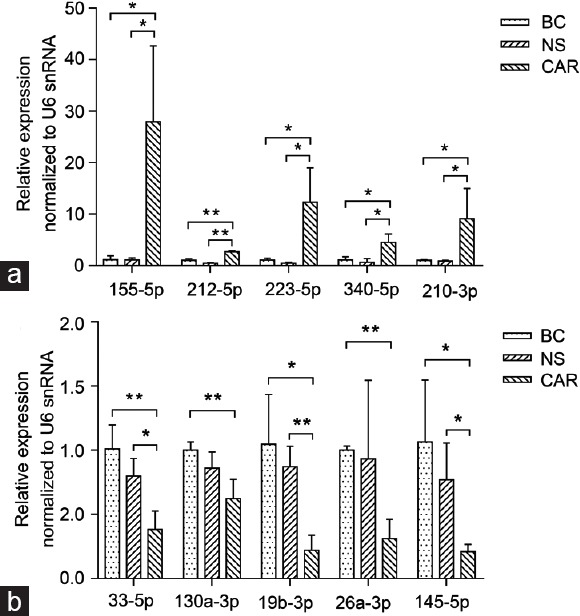
MicroRNAs (miRNAs) are considered to be involved in the pathogenic initiation and progression of chronic nonbacterial prostatitis (CNP); however, the comprehensive expression profile of dysregulated miRNAs, relevant signaling pathways, and core machineries in CNP have not been fully elucidated. In the current research, CNP rat models were established through the intraprostatic injection of carrageenan into the prostate. Then, next-generation sequencing was performed to explore the miRNA expression profile in CNP. Gene Ontology (GO) and Kyoto Encyclopedia of Genes and Genomes (KEGG) bioinformatical analyses were conducted to reveal the enriched biological processes, molecular functions, and cellular components and signaling pathways. As a result, 1224, 1039, and 1029 known miRNAs were annotated in prostate tissues from the blank control (BC), normal saline injection (NS), and carrageenan injection (CAR) groups (n = 3 for each group), respectively. Among them, 84 miRNAs (CAR vs BC) and 70 miRNAs (CAR vs NS) with significantly different expression levels were identified. Compared with previously reported miRNAs with altered expression in various inflammatory diseases, the majority of deregulated miRNAs in CNP, such as miR-146b-5p, miR-155-5p, miR-150-5p, and miR-139-5p, showed similar expression patterns. Moreover, bioinformatics analyses have enriched mitogen-activated protein kinase (MAPK), cyclic adenosine monophosphate (cAMP), endocytosis, mammalian target of rapamycin (mTOR), and forkhead box O (FoxO) signaling pathways. These pathways were all involved in immune response, which indicates the critical regulatory role of the immune system in CNP initiation and progression. Our investigation has presented a global view of the differentially expressed miRNAs and potential regulatory networks containing their target genes, which may be helpful for identifying the novel mechanisms of miRNAs in immune regulation and effective target-specific theragnosis for CNP.
微小 RNA(miRNA)被认为参与慢性非细菌性前列腺炎(CNP)的发病机制;然而,CNP 中失调 miRNA 的全面表达谱、相关信号通路和核心机制尚未完全阐明。在本研究中,通过向前列腺内注射角叉菜胶建立 CNP 大鼠模型。然后,进行下一代测序以探索 CNP 中的 miRNA 表达谱。进行基因本体论(GO)和京都基因与基因组百科全书(KEGG)生物信息学分析,以揭示丰富的生物学过程、分子功能、细胞成分和信号通路。结果,在空白对照组(BC)、生理盐水注射组(NS)和角叉菜胶注射组(CAR)的前列腺组织中分别注释了 1224、1039 和 1029 个已知 miRNA(每组 n = 3)。其中,鉴定出 84 个 miRNA(CAR 与 BC)和 70 个 miRNA(CAR 与 NS)表达水平有显著差异。与先前报道的在各种炎症性疾病中表达改变的 miRNA 相比,CNP 中大多数失调的 miRNA,如 miR-146b-5p、miR-155-5p、miR-150-5p 和 miR-139-5p,表现出相似的表达模式。此外,生物信息学分析富集了丝裂原活化蛋白激酶(MAPK)、环磷酸腺苷(cAMP)、内吞作用、雷帕霉素靶蛋白(mTOR)和叉头框 O(FoxO)信号通路。这些通路均参与免疫反应,表明免疫系统在 CNP 的启动和进展中具有关键的调节作用。我们的研究提供了差异表达 miRNA 的全面视图和包含其靶基因的潜在调节网络,这可能有助于识别 miRNA 在免疫调节中的新机制和针对 CNP 的有效靶向特异性治疗。