Tan Lynn, Wang Luke L, Ranasinghe Weranja, Persad Raj, Bolton Damien, Lawrentschuk Nathan, Sengupta Shomik
Faculty of Medicine, Nursing and Health Sciences, Monash University, Melbourne, Australia.
Department of Urology, Eastern Health, Victoria, Australia.
Prostate Int. 2018 Mar;6(1):31-35. doi: 10.1016/j.prnil.2017.07.002. Epub 2017 Aug 9.
The aim of the paper is to investigate the outcomes of patients younger than 55 years in Victoria, Australia undergoing radical prostatectomy (RP) for prostate cancer.
Data on all men undergoing RP in Victoria between January 1, 2004 and December 31, 2014 were obtained from the Victorian Cancer Registry. Tumor characteristics including Gleason grade, stage of disease (based on final pathology specimen), and cause of death were also obtained. Statistical analysis was performed using Chi-square test, Cox proportional hazards method, and Kaplan-Meier analysis.
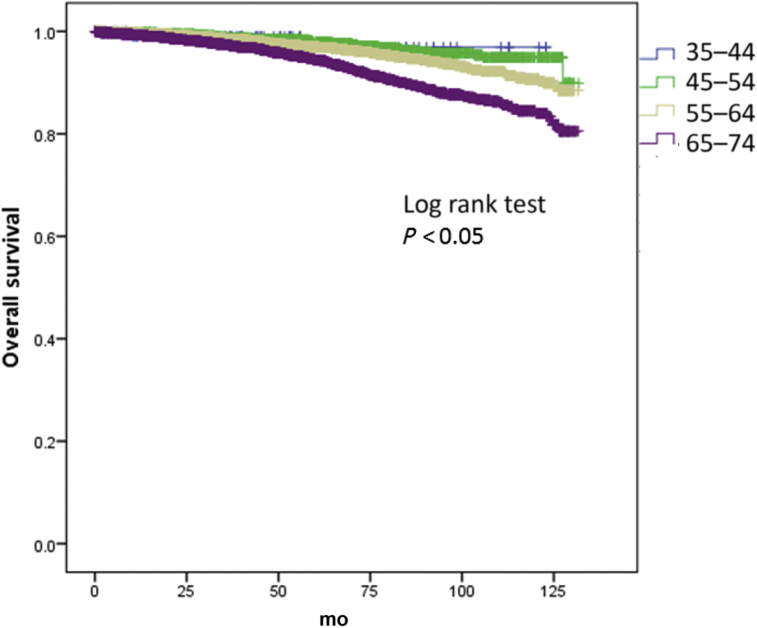
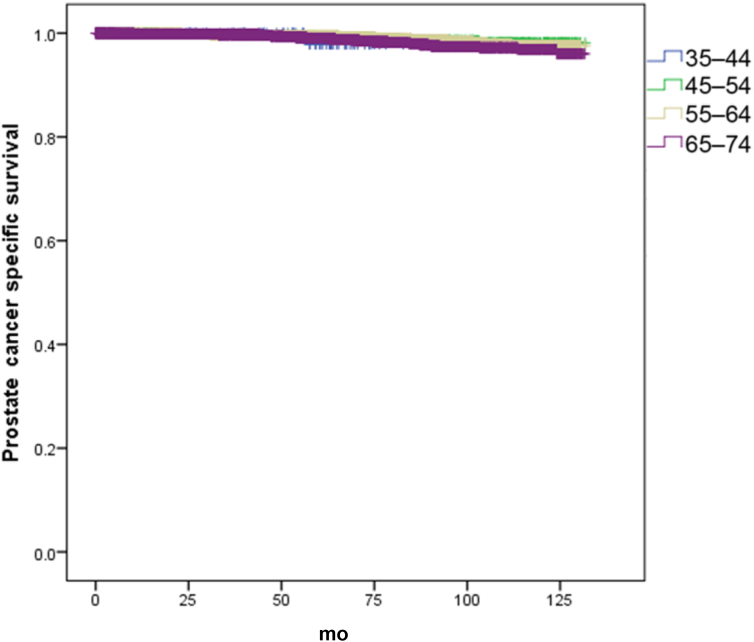
A total of 14,686 men underwent RP during the defined period. Of these men 109 were aged 35-44 years and 1,998 were aged 45-54 years. Men aged 35-44 years and 45-54 years were compared against men aged 55-74 years. The majority of men between the ages of 35 years and 44 years, and 45 years and 54 years had higher rates of Gleason ≤ 7 disease compared with men aged between 55 years and 74 years (92.7% vs. 86.8% vs. 79.3%; < 0.01) and ≤ T2 disease (82.6% vs. 75.6% vs. 49.9%; < 0.01) but similar median prostate-specific antigen values. On a multivariate analysis adjusting for Gleason score, T stage, and prostate-specific antigen, men aged 45-54 years and 55-64 years had 67% and 46% increase in overall survival, respectively, compared to men aged 65-74 years; but these differences were not seen in the 35-44 year age group. There were no differences in prostate cancer specific deaths between the groups. The 5- and 10-year overall survival outcomes were both higher for men aged 45-54 years compared to mean aged 55-74 years (97.9% vs. 95.9% and 94.9% vs. 85.3).
Men aged 45-54 years undergoing RP had better overall survival compared to men aged 55-74 years, but these effects were not seen in men aged 35-44 years. There were no differences in prostate cancer specific survival in these groups.
本文旨在调查澳大利亚维多利亚州年龄小于55岁的前列腺癌患者接受根治性前列腺切除术(RP)的结果。
从维多利亚癌症登记处获取2004年1月1日至2014年12月31日期间在维多利亚州接受RP的所有男性的数据。还获取了肿瘤特征,包括 Gleason 分级、疾病分期(基于最终病理标本)和死亡原因。使用卡方检验、Cox 比例风险法和 Kaplan-Meier 分析进行统计分析。
在规定期间共有14,686名男性接受了RP。其中,109名年龄在35 - 44岁之间,1,998名年龄在45 - 54岁之间。将年龄在35 - 44岁和45 - 54岁的男性与年龄在55 - 74岁的男性进行比较。与年龄在55 - 74岁的男性相比,年龄在35 - 44岁和45 - 54岁的男性中,Gleason评分≤7的疾病发生率更高(92.7%对86.8%对79.3%;P<0.01),≤T2期疾病发生率更高(82.6%对75.6%对49.9%;P<0.01),但前列腺特异性抗原中位数相似。在对Gleason评分、T分期和前列腺特异性抗原进行多变量分析时,与年龄在65 - 74岁的男性相比,年龄在45 - 54岁和55 - 64岁的男性总生存率分别提高了67%和46%;但在35 - 44岁年龄组中未观察到这些差异。各组之间前列腺癌特异性死亡无差异。与年龄在55 - 74岁的男性平均水平相比,年龄在45 - 54岁的男性5年和10年总生存结果均更高(97.9%对95.9%以及94.9%对85.3%)。
与年龄在55 - 74岁的男性相比,接受RP的45 - 54岁男性总生存率更高,但在35 - 44岁男性中未观察到这些效果。这些组之间前列腺癌特异性生存无差异。