Bragazzi Nicola Luigi, Gianfredi Vincenza, Villarini Milena, Rosselli Roberto, Nasr Ahmed, Hussein Amr, Martini Mariano, Behzadifar Masoud
Department of Health Sciences (DISSAL), School of Public Health, University of Genoa, Genoa, Italy.
Department of Experimental Medicine, Unit of Public Health, School of Specialization in Hygiene and Preventive Medicine, University of Perugia, Perugia, Italy.
Front Public Health. 2018 Mar 5;6:62. doi: 10.3389/fpubh.2018.00062. eCollection 2018.
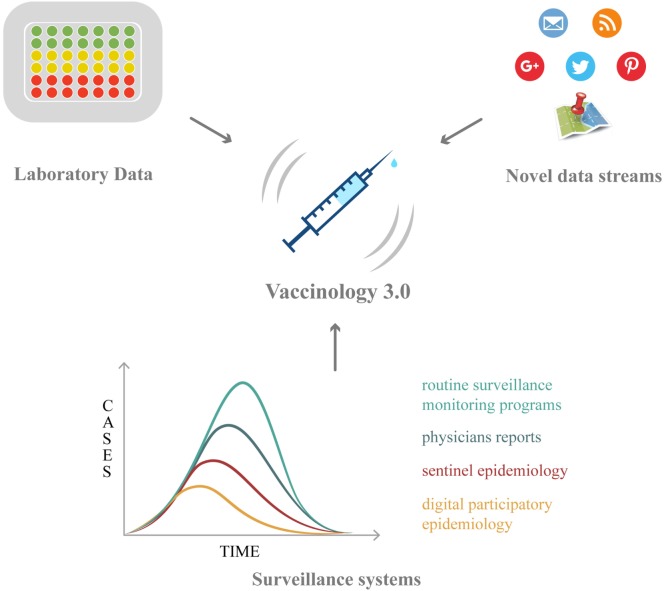
Vaccines are public health interventions aimed at preventing infections-related mortality, morbidity, and disability. While vaccines have been successfully designed for those infectious diseases preventable by preexisting neutralizing specific antibodies, for other communicable diseases, additional immunological mechanisms should be elicited to achieve a full protection. "New vaccines" are particularly urgent in the nowadays society, in which economic growth, globalization, and immigration are leading to the emergence/reemergence of old and new infectious agents at the animal-human interface. Conventional vaccinology (the so-called "vaccinology 1.0") was officially born in 1796 thanks to the contribution of Edward Jenner. Entering the twenty-first century, vaccinology has shifted from a classical discipline in which serendipity and the Pasteurian principle of the three s (isolate, inactivate, and inject) played a major role to a science, characterized by a rational design and plan ("vaccinology 3.0"). This shift has been possible thanks to Big Data, characterized by different dimensions, such as high volume, velocity, and variety of data. Big Data sources include new cutting-edge, high-throughput technologies, electronic registries, social media, and social networks, among others. The current mini-review aims at exploring the potential roles as well as pitfalls and challenges of Big Data in shaping the future vaccinology, moving toward a tailored and personalized vaccine design and administration.
疫苗是旨在预防与感染相关的死亡、发病和残疾的公共卫生干预措施。虽然针对那些可通过预先存在的中和特异性抗体预防的传染病已成功设计出疫苗,但对于其他传染病,应激发额外的免疫机制以实现全面保护。在当今社会,“新型疫苗”尤为迫切,因为经济增长、全球化和移民正导致新旧传染源在动物与人类的界面出现/再次出现。传统疫苗学(即所谓的“疫苗学1.0”)于1796年因爱德华·詹纳的贡献而正式诞生。进入21世纪,疫苗学已从一门偶然性以及巴斯德的三个“s”原则(分离、灭活和注射)起主要作用的经典学科转变为一门以合理设计和规划为特征的科学(“疫苗学3.0”)。这种转变得益于具有高容量、高速度和多样性等不同维度特征的大数据。大数据来源包括新的前沿高通量技术、电子登记册、社交媒体和社交网络等。本综述旨在探讨大数据在塑造未来疫苗学、迈向定制化和个性化疫苗设计与接种方面的潜在作用以及陷阱和挑战。