Weng Jian, Wang Yan-Hua, Li Ming, Zhang Dian-Ying, Jiang Bao-Guo
Department of Orthopedics and Trauma, Peking University People's Hospital, Beijing, China.
Neural Regen Res. 2018 Feb;13(2):324-330. doi: 10.4103/1673-5374.226403.
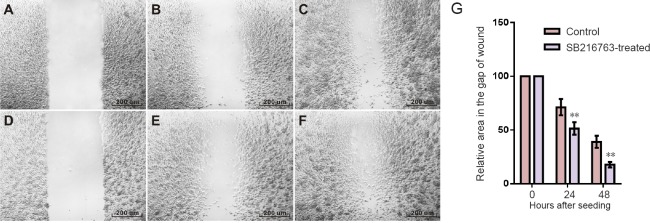
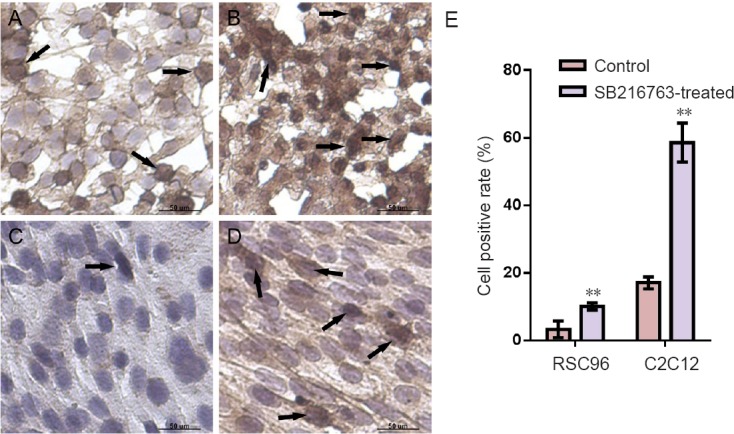
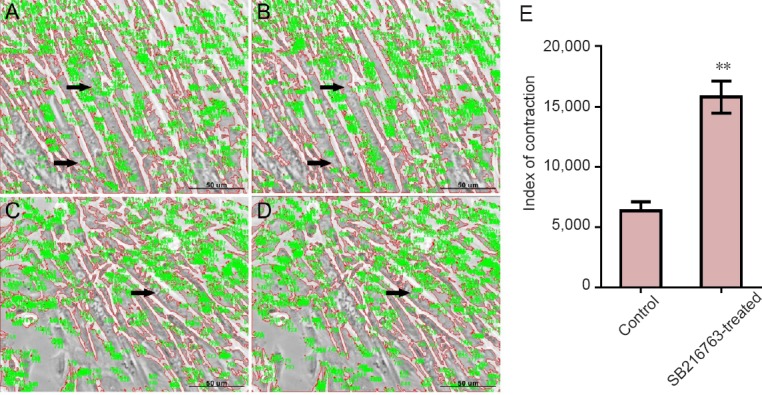
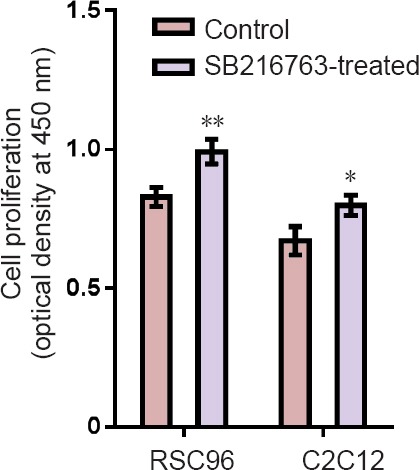
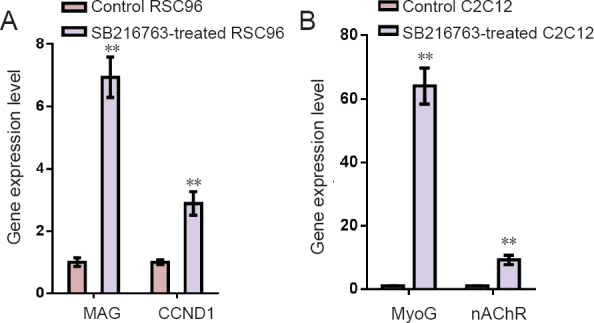
Delay of axon regeneration after peripheral nerve injury usually leads to progressive muscle atrophy and poor functional recovery. The Wnt/β-catenin signaling pathway is considered to be one of the main molecular mechanisms that lead to skeletal muscle atrophy in the elderly. We hold the hypothesis that the innervation of target muscle can be promoted by accelerating axon regeneration and decelerating muscle cell degeneration so as to improve functional recovery of skeletal muscle following peripheral nerve injury. This process may be associated with the Wnt/β-catenin signaling pathway. Our study designed in vitro cell models to simulate myelin regeneration and muscle atrophy. We investigated the effects of SB216763, a glycogen synthase kinase 3 beta inhibitor, on the two major murine cell lines RSC96 and C2C12 derived from Schwann cells and muscle satellite cells. The results showed that SB216763 stimulated the Schwann cell migration and myotube contraction. Quantitative polymerase chain reaction results demonstrated that myelin related genes, myelin associated glycoprotein and cyclin-D1, muscle related gene myogenin and endplate-associated gene nicotinic acetylcholine receptors levels were stimulated by SB216763. Immunocytochemical staining revealed that the expressions of β-catenin in the RSC96 and C2C12 cytosolic and nuclear compartments were increased in the SB216763-treated cells. These findings confirm that the glycogen synthase kinase 3 beta inhibitor, SB216763, promoted the myelination and myotube differentiation through the Wnt/β-catenin signaling pathway and contributed to nerve remyelination and reduced denervated muscle atrophy after peripheral nerve injury.
周围神经损伤后轴突再生延迟通常会导致进行性肌肉萎缩和功能恢复不佳。Wnt/β-连环蛋白信号通路被认为是导致老年人骨骼肌萎缩的主要分子机制之一。我们提出假说,通过加速轴突再生和减缓肌肉细胞变性来促进靶肌肉的神经支配,从而改善周围神经损伤后骨骼肌的功能恢复。这个过程可能与Wnt/β-连环蛋白信号通路有关。我们的研究设计了体外细胞模型来模拟髓鞘再生和肌肉萎缩。我们研究了糖原合酶激酶3β抑制剂SB216763对源自雪旺细胞和肌肉卫星细胞的两种主要小鼠细胞系RSC96和C2C12的影响。结果表明,SB216763刺激了雪旺细胞迁移和肌管收缩。定量聚合酶链反应结果表明,SB216763刺激了髓鞘相关基因、髓鞘相关糖蛋白和细胞周期蛋白D1、肌肉相关基因肌细胞生成素以及终板相关基因烟碱型乙酰胆碱受体的水平。免疫细胞化学染色显示SB216763处理的细胞中RSC96和C2C12细胞溶质和核区室中β-连环蛋白的表达增加。这些发现证实,糖原合酶激酶3β抑制剂SB216763通过Wnt/β-连环蛋白信号通路促进了髓鞘形成和肌管分化,并有助于周围神经损伤后的神经再髓鞘化和减轻失神经肌肉萎缩。