Institute of Animal Hygiene and Veterinary Public Health, University of Leipzig, Leipzig, Germany.
REVENTA® GmbH, Horstmar, Germany.
PLoS One. 2018 Mar 20;13(3):e0194641. doi: 10.1371/journal.pone.0194641. eCollection 2018.
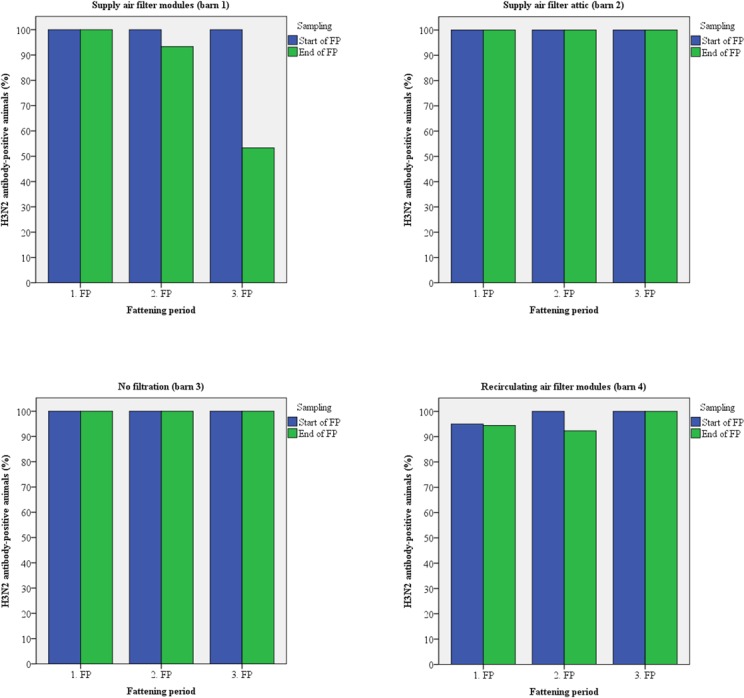
Biosecurity is defined as the implementation of measures that reduce the risk of disease agents being introduced and/or spread. For pig production, several of these measures are routinely implemented (e.g. cleaning, disinfection, segregation). However, air as a potential vector of pathogens has long been disregarded. Filters for incoming and recirculating air were installed into an already existing ventilation plant at a fattening piggery (3,840 pigs at maximum) in Saxony, Germany. Over a period of three consecutive fattening periods, we evaluated various parameters including air quality indices, environmental and operating parameters, and pig performance. Animal data regarding respiratory diseases, presence of antibodies against influenza A viruses, PRRSV, and Actinobacillus pleuropneumoniae and lung health score at slaughter were recorded, additionally. There were no significant differences (p = 0.824) in total bacterial counts between barns with and without air filtration. Recirculating air filtration resulted in the lowest total dust concentration (0.12 mg/m3) and lung health was best in animals from the barn equipped with recirculating air filtration modules. However, there was no difference in animal performance. Antibodies against all above mentioned pathogens were detected but mostly animals were already antibody-positive at re-stocking. We demonstrated that supply air filtration as well as recirculating air filtration technique can easily be implemented in an already existing ventilation system and that recirculating air filtration resulted in enhanced lung health compared to supply air-filtered and non-filtered barns. A more prominent effect might have been obtained in a breeding facility because of the longer life span of sows and a higher biosecurity level with air filtration as an add-on measure.
生物安全被定义为实施各种措施,以降低病原体传入和传播的风险。对于养猪生产,已经常规实施了一些措施(例如清洁、消毒、隔离)。然而,空气作为病原体的潜在载体,长期以来一直被忽视。在德国萨克森州的一个育肥猪场(最大存栏量为 3840 头猪),已经安装了进气和循环空气的过滤器。在三个连续的育肥期内,我们评估了各种参数,包括空气质量指数、环境和操作参数以及猪的生产性能。此外,还记录了有关呼吸道疾病、流感 A 病毒、PRRSV 和胸膜肺炎放线杆菌抗体存在情况以及屠宰时肺部健康评分的动物数据。带有和不带有空气过滤的畜舍之间的总细菌计数没有显著差异(p = 0.824)。循环空气过滤导致总粉尘浓度最低(0.12mg/m3),来自装有循环空气过滤模块的畜舍的动物肺部健康状况最佳。然而,动物生产性能没有差异。检测到了所有上述病原体的抗体,但大多数动物在重新饲养时已经呈抗体阳性。我们证明,供气过滤以及循环空气过滤技术可以很容易地在现有的通风系统中实施,与供气过滤和未过滤的畜舍相比,循环空气过滤可改善肺部健康。在繁殖设施中,由于母猪寿命更长,以及空气过滤作为附加措施的生物安全水平更高,可能会获得更显著的效果。