Department of Radiation Oncology, Osaka International Cancer Institute, 3-1-69 Otemae, Chuo-ku, Osaka, 537-8567, Japan.
Divisin of Radiology, Department of Medical Technology, Kyushu University Hospital, Maidashi, Higashi-ku, Fukuoka, 812-8582, Japan.
Radiat Oncol. 2018 Mar 20;13(1):46. doi: 10.1186/s13014-018-0994-1.
The aim of this study was to evaluate the performance of a commercial knowledge-based planning system, in volumetric modulated arc therapy for prostate cancer at multiple radiation therapy departments.
In each institute, > 20 cases were assessed. For the knowledge-based planning, the estimated dose (ED) based on geometric and dosimetric information of plans was generated in the model. Lower and upper limits of estimated dose were saved as dose volume histograms for each organ at risk. To verify whether the models performed correctly, KBP was compared with manual optimization planning in two cases. The relationships between the EDs in the models and the ratio of the OAR volumes overlapping volume with PTV to the whole organ volume (V/V) were investigated.
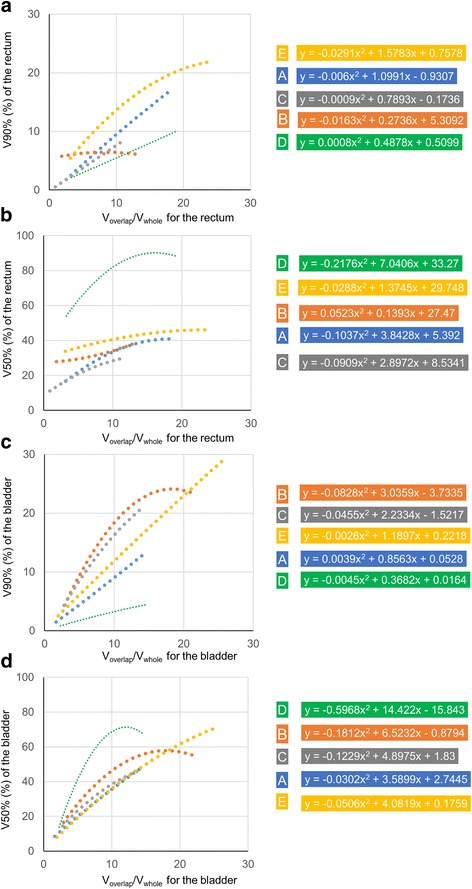
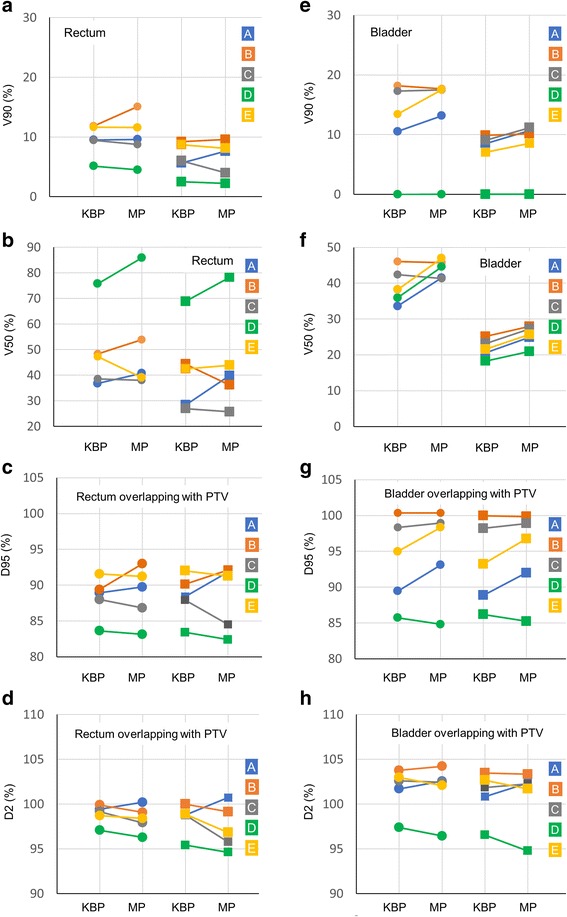
There were no significant dosimetric differences in OARs and PTV between manual optimization planning and knowledge-based planning. In knowledge-based planning, the difference in the volume ratio of receiving 90% and 50% of the prescribed dose (V90 and V50) between institutes were more than 5.0% and 10.0%, respectively. The calculated doses with knowledge-based planning were between the upper and lower limits of ED or slightly under the lower limit of ED. The relationships between the lower limit of ED and V/V were different among the models. In the V90 and V50 for the rectum, the maximum differences between the lower limit of ED among institutes were 8.2% and 53.5% when V/V for the rectum was 10%. In the V90 and V50 for the bladder, the maximum differences of the lower limit of ED among institutes were 15.1% and 33.1% when V/V for the bladder was 10%.
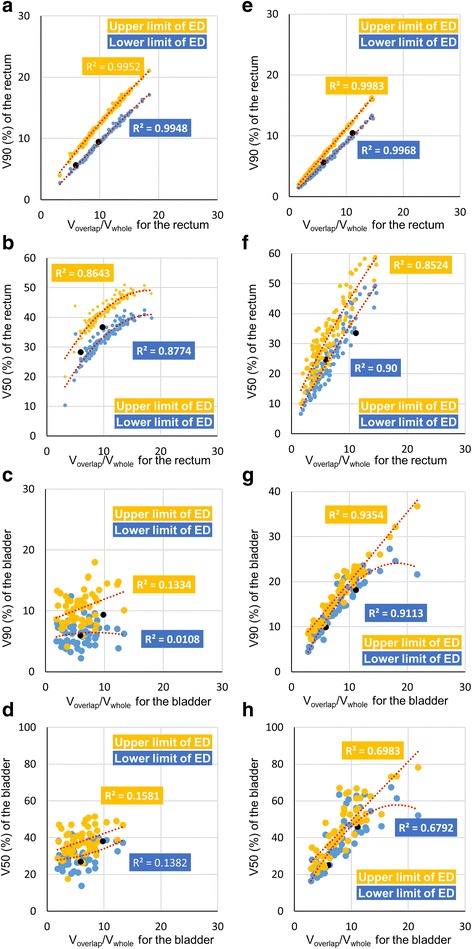
Organs' upper and lower limits of ED in the models correlated closely with the V/V. It is important to determine whether the models in KBP match a different institute's plan design before the models can be shared.
本研究旨在评估一种商业知识型计划系统在多个放射治疗部门进行前列腺癌容积调强弧形治疗时的性能。
在每个研究所中,评估了超过 20 例病例。对于知识型计划,在模型中基于计划的几何和剂量信息生成估计剂量(ED)。为每个危及器官保存了 ED 的上下限剂量体积直方图。为了验证模型是否正确执行,在两个病例中将 KBP 与手动优化计划进行了比较。研究了模型中的 ED 与 OAR 与 PTV 重叠体积与整个器官体积(V/V)的比值之间的关系。
在 OAR 和 PTV 方面,手动优化计划与知识型计划之间没有显著的剂量学差异。在知识型计划中,不同研究所之间接收 90%和 50%处方剂量的体积比(V90 和 V50)的差异分别超过 5.0%和 10.0%。知识型计划计算的剂量在 ED 的上下限之间或略低于 ED 的下限。模型之间 ED 的下限与 V/V 之间的关系不同。在直肠的 V90 和 V50 中,当直肠的 V/V 为 10%时,不同研究所 ED 下限之间的最大差异为 8.2%和 53.5%。在膀胱的 V90 和 V50 中,当膀胱的 V/V 为 10%时,不同研究所 ED 下限之间的最大差异为 15.1%和 33.1%。
模型中器官 ED 的上下限与 V/V 密切相关。在共享模型之前,确定 KBP 中的模型是否与不同研究所的计划设计匹配非常重要。