• 文献检索
  • 文档翻译
  • 深度研究
  • 学术资讯
  • Suppr Zotero 插件Zotero 插件
  • 邀请有礼
  • 套餐&价格
  • 历史记录
应用&插件
Suppr Zotero 插件Zotero 插件浏览器插件Mac 客户端Windows 客户端微信小程序
定价
高级版会员购买积分包购买API积分包
服务
文献检索文档翻译深度研究API 文档MCP 服务
关于我们
关于 Suppr公司介绍联系我们用户协议隐私条款
关注我们

Suppr 超能文献

核心技术专利:CN118964589B侵权必究
粤ICP备2023148730 号-1Suppr @ 2026

文献检索

告别复杂PubMed语法,用中文像聊天一样搜索,搜遍4000万医学文献。AI智能推荐,让科研检索更轻松。

立即免费搜索

文件翻译

保留排版,准确专业,支持PDF/Word/PPT等文件格式,支持 12+语言互译。

免费翻译文档

深度研究

AI帮你快速写综述,25分钟生成高质量综述,智能提取关键信息,辅助科研写作。

立即免费体验

基于传统生态知识的评估:濒危木本物种及其在西非贝宁西北部生物多样性热点阿塔科拉山脉潜在替代品。

Traditional ecological knowledge-based assessment of threatened woody species and their potential substitutes in the Atakora mountain chain, a threatened hotspot of biodiversity in Northwestern Benin, West Africa.

机构信息

Laboratoire d'Ecologie Appliquée (LEA), Faculté des Sciences Agronomiques (FSA), Université d'Abomey-Calavi, 01 BP 526 Tri postal, Cotonou, Bénin.

Laboratoire de Biomathématiques et d'Estimations Forestières (LABEF), Faculté des Sciences Agronomiques (FSA), Université d'Abomey-Calavi, 04 BP 1525, Cotonou, Bénin.

出版信息

J Ethnobiol Ethnomed. 2018 Mar 20;14(1):21. doi: 10.1186/s13002-018-0219-6.

DOI:10.1186/s13002-018-0219-6
PMID:29558963
原文链接:https://pmc.ncbi.nlm.nih.gov/articles/PMC5859633/
Abstract

BACKGROUND

Atakora mountains in Benin are a unique but fragile ecosystem, harboring many endemic plant species. The ecosystem is undergoing degradation, and the woody vegetation is dramatically declining due to high anthropogenic actions and recurrent drought. This study aimed to (i) assess the diversity of threatened woody species and (ii) identify their potential substitutes in the three regions of the Atakora mountains namely East Atakora, Central Atakora, and West Atakora.

METHODS

The data were collected during expeditions on surveyed localities through semi-structured individual interviews. Free-listing was used to record threatened woody species and which were important and why. Alpha-diversity indices were used to assess diversity of threatened and important threatened woody species. A correspondence analysis was used to determine the reason supporting their importance. Differences in species composition were assessed using analysis of similarities. A number of potential substitutes were compared among species using generalized linear models.

RESULTS

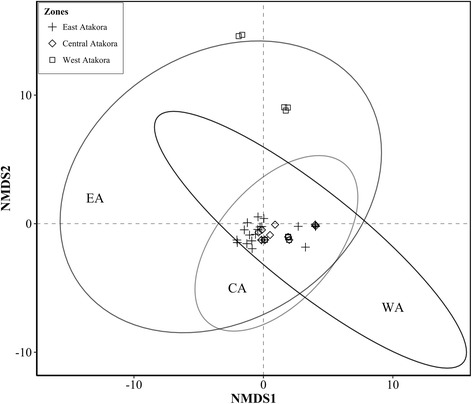
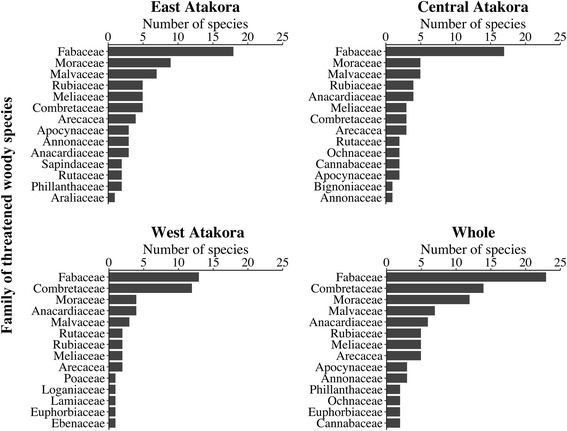
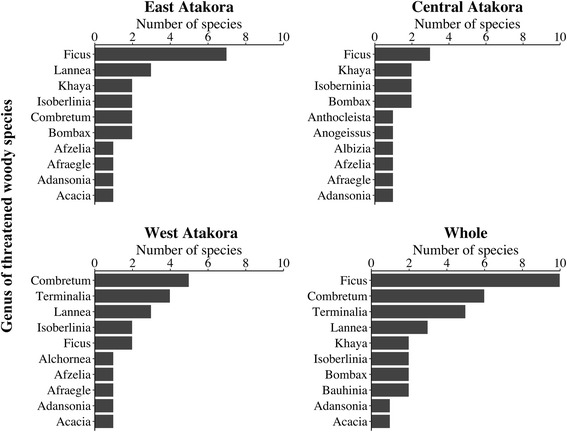
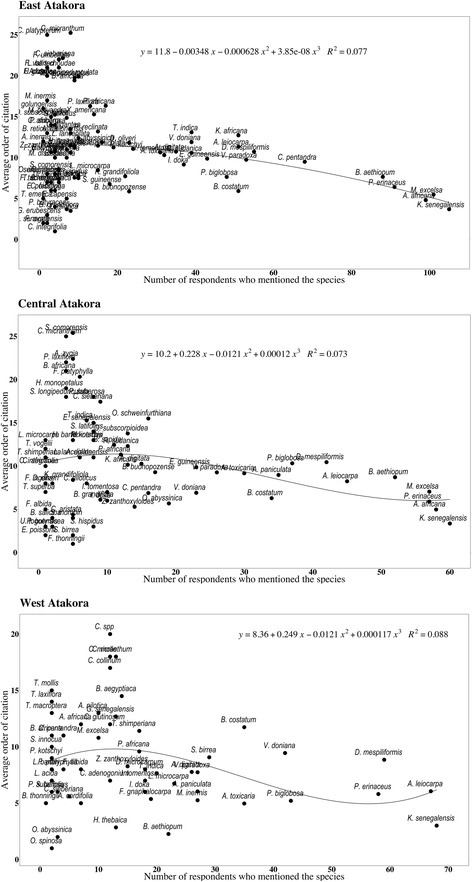
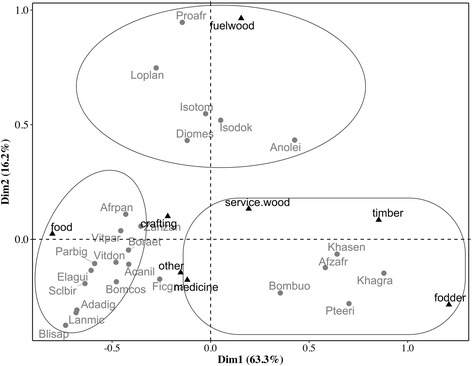
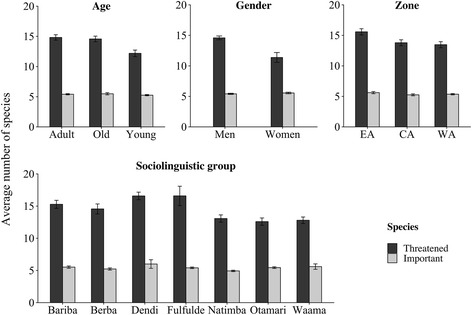
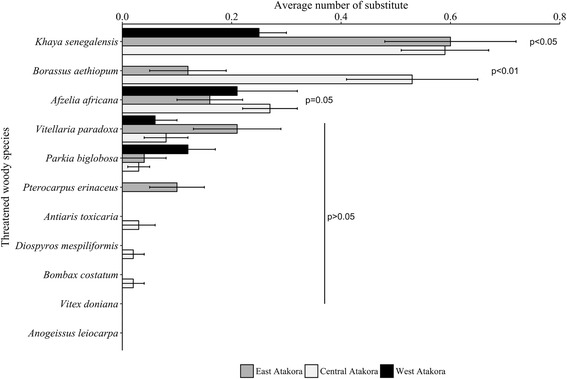
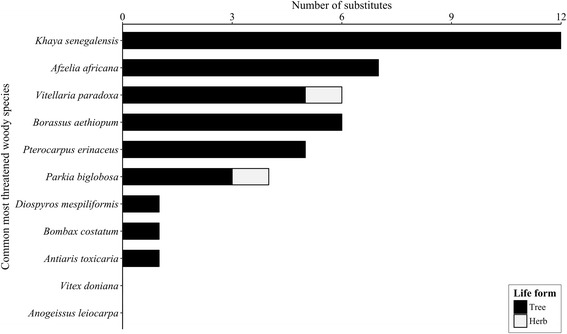
A total of 117 woody species (37 families and 92 genera) were identified. The most prominent families were Fabaceae (19.66%), Combretaceae (12.82%), and Moraceae (10.26%), and the richest genera were Ficus (10 species), Combretum (6), and Terminalia (5). Most threatened species differed across regions (East Atakora, Central Atakora, and West Atakora) and included Afzelia africana, Anogeissus leiocarpa, Borassus aethiopum, Diospyros mespiliformis, Khaya senegalensis, Milicia excelsa, and Pterocarpus erinaceus. Most socio-economically important species (K. senegalensis, Parkia biglobosa, Vitellaria paradoxa, and V. doniana) were used mainly for food, timber, and fuelwood purposes. Old and adult people, and Dendi and Fulfulde sociolinguistic groups had greater knowledge of threatened woody plant species. High intercultural differentiations in species composition were detected between Bariba-Berba and Bariba-Natimba. Knowledge of substitutes also differed across regions with P. erinaceus, Isoberlinia spp., and A. africana being the most cited substitutes.

CONCLUSION

Basic data was provided here to inform decision and guide efficient management of woody resources. There was evidence that immediate conservation measures are required for some high economic value woody taxa which were critically threatened. Ex-situ conservation of these species while promoting their integration into agroforestry-based systems were recommended. Besides, community-based management programs and community-led initiatives involving knowledgeable people from different horizons will lead to a long-lasting conservation of these threatened resources.

摘要

背景

贝宁的阿塔克罗拉山脉是一个独特但脆弱的生态系统,拥有许多特有植物物种。由于人类活动频繁和干旱频发,该生态系统正在退化,木本植被急剧减少。本研究旨在:(i)评估受威胁木本物种的多样性;(ii)确定阿塔克罗拉山脉三个地区(即东阿塔克罗拉、中阿塔克罗拉和西阿塔克罗拉)的潜在替代物种。

方法

通过对调查地点的实地考察,收集了半结构个人访谈的数据。自由列表用于记录受威胁的木本物种以及为什么它们很重要。使用 alpha 多样性指数评估受威胁和重要受威胁木本物种的多样性。对应分析用于确定支持其重要性的原因。使用相似性分析评估物种组成的差异。使用广义线性模型比较了物种之间的一些潜在替代物。

结果

共鉴定出 117 种木本植物(37 科 92 属)。最突出的科是豆科(19.66%)、使君子科(12.82%)和桑科(10.26%),最丰富的属是榕属(10 种)、使君子属(6 种)和诃子属(5 种)。大多数受威胁物种在不同地区(东阿塔克罗拉、中阿塔克罗拉和西阿塔克罗拉)存在差异,包括非洲紫檀、非洲白檀、非洲海枣、光叶榕、塞内加尔相思、非洲桃花心木和非洲朴。大多数具有社会经济重要性的物种(K. senegalensis、Parkia biglobosa、Vitellaria paradoxa 和 V. doniana)主要用于食品、木材和薪材。老年人、丹迪人和富拉尼语社会群体对受威胁的木本植物物种有更多的了解。在巴里巴-贝巴和巴里巴-纳蒂姆巴之间检测到物种组成的高跨文化差异。对替代物种的了解也因地区而异,非洲朴、异叶榕属和非洲紫檀是最常被引用的替代物。

结论

本研究提供了基本数据,为决策提供信息,并指导木本资源的有效管理。有证据表明,一些具有高经济价值的木本类群受到严重威胁,需要立即采取保护措施。建议对这些物种进行就地保护,同时促进将其纳入以农林复合系统为基础的系统。此外,涉及不同领域有知识的人的基于社区的管理方案和社区主导的倡议将导致这些受威胁资源的长期保护。
https://cdn.ncbi.nlm.nih.gov/pmc/blobs/d811/5859633/2eac05092f7e/13002_2018_219_Fig11_HTML.jpg
https://cdn.ncbi.nlm.nih.gov/pmc/blobs/d811/5859633/900c5bbb70d0/13002_2018_219_Fig1_HTML.jpg
https://cdn.ncbi.nlm.nih.gov/pmc/blobs/d811/5859633/c5f5d4337f17/13002_2018_219_Fig2_HTML.jpg
https://cdn.ncbi.nlm.nih.gov/pmc/blobs/d811/5859633/700454aedacc/13002_2018_219_Fig3_HTML.jpg
https://cdn.ncbi.nlm.nih.gov/pmc/blobs/d811/5859633/2691af892a46/13002_2018_219_Fig4_HTML.jpg
https://cdn.ncbi.nlm.nih.gov/pmc/blobs/d811/5859633/9ad4bd1e5a55/13002_2018_219_Fig5_HTML.jpg
https://cdn.ncbi.nlm.nih.gov/pmc/blobs/d811/5859633/73315fa73895/13002_2018_219_Fig6_HTML.jpg
https://cdn.ncbi.nlm.nih.gov/pmc/blobs/d811/5859633/f072fb4b6a55/13002_2018_219_Fig7_HTML.jpg
https://cdn.ncbi.nlm.nih.gov/pmc/blobs/d811/5859633/a8722dc38b44/13002_2018_219_Fig8_HTML.jpg
https://cdn.ncbi.nlm.nih.gov/pmc/blobs/d811/5859633/c1de0c51f8bb/13002_2018_219_Fig9_HTML.jpg
https://cdn.ncbi.nlm.nih.gov/pmc/blobs/d811/5859633/cb6baa06fddf/13002_2018_219_Fig10_HTML.jpg
https://cdn.ncbi.nlm.nih.gov/pmc/blobs/d811/5859633/2eac05092f7e/13002_2018_219_Fig11_HTML.jpg
https://cdn.ncbi.nlm.nih.gov/pmc/blobs/d811/5859633/900c5bbb70d0/13002_2018_219_Fig1_HTML.jpg
https://cdn.ncbi.nlm.nih.gov/pmc/blobs/d811/5859633/c5f5d4337f17/13002_2018_219_Fig2_HTML.jpg
https://cdn.ncbi.nlm.nih.gov/pmc/blobs/d811/5859633/700454aedacc/13002_2018_219_Fig3_HTML.jpg
https://cdn.ncbi.nlm.nih.gov/pmc/blobs/d811/5859633/2691af892a46/13002_2018_219_Fig4_HTML.jpg
https://cdn.ncbi.nlm.nih.gov/pmc/blobs/d811/5859633/9ad4bd1e5a55/13002_2018_219_Fig5_HTML.jpg
https://cdn.ncbi.nlm.nih.gov/pmc/blobs/d811/5859633/73315fa73895/13002_2018_219_Fig6_HTML.jpg
https://cdn.ncbi.nlm.nih.gov/pmc/blobs/d811/5859633/f072fb4b6a55/13002_2018_219_Fig7_HTML.jpg
https://cdn.ncbi.nlm.nih.gov/pmc/blobs/d811/5859633/a8722dc38b44/13002_2018_219_Fig8_HTML.jpg
https://cdn.ncbi.nlm.nih.gov/pmc/blobs/d811/5859633/c1de0c51f8bb/13002_2018_219_Fig9_HTML.jpg
https://cdn.ncbi.nlm.nih.gov/pmc/blobs/d811/5859633/cb6baa06fddf/13002_2018_219_Fig10_HTML.jpg
https://cdn.ncbi.nlm.nih.gov/pmc/blobs/d811/5859633/2eac05092f7e/13002_2018_219_Fig11_HTML.jpg

相似文献

1
Traditional ecological knowledge-based assessment of threatened woody species and their potential substitutes in the Atakora mountain chain, a threatened hotspot of biodiversity in Northwestern Benin, West Africa.基于传统生态知识的评估:濒危木本物种及其在西非贝宁西北部生物多样性热点阿塔科拉山脉潜在替代品。
J Ethnobiol Ethnomed. 2018 Mar 20;14(1):21. doi: 10.1186/s13002-018-0219-6.
2
Local perception of ecosystem services and their conservation in Sudanian savannas of Burkina Faso (West Africa).非洲西部布基纳法索萨赫勒草原地区对生态系统服务的地方认知及其保护
J Ethnobiol Ethnomed. 2022 Feb 19;18(1):8. doi: 10.1186/s13002-022-00508-w.
3
Species richness, cultural importance, and prioritization of wild spices for conservation in the Sudano-Guinean zone of Benin (West Africa).物种丰富度、文化重要性以及贝宁(西非)苏丹-几内亚地带野生香料的保护优先级。
J Ethnobiol Ethnomed. 2018 Nov 15;14(1):67. doi: 10.1186/s13002-018-0267-y.
4
How do plant demographic and ecological traits combined with social dynamics and human traits affect woody plant selection for medicinal uses in Benin (West Africa)?植物的人口统计学和生态学特征如何与社会动态和人类特征相结合,影响了贝宁(西非)药用木本植物的选择?
J Ethnobiol Ethnomed. 2024 Feb 9;20(1):15. doi: 10.1186/s13002-024-00655-2.
5
Factors shaping local people's perception of ecosystem services in the Atacora Chain of Mountains, a biodiversity hotspot in northern Benin.塑造贝宁北部生物多样性热点阿塔科拉山脉地区当地人对生态系统服务感知的因素。
J Ethnobiol Ethnomed. 2019 Aug 14;15(1):38. doi: 10.1186/s13002-019-0317-0.
6
Traditional knowledge and cultural importance of Borassus aethiopum Mart. in Benin: interacting effects of socio-demographic attributes and multi-scale abundance.贝宁油棕 Borassus aethiopum Mart. 的传统知识和文化重要性:社会人口属性和多尺度丰度的相互作用。
J Ethnobiol Ethnomed. 2018 May 15;14(1):36. doi: 10.1186/s13002-018-0233-8.
7
Functional diversity of home gardens and their agrobiodiversity conservation benefits in Benin, West Africa.贝宁(西非国家)家庭园艺的功能多样性及其对农业生物多样性保护的益处。
J Ethnobiol Ethnomed. 2017 Nov 25;13(1):66. doi: 10.1186/s13002-017-0192-5.
8
Integrating traditional ecological knowledge into habitat restoration: implications for meeting forest restoration challenges.将传统生态知识融入栖息地恢复:应对森林恢复挑战的启示。
J Ethnobiol Ethnomed. 2023 Aug 10;19(1):33. doi: 10.1186/s13002-023-00606-3.
9
Exploitation of ethnoecologically important wild trees by two ethnic groups in a community-based Hippopotamus Sanctuary in Northwestern Ghana.加纳西北部一个基于社区的河马保护区中两个族群对具有民族植物学重要性的野生树木的利用。
J Environ Manage. 2020 Feb 1;255:109917. doi: 10.1016/j.jenvman.2019.109917. Epub 2019 Dec 3.
10
Survey on composition of perennial vegetation in Sesa Mariam Monastery, Northwestern Ethiopia.埃塞俄比亚西北部塞萨·马里亚姆修道院多年生植被组成调查
BMC Res Notes. 2015 Oct 30;8:622. doi: 10.1186/s13104-015-1562-5.

引用本文的文献

1
Genetic structure and demographic analysis of a true single-population species, Camellia azalea.真正单一物种种群——杜鹃红山茶的遗传结构与种群统计学分析
BMC Plant Biol. 2024 Dec 30;24(1):1272. doi: 10.1186/s12870-024-05886-9.
2
The resource availability hypothesis (RAH) and cross-cultural patterns: which one explains West African Cochlospermum species' uses in Benin?资源可用性假说(RAH)与跨文化模式:哪一个能更好地解释西非 Cochlospermum 物种在贝宁的用途?
J Ethnobiol Ethnomed. 2022 Aug 23;18(1):56. doi: 10.1186/s13002-022-00555-3.
3
Local perception of ecosystem services and their conservation in Sudanian savannas of Burkina Faso (West Africa).

本文引用的文献

1
Ethnobotanical survey of medicinal plants commonly used by Kani tribals in Tirunelveli hills of Western Ghats, India.印度西高止山脉蒂鲁内尔维利丘陵地带卡尼部落常用药用植物的民族植物学调查。
J Ethnopharmacol. 2011 Apr 12;134(3):851-64. doi: 10.1016/j.jep.2011.01.029. Epub 2011 Feb 1.
2
Cocoa intensification scenarios and their predicted impact on CO₂ emissions, biodiversity conservation, and rural livelihoods in the Guinea rain forest of West Africa.西非几内亚雨林中可可强化情景及其对二氧化碳排放、生物多样性保护和农村生计的预测影响。
Environ Manage. 2011 Aug;48(2):307-21. doi: 10.1007/s00267-010-9602-3. Epub 2010 Dec 30.
3
非洲西部布基纳法索萨赫勒草原地区对生态系统服务的地方认知及其保护
J Ethnobiol Ethnomed. 2022 Feb 19;18(1):8. doi: 10.1186/s13002-022-00508-w.
4
Use Patterns, Knowledge Diversity and Drivers for the Cultivation of the Miracle Plant [ (Schumach & Thonn.) Daniell] in Benin and Ghana.贝宁和加纳种植神奇植物[(舒马赫和托恩)丹尼尔]的模式、知识多样性及驱动因素
Plants (Basel). 2021 Oct 22;10(11):2253. doi: 10.3390/plants10112253.
5
Factors shaping local people's perception of ecosystem services in the Atacora Chain of Mountains, a biodiversity hotspot in northern Benin.塑造贝宁北部生物多样性热点阿塔科拉山脉地区当地人对生态系统服务感知的因素。
J Ethnobiol Ethnomed. 2019 Aug 14;15(1):38. doi: 10.1186/s13002-019-0317-0.
6
Species richness, cultural importance, and prioritization of wild spices for conservation in the Sudano-Guinean zone of Benin (West Africa).物种丰富度、文化重要性以及贝宁(西非)苏丹-几内亚地带野生香料的保护优先级。
J Ethnobiol Ethnomed. 2018 Nov 15;14(1):67. doi: 10.1186/s13002-018-0267-y.
The use of plants in the medical system of the Fulni-ô people (NE Brazil): a perspective on age and gender.
富尔奈斯人和(巴西东北部)医疗体系中植物的应用:年龄和性别的视角。
J Ethnopharmacol. 2011 Jan 27;133(2):866-73. doi: 10.1016/j.jep.2010.11.021. Epub 2010 Nov 18.
4
Tropical forests were the primary sources of new agricultural land in the 1980s and 1990s.20 世纪 80 年代和 90 年代,热带森林是新农业用地的主要来源。
Proc Natl Acad Sci U S A. 2010 Sep 21;107(38):16732-7. doi: 10.1073/pnas.0910275107. Epub 2010 Aug 31.
5
Re-examining hypotheses concerning the use and knowledge of medicinal plants: a study in the Caatinga vegetation of NE Brazil.重新审视关于药用植物使用与知识的假说:巴西东北部卡廷加植被地区的一项研究。
J Ethnobiol Ethnomed. 2006 Jul 26;2:30. doi: 10.1186/1746-4269-2-30.